Representative Robert Mallory
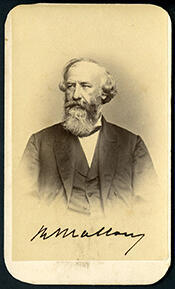
Here you will find contact information for Representative Robert Mallory, including email address, phone number, and mailing address.
| Name | Robert Mallory |
| Position | Representative |
| State | Kentucky |
| District | 5 |
| Party | Unionist |
| Status | Former Representative |
| Term Start | December 5, 1859 |
| Term End | March 3, 1865 |
| Terms Served | 3 |
| Born | November 15, 1815 |
| Gender | Male |
| Bioguide ID | M000082 |
About Representative Robert Mallory
Robert Mallory (November 15, 1815 – August 11, 1885) was an American politician, lawyer, and agriculturalist who represented Kentucky in the United States House of Representatives during the tumultuous years leading up to and encompassing much of the Civil War. He was born on November 15, 1815, in Madison Court House, Virginia, where he spent his early years and attended private schools. His upbringing in Virginia, a state central to the political and sectional conflicts of the nineteenth century, provided the backdrop for a later career that would unfold in neighboring Kentucky, another border state of critical importance in the Union.
Mallory pursued higher education at the University of Virginia, from which he graduated in 1827. His formal education, completed at one of the South’s most prominent institutions of higher learning, prepared him for professional life in both law and public affairs. After leaving the University of Virginia, he relocated to Kentucky, where he would establish his long-term residence and professional base. Settling first in La Grange, Kentucky, he engaged in agricultural pursuits, an occupation that tied him closely to the economic and social life of his adopted state.
While engaged in agriculture, Mallory studied law, further broadening his professional qualifications. He was admitted to the bar in 1837 and commenced the practice of law in New Castle, Kentucky. His legal career, combined with his experience as a landowner and farmer, helped build his reputation in local and state circles. These pursuits positioned him to enter public life at a time when Kentucky’s political alignment was of great national interest, particularly as sectional tensions intensified in the 1850s.
Mallory was elected to the United States House of Representatives in 1858, taking office on March 4, 1859. Identified initially with the Opposition Party and later as a Union Democrat, he was also associated with the broader Unionist movement in Kentucky. He served three consecutive terms in Congress, representing Kentucky from 1859 to 1865. His tenure coincided with a significant period in American history, encompassing the final prewar years and the bulk of the Civil War. As a member of the House of Representatives, Robert Mallory participated in the democratic process and represented the interests of his Kentucky constituents while the nation was divided over secession, slavery, and the preservation of the Union.
During his congressional service, Mallory played a notable role in the legislative process. From 1859 to 1863, he served as chairman of the Committee on Roads and Canals, a position that placed him at the center of debates over internal improvements and infrastructure, which were vital to commerce and military logistics during this era. As a member of the Unionist Party and later a Union Democrat, he contributed to the legislative efforts of the Union cause while Kentucky remained a border state with divided loyalties. Despite his three terms of service, he was unsuccessful in his bid for reelection in 1864, bringing his congressional career to a close on March 3, 1865.
After leaving Congress, Mallory continued to be active in national political affairs. In 1866, he served as a delegate to the National Union Convention, a gathering that sought to shape postwar policy and the course of Reconstruction under the banner of national unity. Later, in 1876, he was appointed one of the vice presidents of the Centennial Exposition in Philadelphia, the international fair commemorating the one-hundredth anniversary of the Declaration of Independence. This role reflected his continued engagement with national civic life and his standing as a public figure beyond Kentucky.
In his later years, Mallory returned to the pursuits that had first grounded his life in Kentucky. He resumed agricultural activities near La Grange, Kentucky, where he lived quietly after his prominent public service. Robert Mallory died near La Grange on August 11, 1885. He was interred in Spring Hill Family Cemetery in Ballardsville, Kentucky. His career, spanning law, agriculture, and three terms in the United States Congress during the Civil War era, marked him as a significant Unionist voice from Kentucky in one of the most critical periods of American history.