Representative Robert B. (Bob) Mathias
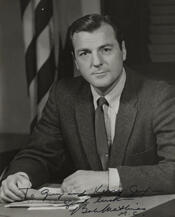
Here you will find contact information for Representative Robert B. (Bob) Mathias, including email address, phone number, and mailing address.
| Name | Robert B. (Bob) Mathias |
| Position | Representative |
| State | California |
| District | 18 |
| Party | Republican |
| Status | Former Representative |
| Term Start | January 10, 1967 |
| Term End | January 3, 1975 |
| Terms Served | 4 |
| Born | November 17, 1930 |
| Gender | Male |
| Bioguide ID | M000242 |
About Representative Robert B. (Bob) Mathias
Robert Bruce Mathias (November 17, 1930 – September 2, 2006) was an American decathlete, politician, and actor who achieved international fame as a two-time Olympic gold medalist before serving four terms in the United States House of Representatives as a Republican from California. Representing California’s 18th congressional district, he served in Congress from 1967 to 1975, contributing to the legislative process during a significant period in American history and representing the interests of constituents in the northern San Joaquin Valley.
Mathias was born in Tulare, California, to a family with partial Greek lineage. He grew up in the agricultural Central Valley and attended Tulare Union High School, where he was a classmate and longtime friend of Sim Iness, who would later win the discus gold medal at the 1952 Olympic Games. Under the guidance of his track coach, Virgil Jackson, Mathias took up the decathlon in early 1948, only months before graduating from high school. That same summer, he qualified for the United States Olympic team for the 1948 Summer Olympics in London, an extraordinary rise for an athlete so new to the demanding ten-event discipline.
At the 1948 London Olympics, Mathias’s inexperience with the technical rules of the decathlon was evident—he nearly fouled out of the shot put and came close to elimination in the high jump. Nonetheless, he recovered and used his strength in the pole vault and javelin to overtake France’s Ignace Heinrich and win the gold medal. At age 17, he became the youngest gold medalist in a track and field event in Olympic history. Later that year, he received the James E. Sullivan Award as the nation’s top amateur athlete. Because his high school academic record did not match his athletic accomplishments, he spent a year at The Kiski School, an all-boys boarding school in Saltsburg, Pennsylvania, to strengthen his scholastic preparation before entering college.
In 1949, Mathias enrolled at Stanford University, where he studied education, played college football, and joined the Phi Gamma Delta fraternity. He quickly established himself as the world’s premier decathlete, setting his first decathlon world record in 1950. He continued to dominate the event in the years leading up to the 1952 Summer Olympics in Helsinki. At Stanford, he was also a standout on the football team and helped lead the Cardinal to a Rose Bowl appearance on January 1, 1952, the first nationally televised college football game. That same year, he became the first person ever to compete in both an Olympic Games and a Rose Bowl in the same year.
At the 1952 Helsinki Olympics, Mathias confirmed his status as one of the greatest all-around athletes in history. He won the decathlon by an extraordinary margin of 912 points, setting a new world record with a total of 7,887 points and becoming the first athlete to successfully defend an Olympic decathlon title. His performance made him a national hero in the United States, and his Olympic score remained the Stanford decathlon record for 63 years, until it was broken in 2015. After the 1952 Games, having secured back-to-back Olympic gold medals, Mathias retired from athletic competition. He graduated from Stanford in 1953 with a Bachelor of Arts degree in education and then served two and a half years in the United States Marine Corps, rising to the rank of captain before receiving an honorable discharge.
Following his military service, Mathias pursued opportunities in film and television while maintaining a public profile as a celebrated Olympian. He and his wife Melba appeared as themselves on the April 29, 1954, episode of the television program “You Bet Your Life,” during which he discussed a forthcoming biographical film, “The Bob Mathias Story,” in which the couple played themselves. Through the 1950s he took on a number of mostly cameo roles in movies and television. In the 1959–1960 television season, he starred as Frank Dugan in the series “The Troubleshooters,” which ran for 26 episodes and dramatized events at construction sites. In 1960 he appeared as an athletic Theseus in the Italian sword-and-sandal film “Minotaur, the Wild Beast of Crete.” These activities helped sustain his public visibility as he transitioned from athletics to a broader public career.
Mathias entered electoral politics in the 1960s as a member of the Republican Party. In 1966 he ran for the U.S. House of Representatives from California’s 18th congressional district, representing the northern San Joaquin Valley. He defeated Harlan Hagen, a 14-year Democratic incumbent, by about 11 percent, reflecting a broader political shift as the region began moving away from its New Deal Democratic roots. Taking office on January 3, 1967, he served four consecutive terms in Congress, remaining in office until January 3, 1975. His congressional tenure coincided with a transformative era in American politics, overlapping exactly with Ronald Reagan’s two terms as governor of California. While aligned with the Republican Party, Mathias, like many California legislators of both parties, continued his predecessor’s support for civil rights, voting in favor of the Civil Rights Act of 1968. He was re-elected three times without serious difficulty, maintaining his position as a prominent Republican voice for his district and participating in the legislative work of the House during the Vietnam War era and the early stages of the Watergate period.
Mathias’s congressional career came to an end following a mid-decade redistricting in California. In 1974, his district was renumbered as the 17th and significantly redrawn, adding a large portion of the city of Fresno while removing several rural areas that had been part of his political base. Running in this newly configured district amid the national backlash against Republicans in the aftermath of the Watergate scandal, he was narrowly defeated for re-election by John Hans Krebs, a member of the Fresno County Board of Supervisors. Mathias was one of several Republicans swept out of office in the 1974 elections. After leaving Congress, he continued to serve in public roles. From June to August 1975 he was deputy director of the Selective Service System, and in 1976 he worked as a regional director in President Gerald Ford’s unsuccessful campaign for re-election. He later became the first director of the United States Olympic Training Center, serving from 1977 to 1983 and helping to shape the institutional framework for training American Olympic athletes.
In his later years, Mathias remained associated with Olympic and athletic organizations and continued to be recognized for his pioneering achievements in the decathlon. He was diagnosed with cancer in 1996 and battled the disease for a decade. Robert Bruce Mathias died of cancer in Fresno, California, on September 2, 2006, at the age of 75. He was interred at Tulare Cemetery in his hometown of Tulare, California. He was survived by his wife Gwen; daughters Romel, Megan, and Marissa; stepdaughter Alyse Alexander; son Reiner; brothers Eugene and Jim; and sister Patricia Guerrero.