Representative Robert H. Michel
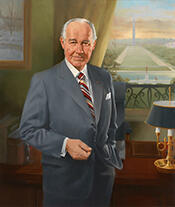
Here you will find contact information for Representative Robert H. Michel, including email address, phone number, and mailing address.
| Name | Robert H. Michel |
| Position | Representative |
| State | Illinois |
| District | 18 |
| Party | Republican |
| Status | Former Representative |
| Term Start | January 3, 1957 |
| Term End | January 3, 1995 |
| Terms Served | 19 |
| Born | March 2, 1923 |
| Gender | Male |
| Bioguide ID | M000692 |
About Representative Robert H. Michel
Robert Henry Michel (March 2, 1923 – February 17, 2017) was an American Republican Party politician who served as a Representative from Illinois in the United States Congress from 1957 to 1995. Over 19 consecutive terms and 38 years in the House of Representatives, he represented central Illinois’ 18th congressional district. A member of the Republican Party, he became a central figure in House leadership, serving as House Minority Leader during his last 14 years in Congress, from the 97th through the 103rd Congresses (1981–1995). His long tenure in Congress spanned a significant period in American history, during which he participated in the legislative process, represented the interests of his constituents, and became widely known for his bipartisanship and collegial style.
Michel was born and raised in Peoria, Illinois, the son of Charles Jean Michel, an immigrant from Alsace, and Anna (Baer) Michel, the daughter of German immigrants. He attended Peoria High School, where he completed his early education in the community he would later represent in Congress. After returning from military service, he enrolled at Bradley University in Peoria, receiving a Bachelor of Science degree in 1948. Bradley University would remain an important institution in his life, later honoring him by naming its student center the Robert H. Michel Student Center.
When the United States entered the Second World War, Michel joined the United States Army and served as an infantryman with the 39th Infantry Regiment from February 10, 1943, to January 26, 1946. He saw combat in England, France, Belgium, and Germany and participated in the Invasion of Normandy in 1944. During his service he was wounded by machine-gun fire and was awarded two Bronze Stars, the Purple Heart, and four battle stars. His wartime experience, which he later cited as shaping his aversion to harsh, militaristic political rhetoric, informed his approach to public service and his preference for negotiation over confrontation in legislative politics.
Following the war, Michel returned to Peoria and completed his studies at Bradley University, graduating in 1948. He soon entered public service as a congressional staff member, working from 1949 to 1956 as an administrative assistant to U.S. Representative Harold Velde of Illinois. This position provided him with extensive exposure to the workings of Congress and the legislative process and laid the groundwork for his own congressional career. In 1978, during his years in Washington, he was the victim of a violent crime when he was robbed and beaten by youths outside his Washington, D.C., home; he required hospital treatment, and one perpetrator was later convicted in juvenile court of assault on a member of Congress and assault with intent to rob.
Michel was elected as a Republican to the U.S. House of Representatives in 1956 and took office in January 1957, serving continuously until his retirement on January 3, 1995. Although he was never part of the majority party in the House during his entire 38-year tenure, he became one of the chamber’s most influential Republicans. From the 94th through the 96th Congresses he served as House Minority Whip, and from 1959 to 1980 he was a member of the House Appropriations Committee, including 12 years as the ranking Republican on the Labor, Health, Education and Welfare Subcommittee. In 1981 he was elected House Minority Leader, a position he held through the 103rd Congress. His voting record included support for major civil rights legislation: he voted in favor of the Civil Rights Acts of 1957, 1960, 1964, and 1968, as well as the 24th Amendment to the U.S. Constitution. He voted for the House amendment to the Voting Rights Act of 1965 on July 9, 1965, but voted against the joint conference committee report on August 3, 1965. He also supported the bill establishing Martin Luther King Jr. Day as a federal holiday in August 1983. In March 1988, however, he voted against the Civil Rights Restoration Act of 1987 and voted to uphold President Ronald Reagan’s veto of that measure.
Michel’s tenure as GOP House leader occurred during the latter part of the decades-long era in which the Democratic Party held a majority in the House of Representatives. He was noted for his bipartisanship and for striking bargains that allowed legislation to move forward, and he was well respected across the aisle. He developed close friendships with prominent Democrats, including Speaker Thomas “Tip” O’Neill and Ways and Means Committee Chairman Dan Rostenkowski. His style of leadership emphasized personal relationships, socializing with colleagues over golf or cards, and quiet negotiation. His most difficult re-election campaign came during the 1982 midterm elections, when dissatisfaction with President Reagan’s economic policies and the early 1980s recession made his race unusually competitive; Reagan traveled to Peoria to campaign on his behalf. During the 1960s, Michel was a frequent winning pitcher in the annual Democrats vs. Republicans congressional baseball game, and in 1993 the Capitol Hill publication Roll Call named him to its Baseball Hall of Fame.
In the late 1980s and early 1990s, Michel’s consensual approach came under criticism from younger, more confrontational conservatives led by Representative Newt Gingrich. Although Michel’s voting record was nearly as conservative as Gingrich’s, Gingrich and his allies argued that Michel did not fight aggressively enough for Republican goals in the House. During negotiations over President George H. W. Bush’s deficit reduction package, which included tax increases despite Bush’s “read my lips: no new taxes” pledge, Gingrich led a revolt that helped defeat the initial appropriations package and contributed to the 1990 federal government shutdown. The deal, supported by the President and congressional leaders of both parties after lengthy negotiations, was publicly announced in the White House Rose Garden, where Gingrich dramatically walked out; Michel later characterized the revolt as “a thousand points of spite.” In 1988 Michel stirred controversy when he publicly recalled enjoying and participating in blackface minstrel shows as a young man and lamented their disappearance, comparing the removal of racially offensive language from songs such as “Ol’ Man River” to Soviet-era rewriting of history. He later apologized for giving offense and said he had been attempting to understand and accept cultural change. In 1993 he delivered the Republican rebuttal to President Bill Clinton’s address to a joint session of Congress, sharply criticizing the administration’s economic policies and rhetoric, and was later criticized by some for obstructing Clinton’s economic stimulus plan.
As Gingrich’s prominence grew and more House Republicans gravitated toward a confrontational style of opposition, Michel decided not to seek re-election in the 1994 midterm elections. He announced his retirement in the context of these internal party tensions, remarking that some of his colleagues seemed more interested in picking fights than in passing laws. The 1994 elections produced the Republican Revolution, in which Republicans gained control of the House for the first time in 40 years under Gingrich’s leadership. Had Michel run and won, he would have served for the first time in a Republican-controlled House, but the caucus was widely expected to favor Gingrich for Speaker. Michel was succeeded in Congress by his longtime chief of staff, Ray LaHood, who later recalled that Michel’s firsthand experience of warfare led him to reject “macho” political rhetoric and to insist that the language of ideological warfare had no place in his office, in the House, or in American politics. Gingrich’s successor as Speaker, Dennis Hastert, later expressed a desire to return to Michel’s more collegial style.
In recognition of his long public service, Michel received numerous honors and awards. On January 18, 1989, outgoing President Ronald Reagan awarded him the Presidential Citizens Medal, the nation’s second-highest civilian award, making him the seventh recipient of that honor. On August 8, 1994, President Bill Clinton presented him with the Presidential Medal of Freedom, the highest civilian award in the United States. In 1994 he received the U.S. Senator John Heinz Award for Greatest Public Service by an Elected or Appointed Official, one of the Jefferson Awards for Public Service. In 1997 he was inducted as a Laureate of The Lincoln Academy of Illinois and awarded the Order of Lincoln, the state’s highest honor, in the area of government. In 2000 he was among the first recipients of the Congressional Distinguished Service Award, created by Speaker Dennis Hastert and Minority Leader Dick Gephardt, along with John Rhodes, Louis Stokes, and Don Edwards. In 2010 the American Society for Biochemistry and Molecular Biology presented him with the Schachman Award, commending his post-congressional efforts to increase public and congressional support for the National Institutes of Health, which contributed to the doubling of the NIH budget.
Michel’s legacy is also reflected in several institutions and landmarks bearing his name. In Peoria, the Bob Michel Bridge, carrying Illinois Route 40 across the Illinois River, honors his service, as does the Robert H. Michel Student Center at Bradley University. At the Peoria Veterans Affairs facility, the community-based outpatient clinic is named the Bob Michel Community Based Outpatient Clinic. In the United States Capitol, the second-floor suite of offices traditionally occupied by the Speaker of the House was designated the Robert H. Michel Rooms in 1995. At the Capitol Hill Club, adjacent to the Republican National Committee headquarters, the cloakroom is named for him. In Peoria, the Creve Coeur Club presents the Robert H. Michel Lifetime Achievement Award each year at its Washington Day Banquet to recognize community leadership.
Michel married Corinne Woodruff in 1948, and the couple remained married until her death in 2003. They had four children: Scott, Bruce, Robin, and Laurie. After leaving Congress, Michel remained active in public affairs and was frequently consulted on matters of congressional leadership and bipartisan cooperation. He died on February 17, 2017, at the age of 93, from pneumonia in Arlington, Virginia.