Representative Robert J. Mrazek
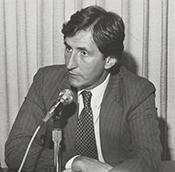
Here you will find contact information for Representative Robert J. Mrazek, including email address, phone number, and mailing address.
| Name | Robert J. Mrazek |
| Position | Representative |
| State | New York |
| District | 3 |
| Party | Democratic |
| Status | Former Representative |
| Term Start | January 3, 1983 |
| Term End | January 3, 1993 |
| Terms Served | 5 |
| Born | November 6, 1945 |
| Gender | Male |
| Bioguide ID | M001057 |
About Representative Robert J. Mrazek
Robert Jan Mrazek (born November 6, 1945) is an American author, filmmaker, and former politician who served as a Democratic member of the United States House of Representatives from New York from 1983 to 1993. Representing New York’s 3rd congressional district on Long Island for most of the 1980s, he completed five terms in Congress and played an active role in legislative debates on conservation, historic preservation, foreign policy, and cultural heritage. Since leaving office, he has become a prolific writer of fiction and nonfiction and has worked in film, earning multiple national awards for his literary and cinematic contributions.
Mrazek was born in Newport, Rhode Island, to Harold Richard Mrazek (1919–2008) and Blanche Rose (née Slezak, 1915–2007), both of Czech descent. Through his mother’s family he is descended from Anna Svašková (1862–1946), who was born in Strážovice in what is now the Czech Republic. He grew up in Huntington, New York, on Long Island, where he attended local schools before entering Cornell University. At Cornell he majored in political science and graduated in 1967. The following year, in 1968, he attended the London Film School, an early indication of the interest in film that he would return to later in life as a screenwriter and director.
In 1967, Mrazek joined the United States Navy with the intention of serving in the Vietnam War. While at Officer Candidate School in Newport, he suffered a disabling training injury that led to his hospitalization alongside wounded Marines. This experience profoundly affected his views, and during his recovery he turned against the war. He was discharged from the Navy in 1968 and soon entered public service as an aide to U.S. Senator Vance Hartke of Indiana, serving in that capacity from 1969 to 1971. His work in the Senate exposed him to national legislative processes and issues of war, veterans’ affairs, and social policy that would later inform his own congressional agenda.
Mrazek began his elective political career at the local level in New York. He was elected to the Suffolk County Legislature in 1975 and served there until 1982, rising to become minority leader. During this period he built a reputation as an energetic Democratic Party figure on Long Island and participated in national party politics as a delegate to the Democratic National Conventions in 1980, 1988, and 1992. In the 1982 elections, following redistricting after the 1980 U.S. Census, he ran for the U.S. House of Representatives in New York’s 3rd congressional district and defeated the incumbent, one-term Conservative Republican Congressman John LeBoutillier.
Democrat Mrazek entered the 98th Congress in January 1983 and served continuously in the United States House of Representatives until January 1993. Unusually for a freshman, he secured a seat on the powerful House Appropriations Committee after persuading Speaker Thomas P. “Tip” O’Neill Jr. to make an exception to the customary seniority rules. Over the course of his five terms, he participated actively in the democratic process, representing the interests of his Long Island constituents while also pursuing a national legislative agenda. After winning election to a fifth term, he announced that he would not seek re-election to the House, instead exploring a campaign for the United States Senate in 1992. He ultimately abandoned that Senate bid after becoming implicated in the House banking scandal, and he retired from Congress at the conclusion of his term in 1993.
During his congressional service, Mrazek authored and advanced several significant pieces of legislation. In the field of conservation, he wrote laws that helped preserve approximately 3,000,000 acres of old-growth forest in Alaska’s Tongass National Forest and protected the Manassas Civil War battlefield in Virginia from commercial development. His Tongass Timber Reform Act, first introduced in 1986 and signed into law by President George H. W. Bush in 1990, revoked artificially high timber-cutting targets in the nation’s largest national forest, protected more than 2,000,000 acres of old-growth and watershed acreage, and mandated broad buffer zones for salmon and resident fishing streams. The measure was the subject of intense conflict with members of the Alaska congressional delegation, including Representative Don Young of Alaska; after losing a House vote on a Mrazek amendment in 1990, Young allegedly confronted Mrazek in a House corridor and threatened him with a knife. In Virginia, Mrazek co-led, with Representative Michael Andrews of Texas, the fight to prevent a large shopping mall from being built adjacent to the Manassas battlefield. In April 1988 he inserted an amendment into an appropriations bill to block federal funds for a needed highway interchange near the 542-acre tract targeted for development, and he and Andrews then introduced H.R. 4526 to authorize federal acquisition of the land and its addition to the park. Despite opposition and personal attacks from Secretary of the Interior Donald Hodel, who accused them of “playing politics” with the battlefield, the Manassas Battlefield Protection Act drafted by Mrazek was signed into law by President Ronald Reagan in November 1988.
Mrazek also played a notable role in foreign policy and human rights legislation. In June 1986, he authored the Edwards Substitute Amendment to Title II of H.R. 5052 concerning U.S. aid to the Nicaraguan Contras. Of four competing amendments to restrict the Reagan Administration’s use of $100,000,000 in approved military assistance, his was the only one to pass. The Mrazek amendment prohibited U.S. personnel involved in training the Contras from coming within 20 miles of the Nicaraguan border, a provision he argued was necessary to prevent a “Gulf of Tonkin”–type incident that could be used to justify direct American military intervention in Nicaragua. Declassified White House memoranda later supported his concerns about the risk of escalation. In Southeast Asia, he authored the Amerasian Homecoming Act, enacted in December 1987, which allowed approximately 25,000 children fathered by American servicemen during the Vietnam War to immigrate to the United States. Often called bui doi, or “children of the dust,” these Amerasian children faced severe discrimination in Vietnam and were frequently denied schooling and left to live on the streets. Prompted by a diplomatically worded letter from high school students in his district to the Vietnamese mission in New York City, Mrazek traveled to Vietnam, where he brought out an American-Vietnamese child, Le Van Minh, from Ho Chi Minh City and met many other Amerasian children who implored him to take them “to the land of my father.” His experience there led directly to the drafting and passage of the Amerasian Homecoming Act, after which many of the children resettled in the United States and went on to successful careers as teachers, entrepreneurs, and businesspeople.
In the realm of cultural policy, Mrazek was the principal author of the National Film Preservation Act of 1988. Concerned that classic American films such as “High Noon” and “Casablanca” were being colorized or “time-compressed” by broadcasters to accommodate more commercials, he introduced legislation to protect such works from significant alteration without the consent of their creators. The so‑called “Mrazek Amendment” provoked an intense lobbying campaign led by Jack Valenti, president of the Motion Picture Association of America, who argued that the proposal “puts a spike in the eye of normal House procedure and creates a group which is something out of 1984.” The measure, however, won strong support from prominent figures in the film industry, including actors Burt Lancaster and James Stewart and directors Steven Spielberg and George Lucas, who favored preserving the integrity of their work. The final law, signed by President Reagan on September 27, 1988, established the National Film Registry in the Library of Congress, under which 25 films each year deemed “culturally, historically, or aesthetically significant” are selected for preservation. It also created the National Film Preservation Board to explore new methods of safeguarding endangered films.
Mrazek’s legislative achievements brought him recognition from conservation and preservation organizations. In 1987, the Directors Guild of America presented him with its first Legislative Achievement Award for his work on film preservation. In 1988, he and Representative Andrews were named Conservationists of the Year by the National Parks Conservation Association for their efforts to protect Manassas National Battlefield from adjacent land development. The Governor of New York honored him with the Commissioner’s Preservationist Award in 1990 for his contributions to historic and environmental preservation in the state. In 2017, long after his congressional career had ended, the American Battlefield Trust named him one of the “Four Legends of Civil War Battlefield Preservation,” recognizing his enduring impact on the protection of historic landscapes.
After leaving Congress in 1993, Mrazek remained active in public affairs and environmental advocacy. That year he became the founding chairman of the Alaska Wilderness League, an organization dedicated to protecting Alaska’s wild lands, including areas such as the Arctic National Wildlife Refuge and the Tongass National Forest. He has continued his association with the group as Honorary Chair, a role he shares with former President Jimmy Carter. In the mid‑1990s he also ventured into sports entrepreneurship as one of the co‑founders of the United Baseball League, a proposed third major professional baseball league that ultimately did not come to fruition. Alongside these efforts, he turned increasingly to writing, drawing on his experiences in war, politics, and history.
Since retiring from Congress, Mrazek has published twelve books, including eight novels and four works of nonfiction, and has emerged as an award‑winning author of military and historical literature. His first novel, “Stonewall’s Gold,” a Civil War–era coming‑of‑age story, was published by St. Martin’s Press in 1999 and won the 1999 Michael Shaara Award for Excellence in Civil War Fiction. He followed it with another Civil War novel, “Unholy Fire,” published by St. Martin’s Press in 2003. His third novel, “The Deadly Embrace,” a World War II murder mystery published by Viking Press in 2006, received the W. Y. Boyd Literary Award for Excellence in Military Fiction from the American Library Association in 2007 as the best military fiction of 2006. His first major nonfiction work, “A Dawn Like Thunder: The True Story of Torpedo Squadron Eight,” published by Little, Brown and Company in 2008, recounted the story of a famed U.S. Navy squadron in World War II and was named a “Best Book of 2009 (American History)” by the Washington Post.
Mrazek has continued to explore historical and adventure themes in both fiction and nonfiction. “The Art Pottery of Joseph Mrazek: A Collector’s Guide,” published by Wingspan Press in 2009, chronicles the life and work of his grandfather, an inventor, painter, and maker of hand‑painted Czech pottery between the world wars. “To Kingdom Come: An Epic Saga of Survival in the Air War Over Germany,” published by NAL–Penguin in 2011, examines a disastrous 1943 bombing mission to Stuttgart and was selected as a main choice of the Military and History Book Club. In 2014 he published two contemporary thrillers with Penguin/Random House: “Valhalla,” centered on the discovery of an ancient Viking ship and its crew beneath the Greenland ice cap, and its sequel, “The Bone Hunters,” which follows the search for the legendary fossil Peking Man, missing since the Japanese occupation of Peking in 1941. His later works include “And the Sparrow Fell” (Cornell University Press, 2017), a coming‑of‑age novel set against the Vietnam War; “Dead Man’s Bridge: A Jake Cantrell Mystery” (Crooked Lane Books, August 8, 2017), the first in a mystery series; “The Indomitable Florence Finch: The Untold Story of a War Widow Turned Resistance Fighter and Savior of American POWs” (Hachette Books, July 21, 2020), a biography of a World War II heroine in the Philippines; and “The Dark Circle” (Crooked Lane Books, August 12, 2022), the second installment in the Jake Cantrell mystery series.
Returning to his early interest in film, Mrazek wrote and co‑directed his first feature motion picture, “The Congressman,” which premiered in Washington, D.C., in April 2016. Drawing in part on his experience in elective office, the film stars Treat Williams, Elizabeth Marvel, Ryan Merriman, George Hamilton, Jayne Atkinson, Fritz Weaver, and Marshall Bell. “The Congressman” received the Breakout Achievement Award at the AARP’s Film Awards in 2017, further cementing Mrazek’s reputation as a creative figure across multiple media. Alongside his appearances on C‑SPAN and his continued public engagement, his career as legislator, conservationist, author, and filmmaker has made him a distinctive figure in late twentieth‑ and early twenty‑first‑century American public life.