Representative Robert Murphy Nevin
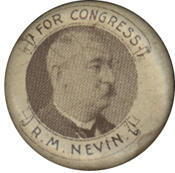
Here you will find contact information for Representative Robert Murphy Nevin, including email address, phone number, and mailing address.
| Name | Robert Murphy Nevin |
| Position | Representative |
| State | Ohio |
| District | 3 |
| Party | Republican |
| Status | Former Representative |
| Term Start | December 2, 1901 |
| Term End | March 3, 1907 |
| Terms Served | 3 |
| Born | May 5, 1850 |
| Gender | Male |
| Bioguide ID | N000057 |
About Representative Robert Murphy Nevin
Robert Murphy Nevin (May 5, 1850 – December 17, 1912) was an American attorney and Republican politician who served three terms as a United States Representative from Ohio from 1901 to 1907. Over the course of his career he became a prominent figure at the Ohio bar, an influential participant in state and local Republican politics, and a notable member of the House of Representatives during a significant period in American political and economic development at the turn of the twentieth century.
Nevin was born on May 5, 1850, in Danville, Ohio, the son of Robert and Frances E. (Eakin) Nevin. His father was a merchant and the first postmaster in Highland County, Ohio, providing the family with close connections to local civic life and public service. During his youth, Nevin attended the public schools in Hillsboro, Ohio, where he received his early education. He then enrolled at Ohio Wesleyan University, from which he was graduated in June 1868, completing his formal education while still a young man.
Following his graduation, Nevin moved to Dayton, Ohio, where he undertook the study of law. He first read law under the tutelage of Thomas O. Lowe, a prominent local attorney. When Lowe was elected to the bench of the superior court, Nevin continued his legal training in the office of Conover & Craighead, a well-known Dayton law firm. He completed his preparation for the bar there and was admitted to the bar in Montgomery County, Ohio, in 1871, beginning what would become a long and distinguished legal career.
In November 1871, shortly after his admission to the bar, Robert Murphy Nevin was united in marriage to Emma Reasoner of Dresden, Ohio. The couple made their home in Dayton and had four children. As his family life became established, Nevin advanced steadily in his profession. In 1876 he entered into a professional partnership with Alvin W. Kumler, forming the firm of Nevin & Kumler. This partnership endured until Kumler’s election as judge of the Montgomery County Court of Common Pleas and, by that time, had become the oldest continuous law partnership in south central Ohio. Nevin developed a reputation as a distinguished criminal lawyer and occupied a prominent place at the Ohio bar. He also served as counsel for the New York Central Railroad for thirty years, from 1882 to 1912, a role that underscored his standing in corporate and transportation law.
A lifelong Republican, Nevin was deeply involved in party affairs at the county and state levels well before his election to Congress. He served as chairman of the Republican county committee of Montgomery County and was a delegate to fourteen Republican state conventions in fifteen years, during which his name was placed in nomination at different times for Secretary of State and for Governor of Ohio. He was a delegate to the Republican National Convention in 1892, reflecting his growing prominence within the party. In 1893, at the Republican state convention in Columbus, Ohio, he placed William McKinley’s name in nomination for Governor of Ohio, participating in the rise of a future President. Nevin was elected as prosecuting attorney of Montgomery County as a Republican and served from 1887 to 1890, further solidifying his public reputation. He was narrowly defeated in his first bid for Congress from Ohio’s third district in 1896, but remained active in politics and public affairs.
Nevin’s congressional career began with his election in 1900 as a Republican to the Fifty-seventh Congress, representing Ohio’s third district. He was subsequently re-elected to the Fifty-eighth and Fifty-ninth Congresses, serving continuously from March 4, 1901, to March 3, 1907. During these three terms in the United States House of Representatives, he participated in the legislative process at a time marked by rapid industrial growth, expanding federal regulation, and the early years of the Progressive Era. As a member of the House of Representatives, Robert Murphy Nevin represented the interests of his Ohio constituents and contributed to national debates characteristic of this significant period in American history. He declined renomination in 1906, choosing not to seek a fourth term.
After leaving Congress in 1907, Nevin returned to Dayton and resumed the full-time practice of law, continuing his association with major clients such as the New York Central Railroad. He remained a respected figure in legal and civic circles. Beyond his professional and political activities, he was active in fraternal organizations, reflecting the social and civic networks of his era. He was a Mason, including Knight Templar and Scottish Rite affiliations, an Odd Fellow, a Knight of Pythias, and a member of the Benevolent and Protective Order of Elks.
Robert Murphy Nevin died in Dayton, Ohio, on December 17, 1912. He was interred in Woodland Cemetery in Dayton, a resting place for many of the city’s leading citizens. His career as an attorney, party leader, and three-term member of Congress left a record of sustained engagement in both the legal profession and public life in Ohio and at the national level.