Representative Robert Pittenger
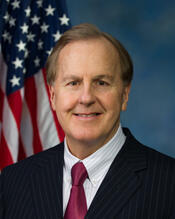
Here you will find contact information for Representative Robert Pittenger, including email address, phone number, and mailing address.
| Name | Robert Pittenger |
| Position | Representative |
| State | North Carolina |
| District | 9 |
| Party | Republican |
| Status | Former Representative |
| Term Start | January 3, 2013 |
| Term End | January 3, 2019 |
| Terms Served | 3 |
| Born | August 15, 1948 |
| Gender | Male |
| Bioguide ID | P000606 |
About Representative Robert Pittenger
Robert Miller Pittenger (born August 15, 1948) is an American businessman and politician who served as a Representative from North Carolina in the United States Congress from 2013 to 2019. A member of the Republican Party, he represented North Carolina’s 9th congressional district for three terms, during a period of significant political and economic change in the United States. The district included several outer portions of Charlotte as well as many of that city’s southern and eastern suburbs, and later, after redistricting, stretched from southeast Charlotte to Fayetteville and the Sandhills.
Pittenger was born in Texas and attended the University of Texas, where he completed his undergraduate education. Following his graduation, he worked with Campus Crusade for Christ, an interdenominational Christian ministry, reflecting an early engagement with faith-based and civic activities. In 1985 he moved to Charlotte, North Carolina, where he established himself as a real estate investor. His business career in the Charlotte area provided the foundation for his later involvement in state and national politics and helped connect him with the region’s growing suburban communities.
Pittenger entered elective office in North Carolina following the state’s legislative redistricting in the early 2000s. In 2002 he ran for the 40th Senate District of the North Carolina General Assembly and defeated incumbent Democratic State Senator Fountain Odom by a margin of 55 percent to 43 percent. After subsequent redistricting, he ran in 2004 for the 39th Senate District and defeated Libertarian nominee Andy Grum with 89 percent of the vote to 11 percent. In 2006 he won reelection to a third term in the North Carolina Senate unopposed. During his tenure, he represented the state’s 39th Senate District, which included portions of southeastern Mecklenburg County, and he served on key committees including Appropriations/Base Budget, Commerce, Finance, Insurance and Civil Justice Reform, Pensions & Retirement and Aging, and Rules and Operation.
In the North Carolina Senate, Pittenger was a lead sponsor of Right to Life legislation and was a supporter of the North Carolina marriage amendment, although he was no longer in office when the amendment passed out of committee and was finally voted on by the General Assembly in 2011. He was active on fiscal and regulatory issues, and in May 2004 he proposed cutting the state’s corporate tax rate from 6.9 percent to 4.9 percent and reducing the income tax rate for the state’s top earners from 8.25 percent to 7.5 percent. He also proposed more than $1.5 billion in state spending cuts, with a particular focus on reducing Medicaid access for persons above the age of Medicare eligibility. In February 2005 he introduced a medical malpractice reform bill that would cap non-economic damages at $250,000 for physicians, hospitals, and long-term care facilities, reflecting his broader interest in tort reform and cost containment in health care.
Pittenger sought statewide office in 2008. He entered the Republican primary for Lieutenant Governor of North Carolina and, on May 6, 2008, defeated three other candidates to become his party’s nominee with 59 percent of the vote. Later that month, on May 27, 2008, he resigned from the North Carolina Senate to focus fully on his campaign. In the November general election he faced fellow State Senator Walter H. Dalton, the Democratic nominee, and lost by a margin of 51 percent to 46 percent. Although unsuccessful, the campaign raised his profile within the state Republican Party and positioned him for subsequent bids for federal office.
After Representative Sue Myrick announced her retirement from North Carolina’s 9th congressional district in early 2012, Pittenger declared his candidacy to succeed her. In the crowded Republican primary held on May 8, 2012, he finished first in an 11-candidate field with 32 percent of the vote but did not secure an outright majority. In the July 17, 2012 primary runoff, he defeated former Mecklenburg County Sheriff Jim Pendergraph by a margin of 53 percent to 47 percent. In the November 6, 2012 general election he defeated Democratic Mecklenburg County Commission Chairwoman Jennifer Roberts, winning 52 percent of the vote to her 47 percent. He lost the district’s share of Mecklenburg County with 47 percent of the vote there, but secured large margins in Union County (63 percent) and Iredell County (64 percent). It was the closest a Republican had come to losing the district since 1986. Pittenger took office in the U.S. House of Representatives in January 2013.
During his three terms in Congress, Pittenger contributed to the legislative process as a Republican member of the House of Representatives and represented the interests of his constituents in a district undergoing demographic and geographic change. He served on the House Committee on Financial Services, including the Subcommittee on Financial Institutions and Consumer Credit and the Subcommittee on Monetary Policy and Trade, where he engaged in oversight of banking, consumer credit, and international financial policy. He was also a member of the Republican Study Committee, a caucus of conservative House Republicans, and participated in several issue-focused caucuses, including the United States Congressional International Conservation Caucus and the U.S.-Japan Caucus, reflecting interests in conservation policy and international relations.
Pittenger’s legislative activity included work on child protection and criminal justice issues. On December 2, 2013, he introduced the Kilah Davenport Child Protection Act of 2013, which became Public Law 113–104. The law broadened the coverage of existing federal statutes addressing domestic assaults by certain repeat offenders and required the United States Department of Justice to prepare a report on child abuse prevention laws in all U.S. states and territories, with particular attention to penalties for cases of severe child abuse. This legislation exemplified his focus on strengthening penalties for violent offenses and enhancing protections for vulnerable children. During his tenure, he also served in Congress while the 9th District was significantly redrawn after a federal court invalidated the previous map as an unconstitutional racial gerrymander, pushing the district’s boundaries well to the east and altering its political and demographic composition.
Pittenger considered running for the U.S. Senate during his time in the House but ultimately chose to seek reelection to his congressional seat. In 2014 he defeated Republican primary challenger Michael Steinberg, who had also been a candidate for the seat in 2012. No Democrat filed to run in the general election that year, making the 9th District the only congressional district in North Carolina not contested by both major parties in 2014, although there was an unsuccessful write-in campaign by Shawn Eckles of Iredell County. In 2016, after the court-ordered redistricting, he faced Baptist pastor Mark Harris in the Republican primary and prevailed by a narrow margin of 134 votes before defeating Democratic nominee Christian Cano in the general election.
In 2018 Pittenger again faced Mark Harris in a Republican primary rematch. On May 8, 2018, Harris defeated him with 48.5 percent of the vote to Pittenger’s 46.2 percent, making Pittenger the first congressional incumbent in the nation to lose a primary that year; former Representative Mark Sanford of South Carolina became the second. Harris appeared to win the November 2018 general election, but the result was not certified due to credible allegations of electoral fraud involving the Harris campaign, and Harris was never seated in Congress. A special election was subsequently ordered for the district. Pittenger, who had already concluded his service in Congress at the end of his third term in January 2019, declined to run in the special election, as did Harris.