Representative Robert Lewis Rodgers
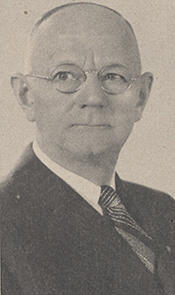
Here you will find contact information for Representative Robert Lewis Rodgers, including email address, phone number, and mailing address.
| Name | Robert Lewis Rodgers |
| Position | Representative |
| State | Pennsylvania |
| District | 28 |
| Party | Republican |
| Status | Former Representative |
| Term Start | January 3, 1939 |
| Term End | January 3, 1947 |
| Terms Served | 4 |
| Born | June 2, 1875 |
| Gender | Male |
| Bioguide ID | R000373 |
About Representative Robert Lewis Rodgers
Robert Lewis Rodgers (June 2, 1875 – May 9, 1960) was a Republican member of the United States House of Representatives from Pennsylvania who served four consecutive terms in Congress from 1939 to 1947. His congressional career spanned a pivotal era in American history, encompassing the final years of the Great Depression, the entirety of World War II, and the beginning of the postwar period. As a member of the House of Representatives, Rodgers participated in the federal legislative process and represented the interests of his Pennsylvania constituents during these transformative years.
Rodgers was born on June 2, 1875, in El Dorado, Kansas. While still a young boy, he moved with his family to Pennsylvania and was raised on a farm near Jamestown, in Mercer County. Growing up in a rural setting, he became familiar with agricultural life and the concerns of farming communities, experiences that would later inform his professional and political perspectives. His early years were shaped by the agrarian economy of western Pennsylvania at the turn of the twentieth century, providing him with a grounding in the practical challenges faced by small farmers and rural workers.
During the war with Spain in 1898, Rodgers enlisted in Company K of the Fifteenth Regiment of the Pennsylvania Volunteer Infantry, joining thousands of other Americans in the Spanish–American War. His military service reflected the patriotic fervor of the period and gave him firsthand experience with national service and military organization. After his return from service, he resumed civilian life in Pennsylvania, where he taught in the district schools and engaged in agricultural pursuits. In combining teaching with farming, he developed ties to both the educational and agricultural communities, building a local reputation as a citizen engaged in public-minded work.
In 1914, Rodgers moved to Erie, Pennsylvania, a growing industrial and commercial center on the shore of Lake Erie. There he entered the insurance, real estate, and mortgage business, establishing himself in the city’s expanding financial and property sectors. His work in these fields brought him into contact with a broad cross-section of Erie’s residents, from homeowners and farmers seeking credit to business owners involved in commercial development. This experience deepened his understanding of economic and housing issues and helped lay the foundation for his later political career within the Republican Party.
Rodgers was elected as a Republican to the Seventy-sixth Congress and to the three succeeding Congresses, serving in the U.S. House of Representatives from January 3, 1939, to January 3, 1947. Representing a district in northwestern Pennsylvania, he served during the administrations of Presidents Franklin D. Roosevelt and Harry S. Truman, a period marked by major federal initiatives in economic recovery, wartime mobilization, and postwar adjustment. As a member of Congress, Rodgers contributed to the legislative process, participating in debates and votes on measures related to the nation’s war effort, domestic policy, and the evolving role of the federal government. Throughout his four terms, he worked to represent the interests of his constituents in Erie and the surrounding region, reflecting both his rural upbringing and his later urban business experience.
Rodgers’s congressional service came to an end after the 1946 election cycle. In that year he was an unsuccessful candidate for renomination, bringing his tenure in the House to a close after eight years. Leaving Congress at the dawn of the postwar era, he returned to private life in Pennsylvania. His departure from elective office marked the conclusion of a public career that had included military service in the Spanish–American War, years as a teacher and farmer, and nearly a decade as a federal legislator during one of the most consequential periods in twentieth-century American history.
Robert Lewis Rodgers died on May 9, 1960. His life traced a path from a Kansas birthplace to a Pennsylvania farm, from the battle lines of the Spanish–American War to the committee rooms and chambers of the United States Congress. As a Republican representative from Pennsylvania, he played a role in guiding the nation through depression, global conflict, and the early postwar years, while maintaining close ties to the local communities and economic interests that had shaped his early life and professional career.