Representative Robert L. F. Sikes
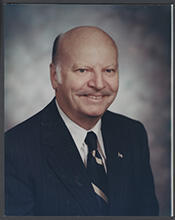
Here you will find contact information for Representative Robert L. F. Sikes, including email address, phone number, and mailing address.
| Name | Robert L. F. Sikes |
| Position | Representative |
| State | Florida |
| District | 1 |
| Party | Democratic |
| Status | Former Representative |
| Term Start | January 3, 1941 |
| Term End | January 3, 1979 |
| Terms Served | 19 |
| Born | June 3, 1906 |
| Gender | Male |
| Bioguide ID | S000406 |
About Representative Robert L. F. Sikes
Robert Lee Fulton Sikes (June 3, 1906 – September 28, 1994) was an American politician of the Democratic Party who represented the Florida Panhandle in the United States House of Representatives from 1941 to 1979, with a brief break in 1944 and 1945 for service during World War II. Over the course of 19 terms in office, he became one of the most influential members of the House, particularly in matters affecting military installations and federal development in northwest Florida. Known in his district as “Florida’s third Senator” and “the He-Coon,” he was also a staunch supporter of racial segregation and a signatory of the 1956 Southern Manifesto. His long career ended amid a major ethics controversy that led to his censure by the House in 1976.
Sikes was born on June 3, 1906. Details of his early childhood and family background are less extensively documented than his public career, but he came of age in the early twentieth-century South, a region dominated politically by the Democratic Party and shaped by the legacy of Reconstruction and the imposition of Jim Crow laws. This political environment, in which African Americans were largely disenfranchised by state constitutions and statutes adopted around the turn of the century, formed the backdrop to Sikes’s later political alignment and views on race and civil rights.
Before entering national politics, Sikes established himself in the publishing business in Crestview, in the Florida Panhandle near Destin and Fort Walton Beach. From 1933 to 1946 he worked in that field, becoming a prominent local figure and using his position in the community to build a political base. During the Great Depression, he joined the Democratic Party at a time when it overwhelmingly dominated Florida politics, and he aligned himself with the New Deal coalition led by President Franklin D. Roosevelt. In 1936, a landslide year for Democrats nationwide, Sikes was elected to the Florida House of Representatives. He was re-elected and served in the state legislature until 1940, gaining experience in lawmaking and constituent service that would shape his later congressional career.
In 1940, Sikes successfully sought national office and was elected as a Democrat to the Seventy-seventh Congress from what was then Florida’s 3rd Congressional District. His victory followed a bitter Democratic primary campaign, which was effectively the decisive contest in a one-party state where general elections were often a formality. He took his seat on January 3, 1941, and was re-elected to the Seventy-eighth Congress. During these early years in Washington, Sikes began pressing for federal investment and military development in his home region, notably advocating for the expansion of Eglin Field as a test facility for the United States Army Air Forces, and later the U.S. Air Force, laying the foundation for the Panhandle’s long-term role as a major military hub.
Sikes’s initial congressional service was interrupted by World War II. On October 19, 1944, he resigned his seat in the House to enter active duty in the United States Army. He was commissioned as a major and served during the war, reflecting the broader pattern of public officials entering military service during the global conflict. When President Franklin D. Roosevelt later ordered all legislators on active duty to return to Washington, Sikes sought to reclaim his former seat. He ran again in 1944, won election, and returned to Congress, beginning service in the Seventy-ninth Congress and then in sixteen succeeding Congresses. In 1959, reflecting his seniority and standing, he was selected as a delegate to the Interparliamentary Conference in Warsaw, Poland.
Over his long tenure, Sikes became a powerful figure in the House, especially on matters related to defense and appropriations. His district, renumbered as the 1st Congressional District in 1963, benefited from his success in directing federal resources to the Florida Panhandle. He used his seniority to help build or expand fourteen military bases in the region, reinforcing the area’s economic dependence on defense spending. His effectiveness in securing projects and providing constituent services earned him the nickname “the He-Coon,” a reference to a Panhandle legend about a male raccoon that knows where food and water are, fends off enemies, and looks after its territory; Sikes said a he-coon was expected to “look after those around him.” Despite the district’s gradual partisan realignment—its voters began splitting their tickets in the 1950s and supported Republican presidential candidates from 1964 onward, except when George Wallace’s segregationist third-party campaign carried it in 1968—Sikes remained personally popular. He never won less than 80 percent of the vote and often faced only token or no Republican opposition; in 1964, for example, he was re-elected unopposed even as Republican Barry Goldwater carried the district by a wide margin.
Sikes’s influence extended beyond his district. In Congress he was often referred to as “Florida’s third Senator” because of his clout in Washington and his ability to shape federal policy affecting his state. He worked closely with colleagues from across the South, including fellow Florida Democrat Courtney W. Campbell and Republican William C. Cramer of St. Petersburg, who in 1954 became the first Republican elected to Florida’s House delegation since 1880. In 1973, Sikes joined Republican Representatives Jack Edwards of Alabama and Trent Lott of Mississippi in originating the Gulf Coast Congressional Report, a regional public affairs program broadcast on WKRG-TV in Mobile, Alabama, which served much of his district. He remained a regular participant on the program until his retirement from Congress in 1979.
Throughout his congressional service, Sikes was a consistent supporter of racial segregation and a vocal opponent of federal civil rights legislation. He was a signatory to the 1956 Southern Manifesto, which condemned the Supreme Court’s decision in Brown v. Board of Education and opposed the desegregation of public schools. In line with this stance, Sikes voted against the Civil Rights Acts of 1957, 1960, 1964, and 1968, as well as against the 24th Amendment to the U.S. Constitution, which abolished the poll tax in federal elections, and the Voting Rights Act of 1965. These positions placed him firmly within the segregationist wing of the mid-twentieth-century Southern Democratic Party and were central to his legislative record during the civil rights era.
Sikes’s long career was marred in its final years by allegations of financial misconduct. In 1975, Common Cause, a public-affairs lobbying group, accused him of using his office for personal gain. The charges centered on his undisclosed ownership of stock in First Navy Bank at Naval Air Station Pensacola—a bank established by government officials at his urging—and in Fairchild Industries, a military contractor that benefited from federal contracts. Sikes failed to report these holdings in the financial disclosure statements required of members of Congress. Following an investigation, the House of Representatives voted on July 26, 1976, by a margin of 381 to 3, to reprimand him for this misconduct. Sikes, a strong conservative, publicly contended that “flaming liberals” had conspired against him, but the reprimand significantly damaged his standing in Washington. He did not seek re-election in 1978, bringing to a close 45 consecutive years as an elected official without ever having lost a race.
After leaving Congress in January 1979, Sikes returned to Crestview, Florida, where he devoted himself to his business interests and remained a prominent local figure. He withdrew from national political life but continued to be recognized in the region for his role in shaping the Panhandle’s economic and military landscape. Sikes died on September 28, 1994. Numerous public facilities and landmarks in northwest Florida bear his name, reflecting both his long service and the enduring imprint of his career on the area. These include the Bob Sikes Bridge connecting Gulf Breeze to Santa Rosa Island; Bob Sikes Airport near Crestview in Okaloosa County; Bob Sikes Elementary School in Crestview; the Robert L. F. Sikes Center, a campus of Northwest Florida State College in Crestview; County Road 280, known locally as “Bob Sikes Road,” linking U.S. Route 331 in DeFuniak Springs to Florida State Road 285; and the Robert L. F. Sikes Library in Crestview.