Representative Robert E. Sweeney
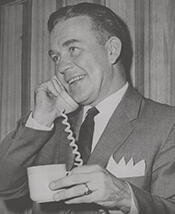
Here you will find contact information for Representative Robert E. Sweeney, including email address, phone number, and mailing address.
| Name | Robert E. Sweeney |
| Position | Representative |
| State | Ohio |
| District | At-Large |
| Party | Democratic |
| Status | Former Representative |
| Term Start | January 4, 1965 |
| Term End | January 3, 1967 |
| Terms Served | 1 |
| Born | November 4, 1924 |
| Gender | Male |
| Bioguide ID | S001103 |
About Representative Robert E. Sweeney
Robert E. Sweeney (November 4, 1924 – June 30, 2007) was an American lawyer, local official, and Democratic politician who served as a U.S. Representative from Ohio from 1965 to 1967. A son of former Representative Martin L. Sweeney, he continued a family tradition of public service while building a distinct career in law, county government, and national party politics.
Sweeney was born in the West Park neighborhood of Cleveland, Ohio, where he grew up in a politically active Irish American family shaped by his father’s long tenure in Congress. He attended Saint Ignatius High School in Cleveland, graduating before the end of World War II. During the war, he joined the United States Army and served from 1943 until 1946, an experience that preceded and informed his later public service. After his military duty, Sweeney pursued higher education at several institutions, reflecting both ambition and persistence in the face of family skepticism about a legal career.
Following his discharge, Sweeney studied at Georgetown University in Washington, D.C., and later attended Baldwin-Wallace College in Berea, Ohio. He then enrolled at Cleveland-Marshall Law School in Cleveland, where he studied law despite the discouragement of his father, who had reservations about his entering the legal profession. Sweeney completed his legal education and, in 1951, was admitted to the bar, launching a professional life that would combine legal practice with an increasingly prominent role in Democratic politics in Ohio.
Sweeney began practicing law in Cleveland in 1951 and quickly moved into public legal service. From 1951 to 1954, he served as assistant director of law for the city of Cleveland, gaining experience in municipal governance and public policy. He later served as a special assistant to the Attorney General of Ohio from 1958 until 1962, a position that broadened his exposure to statewide legal and political issues. In 1962, he became the Democratic nominee for Attorney General of Ohio, but he was defeated in the general election that November. Undeterred, he returned to his law practice while remaining active in party affairs and preparing for another opportunity at higher office.
Sweeney was elected as a Democrat to an at-large seat from Ohio in the United States House of Representatives in the 1964 election, winning a place in the Eighty-ninth Congress. He served one term from January 3, 1965, to January 3, 1967. His tenure in Congress occurred during a significant period in American history marked by the Great Society legislative agenda, the escalation of the Vietnam War, and major civil rights initiatives. As a member of the House of Representatives, Robert E. Sweeney participated in the democratic process, contributed to the legislative work of the chamber, and represented the interests of his Ohio constituents. After Ohio shifted from at-large to district-based congressional elections beginning in 1966, Sweeney chose not to seek re-election to the House. Instead, he again pursued the office of Ohio Attorney General, winning the Democratic nomination a second time but once more losing in the November general election. He then resumed the full-time practice of law.
In the years following his congressional service, Sweeney remained a prominent figure in Cuyahoga County and Ohio Democratic politics. In 1976, he was appointed to an unexpired term on the Cuyahoga County Commission, the county’s chief governing body. He was subsequently elected to a full term in 1977. During his tenure as a county commissioner, he became known as a supporter of regional government and played a key role in establishing Cuyahoga County’s public defender’s office and its solid-waste district. He was also a primary advocate for the renovation and preservation of Cleveland’s Playhouse Square Center, helping to lay the groundwork for what would become one of the nation’s largest performing arts centers. In 1980, Sweeney lost his seat on the commission after an unsuccessful bid for re-election, after which he returned again to private legal practice.
Sweeney’s legal career gained national significance through his pioneering work in asbestos litigation. He was among the first lawyers to bring forward a lawsuit related to asbestos exposure. During his research in these cases, he discovered an incriminating document showing that manufacturers of asbestos had been aware of its dangers for roughly half a century but had conspired to conceal this information from the public. This discovery contributed to a wave of litigation and large settlements against asbestos manufacturers, from which Sweeney earned millions of dollars. His work in this area helped shape the broader legal and public understanding of corporate responsibility for occupational health hazards.
In addition to his legal and governmental roles, Sweeney remained active in Democratic Party politics at the national level. He was instrumental in the placement of the so‑called “Irish plank” into the Democratic platform at the 1992 Democratic National Convention, reflecting his engagement with Irish American issues and international concerns related to Ireland. This effort underscored his continuing influence within the party decades after his single term in Congress and his long-standing identity as an Irish American Democrat from Cleveland.
Sweeney’s health declined sharply after he suffered a major heart attack in 1999, and in his later years he struggled with a variety of ailments. He died at his home in Gates Mills, Ohio, a suburb of Cleveland, on June 30, 2007, at the age of 82. He was survived by his second wife, Kathryn; his first wife, Patricia; their thirteen children—Robert, Daniel, William, Martin, John, James, Thomas, Mary Brigid, Alice Marie, Edward, Patrica, Eileen, and Catherine—along with thirty-seven grandchildren, fifteen great-grandchildren, and two stepchildren from his second marriage. His life reflected a blend of family legacy, military service, legal innovation, and public office at both the local and national levels.