Representative Robert Joseph Twyman
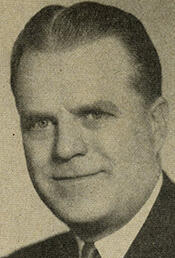
Here you will find contact information for Representative Robert Joseph Twyman, including email address, phone number, and mailing address.
| Name | Robert Joseph Twyman |
| Position | Representative |
| State | Illinois |
| District | 9 |
| Party | Republican |
| Status | Former Representative |
| Term Start | January 3, 1947 |
| Term End | January 3, 1949 |
| Terms Served | 1 |
| Born | June 18, 1897 |
| Gender | Male |
| Bioguide ID | T000444 |
About Representative Robert Joseph Twyman
Robert Joseph Twyman (June 18, 1897 – June 28, 1976) was a Republican U.S. Representative from Illinois who served one term in the United States Congress from 1947 to 1949. Born in Indianapolis, Marion County, Indiana, he came of age in the early twentieth century, a period marked by rapid industrialization and the approach of World War I. Details of his early family life are not extensively documented in public records, but his subsequent education and professional choices reflected an early orientation toward public service and international engagement.
Twyman pursued higher education at Georgetown University in Washington, D.C., an institution known for its emphasis on government, diplomacy, and international affairs. His time in the nation’s capital placed him in close proximity to the federal government and likely influenced his later work in both foreign service and elective office. While still a young man, he entered national service during World War I, serving as an ensign in the United States Navy. This early military experience introduced him to the operational demands of national defense during a major global conflict.
Following World War I, Twyman entered the foreign service of the United States Department of State, where he was employed in capacities that drew on his education and exposure to international issues. In 1919 he worked for a public utility company in Guatemala, an experience that combined elements of international business and infrastructure development. This period in Central America broadened his understanding of economic and technical issues in an international context and added to his background in both foreign affairs and commercial enterprise.
As global tensions mounted again in the late 1930s and early 1940s, Twyman returned to active military service. He accepted a commission in the United States Navy in February 1941, shortly before the United States formally entered World War II, and served until September 1945. His World War II service spanned the entire period of American involvement in the conflict, underscoring a sustained commitment to national defense across two world wars. After the war, he transitioned back to civilian life and entered the private sector in Chicago, Illinois.
In the postwar years, Twyman became president of the Thomas Hoist Company, a supplier of construction and industrial lifts. In this role he was involved in the management of a firm that contributed to the building and industrial sectors during a period of substantial economic expansion and urban development in the United States. His leadership in business complemented his earlier government and military experience, providing him with a broad perspective on both public and private sector operations.
Twyman’s combined background in military service, foreign affairs, and business set the stage for his entry into electoral politics. A member of the Republican Party, he was elected from Illinois to the Eightieth Congress and served in the U.S. House of Representatives from January 3, 1947, to January 3, 1949. His term in Congress coincided with a significant period in American history, marked by the early Cold War, postwar economic adjustment, and the implementation of major foreign policy initiatives. As a Representative, he participated in the legislative process and represented the interests of his Illinois constituents in national deliberations.
During his congressional service, Twyman sponsored a bill that created a United States postage stamp honoring Swedish-Americans, reflecting attention to the contributions of ethnic communities to American life. In recognition of this effort, he was awarded a medal by the Swedish government in 1949, underscoring the international and cultural resonance of his legislative work. Despite this achievement and his active participation in the House, he was an unsuccessful candidate for reelection in 1948 to the Eighty-first Congress, bringing his formal congressional career to a close after one term.
After leaving Congress, Twyman resumed his business interests, returning to the private sector and continuing his involvement in commercial activities until his retirement. He maintained ties to Illinois, particularly the Chicago area, where his business career had been centered. In his later years, he relocated to Florida. Twyman died in West Palm Beach, Florida, on June 28, 1976. He was interred in Rosehill Cemetery in Chicago, Illinois, a final resting place that reflected his long association with the city and the state he had represented in the United States House of Representatives.