Representative Robert Bruce Van Valkenburgh
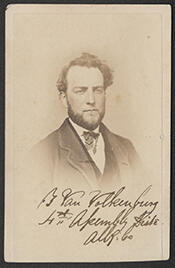
Here you will find contact information for Representative Robert Bruce Van Valkenburgh, including email address, phone number, and mailing address.
| Name | Robert Bruce Van Valkenburgh |
| Position | Representative |
| State | New York |
| District | 27 |
| Party | Republican |
| Status | Former Representative |
| Term Start | July 4, 1861 |
| Term End | March 3, 1865 |
| Terms Served | 2 |
| Born | September 4, 1821 |
| Gender | Male |
| Bioguide ID | V000061 |
About Representative Robert Bruce Van Valkenburgh
Robert Bruce Van Valkenburgh (September 4, 1821 – August 1, 1888) was a United States Representative from New York, an officer in the Union Army during the American Civil War, and later United States Minister Resident to Japan. A member of the Republican Party, he served two terms in the U.S. House of Representatives from 1861 to 1865, representing his New York constituents during one of the most consequential periods in American history.
Van Valkenburgh entered national public life as the sectional crisis over slavery culminated in the outbreak of the Civil War. Elected as a Republican to the Thirty-seventh and Thirty-eighth Congresses, he served in the House of Representatives from 1861 to 1865. During these years he participated in the legislative process that supported the Union war effort, helped shape wartime policy, and represented the interests of his New York district as the nation confronted secession, military mobilization, and the beginnings of Reconstruction. His congressional service coincided with the presidencies of Abraham Lincoln and the early phase of Andrew Johnson’s administration, placing him at the center of debates over union, emancipation, and the postwar settlement.
In addition to his legislative role, Van Valkenburgh was an officer in the Union Army during the American Civil War. His dual service in Congress and the military reflected the close interconnection between political leadership and military command in the Union cause. He contributed to the broader war effort both on the floor of the House and in uniform, exemplifying the commitment of many Northern political figures who took up arms in defense of the Union.
Following the war, Van Valkenburgh continued in federal service. In 1865 he served as Acting Commissioner of Indian Affairs, participating in the administration of U.S. policy toward Native American nations at a time when the federal government was redefining its priorities in the aftermath of the Civil War. His experience in Congress and the military helped prepare him for subsequent diplomatic responsibilities.
On January 18, 1866, Van Valkenburgh was appointed United States Minister Resident to Japan, a post he held until November 11, 1869. His tenure coincided with the turbulent final years of the Tokugawa shogunate and the onset of the Meiji Restoration. In this role, he played a notable part in international diplomacy during the Boshin War, most prominently by preventing the delivery of the Confederate ironclad CSS Stonewall to the forces of the Tokugawa clan. This action had implications both for the balance of power within Japan and for the enforcement of post–Civil War U.S. policy regarding former Confederate military assets.
After returning from Japan, Van Valkenburgh settled in Florida, where he entered the state’s judicial service during the Reconstruction era. On May 20, 1874, he was appointed an associate justice of the Florida Supreme Court. He remained on the bench for the rest of his life, contributing to the development of Florida’s jurisprudence as the state navigated the complex legal and political issues of the postwar South.
Robert Bruce Van Valkenburgh died at Suwannee Springs, near Live Oak, Florida, on August 1, 1888, while still serving as an associate justice of the Florida Supreme Court. He was buried in Old St. Nicholas Cemetery on the south side of the St. Johns River in Jacksonville, Florida, in the same cemetery as his wife, Anna Van Valkenburgh (née Simpson). His career spanned legislative, military, diplomatic, and judicial service, reflecting a broad engagement with the major national and international issues of his time.