Representative Roderick Randum Butler
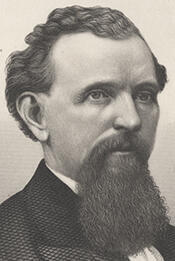
Here you will find contact information for Representative Roderick Randum Butler, including email address, phone number, and mailing address.
| Name | Roderick Randum Butler |
| Position | Representative |
| State | Tennessee |
| District | 1 |
| Party | Republican |
| Status | Former Representative |
| Term Start | March 4, 1867 |
| Term End | March 3, 1889 |
| Terms Served | 5 |
| Born | April 9, 1827 |
| Gender | Male |
| Bioguide ID | B001188 |
About Representative Roderick Randum Butler
Roderick Randum Butler (April 9, 1827 – August 18, 1902) was an American politician who represented Tennessee’s 1st congressional district in the United States House of Representatives from 1867 to 1875, and again from 1887 to 1889. A member of the Republican Party, he served five terms in Congress during a significant period in American history, contributing to the legislative process and representing the interests of his East Tennessee constituents during Reconstruction and its aftermath. He also held several terms in the Tennessee state legislature, briefly served as a state court judge, and was a prominent Unionist leader in East Tennessee during the Civil War.
Butler was born in Wytheville, Wythe County, Virginia, on April 9, 1827, the youngest son of George Butler. His father died before he was one year old, and his early life was marked by modest circumstances. At age thirteen, he was bound out as an apprentice to John Haney of Newbern, Virginia, to learn the tailor’s trade. After completing a six-year apprenticeship, he moved to Taylorsville, Tennessee (modern Mountain City in Johnson County), where he worked as a tailor and began establishing himself in the community. In 1849, he married Emeline Jane Donnelly, the daughter of a wealthy Taylorsville-area farmer; the couple had eleven children. Through this marriage and his growing professional standing, Butler became closely tied to the social and economic life of upper East Tennessee.
At the age of twenty-one, Butler began reading law under Carter County attorney Carrick W. Nelson. He was admitted to the bar in 1853 and entered into a law partnership with Nelson, practicing in Johnson and Carter counties until the outbreak of the Civil War. Early in his adult life he aligned himself with the Whig Party, reflecting the strong Unionist and anti-secession sentiment prevalent in much of East Tennessee. Around 1850 he was elected a major in the First Battalion of the Tennessee Militia, and he was appointed postmaster of Taylorsville by President Millard Fillmore. In 1855 he was elected to a county judgeship, further enhancing his local prominence and legal reputation.
Butler’s formal political career began in the Tennessee General Assembly. He was elected to the Tennessee House of Representatives in 1859, representing Johnson and Carter counties, and was reelected in 1861. In May 1861 he was one of only fifteen legislators to vote against Tennessee’s military alignment with the Confederate States of America. That same year he represented Johnson County at both the Knoxville session (May 30–31) and the Greeneville session (June 17–20) of the East Tennessee Convention, which petitioned the state legislature to allow East Tennessee to separate from Tennessee and form a Union-aligned state. An outspoken opponent of secession, he was described by fellow Unionist Oliver Perry Temple as “unshrinking” and “outspoken.” His Unionism brought him under suspicion by Confederate authorities: he was arrested and charged with treason in 1862 but acquitted for lack of witnesses, then arrested again on a similar charge and released only through the intervention of friends, after which he fled to Kentucky.
During the Civil War, Butler entered military service on the Union side. Authorized by Union General Ambrose Burnside to raise a regiment of Union troops from East Tennessee, he began organizing a new unit that was subsequently consolidated into the 13th Regiment Tennessee Volunteer Cavalry under Colonel John K. Miller in late 1863. Butler received the rank of lieutenant colonel and served in the Union Army until 1864, when he resigned his commission for health reasons. With the war drawing to a close, he quickly resumed political activity. He was a delegate to the Republican National Convention in 1864, and in 1865 he served as a delegate to the Tennessee state constitutional convention that framed the postwar state constitution. That same year he was elected to the Tennessee Senate but resigned to accept an appointment from Governor William G. Brownlow as judge of the First Judicial Circuit Court of Tennessee. He also served as chairman of the first state Republican executive committee in Tennessee and was a delegate to the Baltimore Border State Convention in 1867.
In 1867, Butler was elected as a Republican to the Fortieth Congress, winning more than 86 percent of the vote against Democrat James White, and he ran virtually unopposed for reelection in 1868. His service in the U.S. House of Representatives extended from March 4, 1867, to March 3, 1875, and from March 4, 1887, to March 3, 1889, encompassing five terms in total. During the Fortieth Congress (1867–1869) he served on the Committee on the Revision of Laws (later incorporated into the Judiciary Committee). In the Forty-first Congress he was a member of the Committee on Elections and the Committee on Revolutionary Pensions. For the Forty-second Congress he served on the Committee on Freedmen’s Affairs, which dealt with issues arising from emancipation and Reconstruction, and in the Forty-third Congress he was assigned to the Committee on Indian Affairs. His congressional career was not without controversy: on March 17, 1870, he was formally censured by the House of Representatives for accepting payment in return for recommending the appointment of a cadet to the United States Military Academy at West Point. A motion to expel him failed, and he retained his seat. Later accounts also noted that he had been censured for receiving payment in connection with recommending an appointment to the U.S. Naval Academy.
Despite the censure, Butler continued to enjoy substantial electoral support in his district. He was narrowly reelected in 1870 in a three-way race against James White and former congressman Nathaniel Green Taylor. Although the Tennessee legislature attempted to weaken his position by gerrymandering the First District, he was nevertheless reelected to a fourth consecutive term in 1872, winning 56 percent of the vote against William B. Carter, a fellow Unionist and leader of the East Tennessee bridge-burning conspiracy. His tenure in this initial congressional period ended when he was defeated for reelection in 1874, receiving about 44 percent of the vote against Democrat William McFarland. He remained active in national politics as a delegate to the Republican National Conventions of 1872 and 1876, and he continued to be a significant figure in Tennessee Republican circles during the waning years of Reconstruction.
After leaving Congress in 1875, Butler returned to state politics and his legal practice. In 1878 he was again elected to the Tennessee House of Representatives, where he served until 1885, reinforcing his long-standing role as a leading Republican voice in East Tennessee. In 1887 he returned to the U.S. House of Representatives, winning election as a Republican to the Fiftieth Congress by defeating his old opponent James White with about 60 percent of the vote. However, in 1888 he failed to secure the Republican nomination for another term. Running in the general election as an Independent Republican, he was narrowly defeated by Alfred A. Taylor, a rising Republican politician and brother of future governor Robert L. Taylor. Butler subsequently reentered the state legislature once more, winning election to the Tennessee Senate in 1893 and serving there until 1901, thus extending his legislative career in Tennessee over more than four decades.
In his later years, Butler reflected critically on the burdens of public life. In a letter to editor William S. Speer, who was compiling material for the volume Sketches of Prominent Tennesseans, Butler wrote that if he had his life to live over again, he would devote himself solely to his profession and avoid politics, which he described as “a dog’s life,” remarking that “the politician is a pack-horse for everybody, has to go everybody’s security and neglect one’s private affairs.” He continued to reside in Mountain City, Tennessee, where his private residence, known as the Butler House, later gained recognition and was listed on the National Register of Historic Places. In recognition of his influence in the region, the Johnson County community of Smith’s Mill was renamed Butler in his honor after the Civil War.
Roderick Randum Butler died in Mountain City, Johnson County, Tennessee, on August 18, 1902, at the age of seventy-five. He was interred at Mountain View Cemetery in Mountain City. His family’s political legacy extended beyond Tennessee: a grandson, Robert Reyburn Butler, represented an Oregon district in the U.S. House of Representatives from 1928 to 1933. Through his long service in both state and national office, his steadfast Unionism during the Civil War, and his role in shaping Republican politics in Tennessee, Butler left a durable imprint on the political history of East Tennessee and the Reconstruction-era South.