Representative Roland Victor Libonati
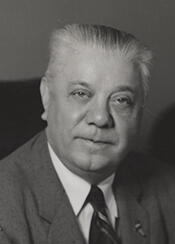
Here you will find contact information for Representative Roland Victor Libonati, including email address, phone number, and mailing address.
| Name | Roland Victor Libonati |
| Position | Representative |
| State | Illinois |
| District | 7 |
| Party | Democratic |
| Status | Former Representative |
| Term Start | January 3, 1957 |
| Term End | January 3, 1965 |
| Terms Served | 4 |
| Born | December 29, 1897 |
| Gender | Male |
| Bioguide ID | L000299 |
About Representative Roland Victor Libonati
Roland Victor Libonati (December 29, 1897 – May 30, 1991) was a Democratic member of the United States House of Representatives from Illinois, serving four terms in Congress from 1957 to 1965. His congressional career unfolded during a significant period in American history, encompassing the late Eisenhower years and the Kennedy and Johnson administrations, and intersecting with the legislative battles over civil rights and other major national issues. Over the course of his public life, he combined a long legal career in Chicago with decades of service in state and national politics.
Libonati was born in Chicago, Illinois, the son of Ernest and Flora (née Pellettieri) Libonati. Raised in the city he would later represent, he pursued his early education locally and earned an Associate of Arts degree from the Lewis Institute in 1918. During World War I, he served as a lieutenant in the United States Army, gaining early leadership experience in uniform. After the war, he returned to his studies, graduating from the University of Michigan in 1921. He then enrolled at Northwestern University Law School, where he earned a Juris Doctor degree in 1924, preparing for a professional life at the intersection of law and politics.
Admitted to the bar in 1924, Libonati commenced the practice of law in Chicago. He developed a substantial legal practice and became known for representing a wide range of clients, including, infamously, serving as a lawyer to organized crime figure Al Capone. At the same time, he demonstrated a commitment to social welfare and youth services by founding and owning the American Boys’ Camp for indigent children at Coloma, Wisconsin, which provided recreational and developmental opportunities for underprivileged boys. His legal and civic activities helped establish his prominence in Chicago’s public life. In 1942 he married Jeannette Van Hanxleden; the couple had one son, Michael.
Libonati’s formal political career began in the Illinois General Assembly. He served as a member of the Illinois House of Representatives from 1930 to 1934 and again from 1940 to 1942, representing Chicago-area constituencies during the challenging years of the Great Depression and the early stages of World War II. He then moved to the upper chamber of the state legislature, serving in the Illinois Senate from 1942 to 1947. Throughout these years he was closely aligned with the Democratic Party organization in Cook County, and he became a fixture in party affairs. Reflecting his long-standing role in state politics, he served as a delegate to every Illinois state Democratic convention from 1942 to 1987, spanning more than four decades of party leadership and internal deliberations.
Libonati entered national office when he was elected as a Democrat to the Eighty-fifth Congress to fill the vacancy caused by the death of Representative James B. Bowler. He took his seat on December 31, 1957, and was subsequently reelected to the Eighty-sixth, Eighty-seventh, and Eighty-eighth Congresses, serving continuously until January 3, 1965. As a member of the House of Representatives, he participated in the legislative process during a period marked by the Cold War, the early space race, and the intensifying struggle over civil rights. Representing an Illinois district anchored in Chicago, he worked within the framework of the city’s powerful Democratic machine led by Mayor Richard J. Daley, and he was generally regarded as a reliable ally of the Cook County Democratic Party organization.
Libonati’s role in the congressional consideration of civil rights legislation proved decisive for his political future. During the House Judiciary Committee’s markup of what became the Civil Rights Act of 1964, he was involved in negotiations with Chairman Emanuel Celler and the Kennedy administration. President John F. Kennedy and party leaders had sought to modify and weaken certain provisions of the bill to secure broader bipartisan support and improve its chances of overcoming a filibuster in the Senate. Although Libonati had been expected to support this strategy, he ultimately voted with liberal colleagues who favored maintaining stronger civil rights protections in the bill. According to Todd S. Purdum’s account in An Idea Whose Time Has Come, this defiance angered both national and local party leaders; Kennedy personally complained to Mayor Daley, and Libonati later confided to a colleague that he had received a call from the Daley machine informing him that his political career was effectively over. He was not a candidate for renomination to the Eighty-ninth Congress in 1964, bringing his congressional service to a close.
After leaving Congress, Libonati resumed the practice of law in Chicago, returning to the profession that had anchored his public life. He remained a resident of Chicago for the rest of his years, continuing to be associated with the city’s legal and political communities even after his formal retirement from elective office. Roland Victor Libonati died in Chicago on May 30, 1991. He was interred at Calvary Cemetery in Evanston, Illinois, closing a life that had spanned nearly the entire twentieth century and combined military service, legal practice, state legislative leadership, and four terms in the United States House of Representatives.