Senator Roman L. Hruska
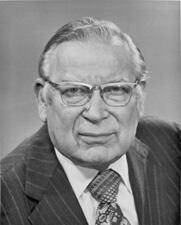
Here you will find contact information for Senator Roman L. Hruska, including email address, phone number, and mailing address.
| Name | Roman L. Hruska |
| Position | Senator |
| State | Nebraska |
| Party | Republican |
| Status | Former Representative |
| Term Start | January 3, 1953 |
| Term End | January 3, 1977 |
| Terms Served | 12 |
| Born | August 16, 1904 |
| Gender | Male |
| Bioguide ID | H000875 |
About Senator Roman L. Hruska
Roman Lee Hruska (August 16, 1904 – April 25, 1999) was an American attorney and politician who served as a Republican U.S. Senator from the state of Nebraska from 1953 to 1976. A member of the Republican Party, he was known as one of the most vocal conservatives in the Senate during the 1960s and 1970s and contributed to the legislative process during five terms in office. Over the course of his congressional career, he became an influential figure on key committees and was recognized as a skillful legislator despite serving his entire Senate tenure in a period when Congress was controlled by Democrats.
Hruska was born in David City, Nebraska, on August 16, 1904, one of eleven children of Czech immigrant parents. In 1917, his family moved to Omaha, Nebraska, where he attended local schools and graduated from high school. He pursued higher education at the University of Omaha (now the University of Nebraska–Omaha) and later attended the University of Chicago Law School. He completed his legal education at Creighton University School of Law in Omaha, graduating in 1929. After earning his law degree, he returned to Omaha to practice law, establishing himself in the legal profession before entering public life. In addition to his legal work, he later became co‑founder of the Douglas Theatre Company, based in Nebraska, reflecting his involvement in local business and civic affairs.
Hruska first entered politics in 1944, when he accepted a seat on the Douglas County, Nebraska, Board of Commissioners to fill a vacancy created by the resignation of a friend. He served as a regular member of the board from 1944 to 1945 and as its chair from 1945 to 1952. During this period, he also served on the advisory committee of the Nebraska Board of Control from 1947 to 1952, which oversaw state institutions. His leadership extended to professional associations of local officials: he was president of the Nebraska Association of County Officials from 1950 to 1951 and vice president of the National Association of County Officials from 1951 to 1952. These roles helped establish his reputation as an effective administrator and advocate for local government.
In 1952, Hruska was elected to the United States House of Representatives from Nebraska’s Omaha‑dominated Second Congressional District. His service in the House was brief; he served only part of one term because he became a candidate for the United States Senate following the death of Senator Hugh Butler. In 1954, he ran for the Senate seat vacated by Butler’s death and won the election, beginning a Senate career that would span more than two decades. He was reelected to the Senate in 1958, 1964, and 1970, defeating Democrat Frank B. Morrison in both the 1958 and 1970 contests. Roman Lee Hruska’s service in Congress occurred during a significant period in American history, encompassing the civil rights era, the Vietnam War, and the Watergate scandal. As a member of the Senate, he participated in the democratic process and represented the interests of his Nebraska constituents until his retirement in 1976, choosing not to run for reelection to a fourth full term.
During his Senate career, Hruska emerged as a leading conservative voice, particularly in the 1960s and 1970s. He became an influential member of the Senate Appropriations Committee and the Senate Judiciary Committee, eventually serving as the ranking minority member of the Judiciary Committee at the time of his retirement. Despite his conservative reputation, he supported several major civil rights measures. He voted in favor of the Civil Rights Acts of 1957, 1960, 1964, and 1968, the 24th Amendment to the U.S. Constitution abolishing the poll tax in federal elections, the Voting Rights Act of 1965, and the confirmation of Thurgood Marshall to the U.S. Supreme Court. He was widely regarded as having played a significant role in shaping changes to the federal criminal justice system during his years in the Senate.
Hruska also became nationally known for his strong support of President Richard Nixon. Even after Nixon resigned in 1974 in the wake of the Watergate scandal, Hruska continued to defend him and argued that Watergate had become a scandal largely as part of a partisan effort to attack the president. In 1970, he drew particular attention during the debate over Nixon’s nomination of G. Harrold Carswell to the U.S. Supreme Court. Responding to criticism that Carswell had been a mediocre judge, Hruska addressed the Senate and argued that even mediocre people deserved representation on the Court, remarking that “we can’t have all Brandeises, Frankfurters and Cardozos.” Democrats and other critics seized upon these remarks, and the Carswell nomination ultimately failed, but the episode became one of the most widely remembered moments of Hruska’s Senate career.
After leaving the Senate in 1976, Hruska returned to Omaha, where he lived for the remainder of his life. His long public service was recognized through several honors. On October 10, 1978, President Jimmy Carter signed into law a bill renaming the U.S. Meat Animal Research Center (USMARC) in Clay County, Nebraska, in his honor. The federal courthouse in downtown Omaha was named the Roman L. Hruska Federal Courthouse, and the Roman L. Hruska Law Center in Lincoln, Nebraska, which houses the Nebraska State Bar Association, also bears his name, reflecting his impact on both the legal profession and public life in the state.
In his later years, Hruska remained in Omaha. On April 10, 1999, he fell and broke his hip, and he died fifteen days later, on April 25, 1999, from complications during treatment. He was buried in Bohemian Cemetery in Omaha, Nebraska.