Representative Roman, Pucinski
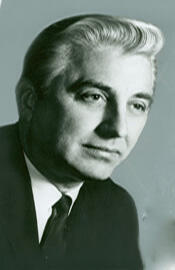
Here you will find contact information for Representative Roman, Pucinski, including email address, phone number, and mailing address.
| Name | Roman, Pucinski |
| Position | Representative |
| State | Illinois |
| District | 11 |
| Party | Democratic |
| Status | Former Representative |
| Term Start | January 7, 1959 |
| Term End | January 3, 1973 |
| Terms Served | 7 |
| Born | May 13, 1919 |
| Gender | Male |
| Bioguide ID | P000559 |
About Representative Roman, Pucinski
Roman Conrad Pucinski (May 13, 1919 – September 25, 2002) was an American Democratic politician from Chicago, Illinois, who served as a Representative from Illinois in the United States Congress from 1959 to 1973 and later as an alderman from the 41st Ward of Chicago from 1973 to 1991. A member of the Democratic Party, he was considered a longtime leader of Chicago Polonia and was widely regarded as a principal representative of Polish-American interests in Washington. Over seven terms in the House of Representatives, he contributed to the legislative process during a significant period in American history, participating actively in the democratic process and representing the interests of his constituents.
Pucinski was born in Buffalo, New York, on May 13, 1919, to a Polish-American family and moved with his parents to Chicago when he was a child. Growing up in the city that would define his public career, he became closely connected to its large Polish community on the Northwest Side. He attended local schools and went on to Northwestern University, from which he graduated in 1941. His early life in Chicago’s ethnic neighborhoods and his higher education at a major Midwestern university helped shape his later focus on ethnic issues, education, and urban policy.
During World War II, Pucinski served in the United States Army Air Forces, contributing to the nation’s war effort at a time when many second-generation immigrants were demonstrating their loyalty and patriotism. After the war, he returned to Chicago and pursued legal studies at John Marshall Law School. He graduated from John Marshall in 1949, adding formal legal training to his background in public affairs and preparing himself for a career that would span journalism, congressional service, and municipal government.
Before entering elective office, Pucinski worked for many years in journalism, most notably at the Chicago Sun-Times. His reporting and editorial work kept him closely engaged with civic issues and the concerns of Chicago’s working- and middle-class communities. In 1952, he came to national attention as chief investigator for the Congressional Special Committee that investigated the Katyn Massacre, the World War II execution of Polish officers by Soviet forces. This assignment was of particular personal and political importance to him as a Polish-American, and it reinforced his reputation as an advocate for Polish and Eastern European causes during the early Cold War.
In 1958, Pucinski was elected to the U.S. House of Representatives from Illinois’s heavily Polish-American 11th Congressional District on the Northwest Side of Chicago. He was re-elected to six additional terms, serving continuously from January 3, 1959, to January 3, 1973. As a representative, he pushed for the installation of “black box” flight recorders on all passenger airliners, an initiative that contributed to improved aviation safety standards. He also supported federal assistance to community colleges, reflecting his broader interest in expanding educational opportunities and strengthening local institutions. His congressional service coincided with major national developments, including the civil rights movement, the Great Society programs, and the Vietnam War era, during which he consistently sought to represent the interests of his urban, largely ethnic constituency.
Following the 1970 Census, congressional redistricting altered the political landscape in Illinois. Although his district remained solidly Democratic, Pucinski was selected as the Democratic nominee for the United States Senate in 1972, challenging incumbent Republican Senator Charles H. Percy. Running statewide proved far more difficult than campaigning in his home district, and he lost the Senate race in a landslide. His defeat ended his service in Congress in 1973 but did not conclude his public career or his influence in Chicago politics.
In 1973, Pucinski was first elected alderman from Chicago’s 41st Ward, an area that had been part of his old congressional district and was heavily Polish-American. He also served for many years as the Democratic Ward Committeeman for the 41st Ward, consolidating his role as a key figure in the local Democratic organization. After Mayor Richard J. Daley’s death in 1976, Pucinski entered the Democratic primary in the 1977 special election to succeed him, running against the party’s endorsed candidate, Michael Bilandic. Bilandic won the nomination; Pucinski finished second, and Harold Washington, who would later become mayor, placed third with 11 percent of the vote. During Harold Washington’s first term as mayor in the 1980s, Pucinski joined the “Vrdolyak 29,” the bloc of aldermen who opposed many of Washington’s initiatives during the period known as the Council Wars.
As an alderman, Pucinski remained active on issues of local governance, economic policy, and neighborhood services. In 1984, he supported a redistribution of Community Development Block Grant funds that would have allocated $1.3 million to repave streets in the 41st Ward, underscoring his emphasis on infrastructure and constituent services. In 1987, he proposed requiring employee voting on any Employee Stock Ownership Plan established by a corporation based in Chicago, reflecting his interest in worker participation and corporate governance. Although the 41st Ward usually voted for Republicans in national and statewide elections, Pucinski held his aldermanic seat for nearly two decades before being defeated in his 1991 re-election campaign by Republican Brian Doherty, marking the end of his long tenure in elective office.
Pucinski was a practicing Catholic, and his faith, ethnic heritage, and family ties were central to his public identity. His daughter, Aurelia Pucinski, followed him into law and politics, serving in various judicial and county offices. She left the Democratic Party for the Republican Party in 1997 but returned to the Democrats seven years later, continuing the family’s long engagement in Chicago and Illinois public life. Roman Conrad Pucinski died in Chicago on September 25, 2002. His son Christopher died in 2006, closing a chapter on a family that had been deeply involved in the civic and political affairs of Chicago’s Polish-American community for much of the twentieth century.