Representative Romualdo Pacheco
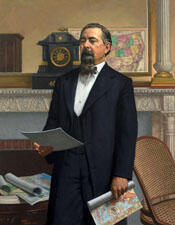
Here you will find contact information for Representative Romualdo Pacheco, including email address, phone number, and mailing address.
| Name | Romualdo Pacheco |
| Position | Representative |
| State | California |
| District | 4 |
| Party | Republican |
| Status | Former Representative |
| Term Start | October 15, 1877 |
| Term End | March 3, 1883 |
| Terms Served | 3 |
| Born | October 31, 1831 |
| Gender | Male |
| Bioguide ID | P000003 |
About Representative Romualdo Pacheco
José Antonio Romualdo Pacheco (October 31, 1831 – January 23, 1899) was a Californio statesman, legislator, and diplomat who became the first Hispanic and first Latino governor of California after the American conquest, and the first Latino to represent a state in the United States Congress. A Republican for most of his long public career, he held a succession of local, state, federal, and diplomatic posts over more than three decades, including service as a California State Senator, California State Treasurer, Lieutenant Governor, Governor of California, and three terms as a Representative from California in the U.S. House of Representatives from 1877 to 1883. He was the first Governor of California to have been born within the territory that would become the state, although his birth preceded statehood, and earlier governors had been settlers born elsewhere.
Pacheco was born in Santa Barbara, Alta California, into a prominent Californio family with extensive political and social connections. His father, José Antonio Romualdo Pacheco, had migrated from Guanajuato, Mexico, to Alta California in 1825 and served as an aide to Governor José María de Echeandía. When the younger Romualdo was only about five weeks old, his father was killed at the Battle of Cahuenga Pass in 1831 after shooting José María Avila, who had attacked Governor Manuel Victoria with a lance; Avila’s lance fatally wounded Pacheco’s father. His mother, María Ramona Carrillo de Pacheco, was the daughter of María Ygnacia López de Carrillo, grantee of Rancho Cabeza de Santa Rosa, and a sister-in-law of General Mariano Guadalupe Vallejo, further anchoring the family in the upper ranks of Californio society. After her first husband’s death, she married Captain John D. Wilson, a Scotsman, who played a decisive role in Romualdo’s upbringing.
Under Wilson’s direction, Pacheco was sent to Honolulu, Hawaii, for part of his education, an unusual path that exposed him early to maritime commerce and international environments. At the age of twelve he began an apprenticeship aboard a trading vessel, working in Pacific coastal trade. During one voyage in July 1846, as the Mexican–American War and the U.S. conquest of California unfolded, he was briefly detained by American forces when his ship entered Yerba Buena (now San Francisco). The vessel was searched, and he was required to swear an oath of allegiance to the United States before being released. This early encounter with the transition from Mexican to American rule foreshadowed his later role as a political figure navigating two eras and cultures in California.
Pacheco’s association with a well-known Californio family and his ability to work effectively with incoming Anglo settlers aided his entry into politics in the early 1850s. Initially a Democrat, he later aligned with the National Union Party during the Civil War era and ultimately became a Republican, the party under which he would win most of his offices. In 1853, at age twenty-two, he successfully sought the position of county judge in San Luis Obispo County, marking his first significant public office. In 1857 he was elected to the California State Senate, succeeding his cousin Pablo de la Guerra; at twenty-seven, he was the youngest member of the legislature. He was re-elected twice and served in the State Senate until 1863. During the American Civil War, Governor Leland Stanford appointed him a brigadier general of state militia, directing him to disarm military companies in the Los Angeles area that were suspected of disloyalty to the Union, underscoring his importance as a Unionist Californio leader.
From 1863 to 1867, Pacheco served as California State Treasurer, overseeing the state’s finances during a period of wartime and postwar adjustment. After completing his term as treasurer, he returned to the State Senate, continuing his legislative work until his election as Lieutenant Governor in 1871. He served as Lieutenant Governor under Governor Newton Booth. When Booth was elected to the United States Senate in 1873 and took his Senate seat in 1875, Pacheco succeeded him and served as Governor of California from February 27 to December 9, 1875. He was thus the first governor born within California’s eventual state boundaries. Having been denied the Republican nomination for governor in the 1875 election, he instead ran for lieutenant governor on the People’s Independent ticket alongside gubernatorial candidate John Bidwell. William Irwin, a Democrat, won the governorship in the September 1875 election, and Pacheco’s brief gubernatorial tenure ended when Irwin was inaugurated on December 9, 1875.
After leaving the governor’s office, Pacheco sought federal office. In 1876 he ran for a seat in the U.S. House of Representatives and narrowly defeated incumbent Democrat Peter D. Wigginton by a single vote. California Secretary of State Thomas Beck initially refused to certify the election after it was revealed that two votes cast for Wigginton in Monterey County had not been counted. Pacheco contested the refusal, and the case reached the Supreme Court of California, which found that a tally clerk had removed two votes after the state Board of Elections had adjourned, but that this was done to correct a clerical error in the totals, thereby upholding Pacheco’s victory. Despite efforts in the Democrat-controlled U.S. House to block him from taking his seat while Wigginton’s contest was pending, Pacheco was sworn in on October 17, 1877, and commenced his service as a Representative from California. On January 31, 1878, however, the House Committee on Elections concluded that, although the state court’s ruling on the Monterey votes was valid, numerous ballots for both candidates elsewhere had been improperly cast or marked, and that precinct judges had authority under state law to discard such ballots. After discounting these votes, the committee determined that Wigginton had prevailed by a margin of four votes. The full House, in a partisan vote of 136 to 125, adopted the committee’s recommendation and unseated Pacheco on February 7, 1878.
Undeterred, Pacheco ran again for Congress in 1878 and won with approximately 40 percent of the vote, outpolling Democrat Wallace Leach and independent candidate James Ayers. His success was attributed in part to his ability to appeal to what contemporary observers called “the Spanish vote,” as he campaigned in both English and Spanish and maintained strong support among Californio and other Spanish-speaking voters. He was re-elected in 1880 with about 46 percent of the vote, narrowly defeating Leach by 191 votes. In total, Romualdo Pacheco served three terms in the U.S. House of Representatives between 1877 and 1883, representing California during a significant period in American political and economic development. During his first term he served on three standing committees—Public Lands, Private Land Claims, and Public Expenditures—and he generally preferred the detailed work of these smaller committees to speaking on the House floor. His legislative efforts focused on improving harbors and railroads in his district, though many of his initiatives were blocked while Democrats controlled the House. When Republicans later gained the majority, his expertise in land issues led to his appointment as chairman of the Committee on Private Land Claims.
Although often reticent on national controversies, Pacheco broke his customary silence on broader issues in 1882 when he spoke in favor of the Chinese Exclusion Act. Reflecting the prevailing anti-Chinese sentiment in much of California at the time, he argued that Chinese immigrants working in mines and on railroads were displacing white American laborers and degrading the morality of California cities. He joined sixty Republicans and all of the California delegation in voting for the measure, which became law and marked a major turning point in federal immigration policy. His congressional service, as the first Latino member of Congress with full voting rights from any state, also established a lasting milestone: while Latinos had previously served as non-voting territorial delegates, Pacheco was the first Latino to hold a full voting seat in the U.S. House of Representatives. He remained the last Hispanic Republican elected to represent California in Congress until Mike Garcia won a special election in the 25th District in May 2020, although Frank Coombs, whose mother was Mexican, served one term as a Republican U.S. Representative from California from 1901 to 1903, and Mexican-American Representative Matthew G. Martínez, originally elected as a Democrat, switched to the Republican Party on July 27, 2000 and served out his term as a Republican until January 3, 2001. Pacheco was also the last Latino governor anywhere in the United States until Bill Richardson served as governor of New Mexico from 2002 to 2011.
After leaving Congress in 1883, Pacheco withdrew from elective politics and turned to private life and diplomacy. He lived for about five years on a cattle ranch in the northern Mexican state of Coahuila, maintaining his ties to both sides of the U.S.–Mexico border. In 1890 he returned to public service when he was appointed United States Minister to several Central American republics, reflecting his experience, bilingual abilities, and long-standing engagement with international and Hispanic affairs. He served in these diplomatic posts until 1893, when he returned to California. In his later years he remained a respected figure in Californio and Republican circles, emblematic of the transition from Mexican to American governance in the state.
On October 31, 1863, Pacheco had married Mary McIntire, a twenty-two-year-old playwright, and the couple had two children, Maybella Ramona and Romualdo. His family life and marriage into an Anglo-American family further illustrated his position at the intersection of Californio and American cultures. Pacheco died in Oakland, California, on January 23, 1899, at the home of his brother-in-law. He was buried in Mountain View Cemetery in Oakland. His career as the first Hispanic governor of California and the first Latino to represent a state in the U.S. Congress, combined with his service as state treasurer, state senator, lieutenant governor, and diplomat, secured his place as one of the most significant Latino political figures in nineteenth-century American history.