Representative Ron Klein
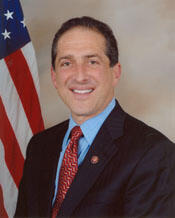
Here you will find contact information for Representative Ron Klein, including email address, phone number, and mailing address.
| Name | Ron Klein |
| Position | Representative |
| State | Florida |
| District | 22 |
| Party | Democratic |
| Status | Former Representative |
| Term Start | January 4, 2007 |
| Term End | January 3, 2011 |
| Terms Served | 2 |
| Born | July 10, 1957 |
| Gender | Male |
| Bioguide ID | K000366 |
About Representative Ron Klein
Ronald Jason Klein (pronounced KLYNE; born July 10, 1957) is an American politician and lawyer who served as a Democratic Representative from Florida in the United States Congress from 2007 to 2011. A former member of the United States House of Representatives for Florida’s 22nd congressional district, he previously served in both the Florida House of Representatives and the Florida Senate and later became chair of the Jewish Democratic Council of America. Following his congressional service, he entered private legal practice and is employed by the law firm Holland & Knight.
Klein was born in Cleveland, Ohio, and grew up in the Cleveland area. He graduated from Cleveland Heights High School in 1975. He attended Ohio State University, where he earned a Bachelor of Arts degree in political science in 1979. While at Ohio State, he became a member of the Alpha Epsilon Pi fraternity and gained early exposure to government and public policy by interning at the Ohio General Assembly. Klein went on to study law at Case Western Reserve University School of Law in Cleveland, receiving his J.D. degree in 1982. That same year, he married Dori Dragin, and in 1985 the couple moved to Boca Raton, Florida, where they raised their two children.
Before entering elective office, Klein practiced as a corporate lawyer, developing experience that would later inform his work on economic and regulatory issues. His formal political career began in Florida state government. In 1992, he challenged and defeated ten-year incumbent Steve Press in the Democratic primary, winning a seat in the Florida House of Representatives. Klein served in the Florida House through the 1990s, building a reputation as an active legislator. In 1996, he was elected to the Florida Senate. There he rose in the Democratic leadership, serving as minority whip in 1998 and later as minority leader from 2002 to 2004, playing a central role in shaping his party’s strategy and legislative agenda in the state legislature.
Klein sought federal office in the mid-2000s, running for the U.S. House of Representatives in Florida’s 22nd congressional district against 13-term Republican incumbent E. Clay Shaw Jr. Although Shaw had won re-election easily in 2004—his opponent dropped out before the election—Democratic presidential nominee John Kerry carried the district that year by a margin of 50 to 48 percent over President George W. Bush, signaling shifting political currents. On Election Day in 2006, amid voter discontent over the war in Iraq and fallout from the scandal involving Republican Congressman Mark Foley in a neighboring district, Klein defeated Shaw by a margin of 51 to 48 percent. He assumed office when the 110th Congress convened on January 4, 2007, beginning the first of his two terms in the House of Representatives.
During his congressional service from 2007 to 2011, Klein represented a South Florida district that included parts of Broward and Palm Beach Counties and participated actively in the legislative process during a period of major national and international challenges. He served on the House Committee on Financial Services, including the Subcommittee on Capital Markets, Insurance and Government Sponsored Enterprises and the Subcommittee on Financial Institutions and Consumer Credit, positions that placed him at the center of congressional responses to the financial crisis. He also served on the House Committee on Foreign Affairs, where he sat on the Subcommittee on Terrorism, Nonproliferation and Trade, the Subcommittee on the Middle East and South Asia, and the Subcommittee on the Western Hemisphere, engaging in oversight and policy related to international security, trade, and regional affairs.
Klein’s voting record reflected alignment with the major legislative initiatives of the Democratic majority during the 110th and 111th Congresses. On September 29, 2008, he voted for the Emergency Economic Stabilization Act of 2008, which created the Troubled Asset Relief Program in response to the financial crisis. During the 111th Congress, he supported the American Recovery and Reinvestment Act of 2009, aimed at economic stimulus following the Great Recession, and the American Clean Energy and Security Act of 2009, a comprehensive energy and climate bill. He voted for both major health care reform measures: the Affordable Health Care for America Act, the House bill, and the Patient Protection and Affordable Care Act, the Senate bill, as well as the accompanying reconciliation bill. He also voted for the Dodd–Frank Wall Street Reform and Consumer Protection Act. Klein voted with a majority of his Democratic colleagues 97.9 percent of the time during the 111th Congress. The nonpartisan National Journal rated his voting record as 58.3 percent liberal and 41.7 percent conservative. On December 18, 2007, Politico named him its “Rookie of the Year,” citing his willingness to cross party lines and his ability to help secure passage of significant legislation.
Klein stood for re-election in 2008 and 2010. In the 2008 election, he faced Republican nominee Allen West and won with 54.7 percent of the vote, securing a second term. In the 2010 midterm elections, amid a national shift toward Republican candidates, he faced West again in a rematch. That year, Klein lost his bid for a third term, and West succeeded him as the representative for Florida’s 22nd congressional district, concluding Klein’s service in the U.S. House at the end of the 111th Congress in January 2011.
After leaving Congress, Klein returned to the private sector and was hired by the law firm Holland & Knight. Drawing on his background as a corporate lawyer and as a former state and federal lawmaker, he focused on providing legal, political, policy, and business advice to clients. Reflecting on his transition, he noted that having served in one of the busiest congresses in decades—particularly on the Financial Services Committee and in passing major health care and financial regulatory legislation—placed him in a unique position to help businesses understand and adapt to new laws and regulations. He observed that the wave of new rulemaking created substantial work and opportunity for businesses seeking strategic advantages, planning for the future, and helping shape legislation as it developed. In addition to his legal practice, Klein has remained active in Democratic politics and Jewish communal affairs, serving as chair of the Jewish Democratic Council of America, a role that underscores his continued engagement in national political discourse and public policy.