Representative Ron Klink
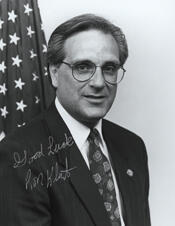
Here you will find contact information for Representative Ron Klink, including email address, phone number, and mailing address.
| Name | Ron Klink |
| Position | Representative |
| State | Pennsylvania |
| District | 4 |
| Party | Democratic |
| Status | Former Representative |
| Term Start | January 5, 1993 |
| Term End | January 3, 2001 |
| Terms Served | 4 |
| Born | September 23, 1951 |
| Gender | Male |
| Bioguide ID | K000270 |
About Representative Ron Klink
Ronald Paul Klink (born September 23, 1951) is an American television broadcaster and politician who served four terms as a United States Representative from Pennsylvania from 1993 to 2001 as a member of the Democratic Party. He was born in Canton, Ohio, and moved to Pennsylvania as a youth, graduating from Meyersdale High School in Meyersdale, Pennsylvania, in 1969. On August 27, 1977, he married Linda Loree Hogan in Greensburg, Pennsylvania, establishing long-standing personal and professional ties to western Pennsylvania that would later shape his political career.
Following high school, Klink entered the broadcasting field, beginning his career behind the scenes at WTAJ-TV in Altoona, Pennsylvania, from 1976 to 1977. He soon advanced to an on-air role at the station, serving as a weatherman and fill-in sports anchor. In July 1978 he left Altoona for Pittsburgh, where he joined KDKA-TV. From 1978 to 1991, Klink became a recognizable figure in the Pittsburgh media market as a television news weatherman and reporter. His visibility and name recognition in western Pennsylvania, combined with his communication skills developed in broadcasting, laid the groundwork for his entry into electoral politics.
In 1992, Klink sought the Democratic nomination for Pennsylvania’s 4th Congressional District. Running as a moderate Democrat with strong labor ties, he challenged and defeated five-term incumbent Democrat Joe Kolter in the primary election, a significant intra-party upset. In the general election that November, he was easily elected to the U.S. House of Representatives. Klink’s popularity in his district was reflected in his subsequent reelection campaigns; during his four terms in Congress he never won less than 64 percent of the vote. In the 1994 general election, write-in candidates received 6 votes; in 1996, write-ins received 98 votes; and in 1998, write-ins received 17 votes, underscoring the strength of his electoral position.
Klink served in the United States Congress from January 3, 1993, to January 3, 2001, representing Pennsylvania as a Democrat during a period of significant political and economic change in the United States. As a member of the House of Representatives, he participated in the legislative process and represented the interests of his constituents in the 4th District, bringing to his work the perspective of a broadcaster familiar with public communication and regional issues. Throughout his four terms in office, he contributed to the democratic process in Washington while maintaining his reputation at home as a labor-oriented, moderate Democrat.
In 2000, Klink chose not to seek reelection to his House seat and instead ran for the United States Senate from Pennsylvania. He secured the Democratic nomination in a crowded primary but faced substantial challenges in the general election against incumbent Republican Senator Rick Santorum. Klink was virtually unknown on the eastern side of Pennsylvania, including the populous and politically crucial Philadelphia area, and he had expended considerable campaign resources in the primary. His relatively conservative positions on certain social issues also complicated his appeal in a statewide race. In the November 2000 election, Klink lost to Santorum by approximately five percentage points.
After leaving Congress in January 2001, Klink returned to private life but remained occasionally mentioned in political circles. He was discussed as a potential candidate to reclaim his former congressional seat from Republican Melissa Hart, who had succeeded him in representing the 4th District. However, in December 2005, Klink announced that he would not run for the seat. His name also surfaced in connection with national security issues: according to then-Congressman Curt Weldon in his book “Countdown to Terror,” in 2003 Klink offered Weldon the identity of an intelligence source said to possess information on Iraqi uranium purchases. The source was believed to be Iranian arms dealer Manucher Ghorbanifar, and the intelligence reportedly later proved to be fabricated.
Klink’s career thus spans local broadcasting and national legislative service, with his tenure in Congress from 1993 to 2001 marking his most prominent role in public life. As a representative from Pennsylvania and a member of the Democratic Party, he served during four consecutive terms, participating in the work of the House of Representatives and representing the interests of his western Pennsylvania constituents during a consequential era in American politics.