Representative Ron Packard
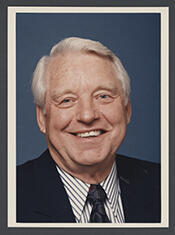
Here you will find contact information for Representative Ron Packard, including email address, phone number, and mailing address.
| Name | Ron Packard |
| Position | Representative |
| State | California |
| District | 48 |
| Party | Republican |
| Status | Former Representative |
| Term Start | January 3, 1983 |
| Term End | January 3, 2001 |
| Terms Served | 9 |
| Born | January 19, 1931 |
| Gender | Male |
| Bioguide ID | P000005 |
About Representative Ron Packard
Ronald C. Packard (born January 19, 1931) is an American retired Republican politician from California who served as a Representative from California in the United States Congress from 1983 to 2001. Over the course of nine terms in office, he was a member of the Republican Party and contributed to the legislative process during a significant period in American history, participating in the democratic process and representing the interests of his constituents in a heavily Republican district north of San Diego.
Packard was born and raised in Meridian, Idaho, where he attended Meridian High School. He pursued higher education at Brigham Young University and Portland State University before entering the University of Oregon Dental School (now the Oregon Health & Science University School of Dentistry). He received his Doctor of Dental Medicine (D.M.D.) degree in 1957. Following his graduation, Packard served in the United States Navy Dental Corps from 1957 to 1959, providing dental care to service members. After leaving the Navy, he established himself in private practice as a dentist, a profession he continued as he began to enter public life.
Packard’s political career began at the local level in California. After relocating to Carlsbad, he first entered politics as a trustee of the Carlsbad Unified School District, serving from 1962 to 1974. In this role he gained experience in public administration and education policy. He was elected to the Carlsbad City Council in 1976, and two years later, in 1978, he was elected Mayor of Carlsbad. As mayor, Packard became active in community and regional affairs, serving on the transportation policy committee of the League of California Cities, as a director of the North County Transit District, and as president of the Council of Mayors for San Diego County. These positions expanded his influence in regional transportation and municipal issues and helped establish his reputation as a public official.
Packard’s entry into national politics came in 1982, when he sought election to the U.S. House of Representatives for the seat being vacated by Representative Clair Burgener. In a crowded Republican primary field of eighteen candidates, he narrowly lost the nomination to political novice Johnnie R. Crean by 92 votes out of more than 83,000 cast. Crean’s campaign, heavily financed by family wealth, relied on saturation advertising and negative attacks on fellow Republicans, and was marred by a false claim of endorsement by President Ronald Reagan. In response, Packard launched an independent write-in campaign for the general election. After internal polling showed voters were willing to support him if they understood how to cast a write-in ballot, he ran an unconventional campaign using a gigantic pencil as a prop and distributing golf pencils to district residents to emphasize the write-in process. An organized effort among fellow members of his Latter-day Saint community also bolstered his candidacy.
In the November 1982 general election, Packard won as a write-in candidate with 37 percent of the vote, defeating both the Democratic nominee Roy “Pat” Archer, who received 32 percent, and Crean, who received 31 percent. He became the first independent write-in candidate to defeat both Democratic and Republican nominees for a seat in Congress and only the third person ever elected to Congress as a write-in candidate, following Senator Strom Thurmond of South Carolina in 1954 and Representative Joe Skeen of New Mexico in 1980. His unusual victory, later documented in Campaigns and Elections and attributed in part to the efforts of campaign strategist Russell Reed Benedict, drew national attention as an example of a successful insurgent candidacy. Upon being sworn in, Packard joined the Republican caucus in the House of Representatives.
Packard’s congressional service extended from January 3, 1983, to January 3, 2001, encompassing nine consecutive terms. Once in Congress, he was reelected as a Republican eight times with little opposition in his strongly Republican district. During his tenure, he served on the influential House Appropriations Committee, where he played a role in shaping federal spending priorities. He became known as a fiscal conservative and deficit hawk, a critic of legislative “pork,” and an opponent of illegal immigration. His years in Congress coincided with major national developments, including the final decade of the Cold War, the end of the Reagan era, the administrations of George H. W. Bush and Bill Clinton, and the budget battles of the 1990s, during which he consistently advocated for restrained federal spending and conservative budget policies. Packard retired from the House at the end of his term in 2001 in order to spend more time with his family and was succeeded by Republican Darrell Issa.
In recognition of his service, several public honors were bestowed upon Packard after his retirement. In 2002, a United States Post Office building in Oceanside, California, was named in his honor. Additionally, the westernmost 16.6 miles of California State Route 78, between Interstate 5 in Oceanside and Interstate 15 in Escondido, were designated the Ronald Packard Parkway, reflecting his long-standing involvement in regional transportation and infrastructure issues dating back to his mayoral and regional service.
In later life, Packard and his wife, Jean, settled in Utah. The couple had seven children. Even in retirement from elective office, Packard remained engaged in public affairs, working part-time as a lobbyist in Washington, D.C., drawing on his many years of experience in Congress and on the Appropriations Committee.