Senator Roscoe Conkling Patterson
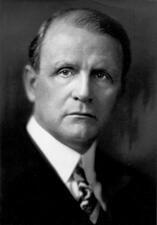
Here you will find contact information for Senator Roscoe Conkling Patterson, including email address, phone number, and mailing address.
| Name | Roscoe Conkling Patterson |
| Position | Senator |
| State | Missouri |
| Party | Republican |
| Status | Former Representative |
| Term Start | April 11, 1921 |
| Term End | January 3, 1935 |
| Terms Served | 2 |
| Born | September 15, 1876 |
| Gender | Male |
| Bioguide ID | P000127 |
About Senator Roscoe Conkling Patterson
Roscoe Conkling Patterson (September 15, 1876 – October 22, 1954) was an American lawyer and Republican politician from Missouri, most notable for his service as a United States representative from 1921 to 1923 and as a United States senator from 1929 to 1935. Over the course of his career, he held a series of local, state, and federal positions and played a prominent role in national legislation during a transformative period in American history.
Patterson was born in Springfield, Greene County, Missouri, on September 15, 1876. He was educated in the public and private schools of Springfield and pursued higher education at Drury College in Springfield and the University of Missouri in Columbia. He subsequently studied law at Washington University School of Law in St. Louis, from which he graduated in 1897. Later that year he was admitted to the bar and returned to Springfield, where he commenced the practice of law.
Early in his career, Patterson became active in local public service. From 1903 to 1907 he served as prosecuting attorney of Greene County, Missouri, gaining experience in criminal law and local administration. His involvement in Republican politics deepened over the following decade. In 1912 he was appointed to the Missouri Republican State Committee, on which he served until 1920, helping to shape party strategy and organization in the state during the Progressive Era and World War I.
Patterson entered national office when he was elected as a Republican to the United States House of Representatives in 1920. He represented Missouri in the 67th Congress from March 4, 1921, to March 3, 1923. His service in the House coincided with the early 1920s postwar period, during which he participated in the legislative process and represented the interests of his Missouri constituents. He was an unsuccessful candidate for reelection in 1922 and returned to Springfield to resume the practice of law. Remaining active in party affairs, he served as a presidential elector in 1924.
In 1925 Patterson moved to Kansas City, Missouri, where he continued his legal and public career at the federal level. That year he was appointed United States district attorney for the Western District of Missouri, a position he held from 1925 to 1929. He resigned in February 1929 in anticipation of taking a seat in the United States Senate to which he had been elected in November 1928. A member of the Republican Party, he won the general election in 1928 and entered the Senate at the outset of the Herbert Hoover administration.
Patterson’s service in the United States Senate occurred during a significant period in American history marked by the onset of the Great Depression and intense debate over federal economic policy. He served one term, from March 4, 1929, to January 3, 1935. During his tenure he participated fully in the democratic process, contributing to the legislative work of the Senate and representing Missouri’s interests. He was chairman of the Senate Committee on Mines and Mining in the 72nd Congress, reflecting the importance of mineral and energy issues in the national economy. His chief legislative accomplishment was sponsorship of the so‑called Lindbergh Law, which authorized federal authorities to investigate kidnappings when victims were transported across state lines, significantly expanding federal jurisdiction in such cases. Serving during the Great Depression, Patterson aligned with his party in consistently opposing the New Deal remedies advanced by President Franklin D. Roosevelt. As the economic crisis deepened and Republican economic policies were widely blamed, his opposition to the New Deal became increasingly unpopular in Missouri. In the 1934 election he was an unsuccessful candidate for reelection, losing the general election to Democratic nominee Harry S. Truman.
After leaving the Senate in January 1935, Patterson returned to Springfield and resumed the practice of law. He remained engaged in public affairs and the legal profession in Missouri. For several years he served as a member of the Missouri Appellate Judicial Commission, participating in the process of screening and recommending candidates for the state’s appellate courts, thereby influencing the composition of the judiciary in Missouri.
In his personal life, Patterson married Ada Holman of Springfield (1877–1957). The couple had two children: Paul Patterson (1902–1924) and Hadley Patterson (1908–1958). The family maintained close ties to Springfield throughout Patterson’s career, even during his periods of residence in Kansas City and Washington, D.C.
Patterson suffered a stroke in July 1954, after which his health declined steadily. He died in Springfield on October 22, 1954. He was interred at Maple Park Cemetery in Springfield, Missouri. His career, spanning local prosecution, party leadership, service as a United States representative, United States district attorney, and United States senator, reflected the trajectory of a Missouri lawyer who rose to national prominence during a period of profound political and economic change.