Representative Ross Rizley
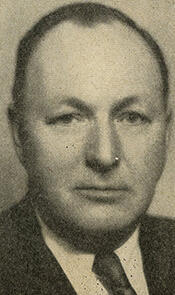
Here you will find contact information for Representative Ross Rizley, including email address, phone number, and mailing address.
| Name | Ross Rizley |
| Position | Representative |
| State | Oklahoma |
| District | 8 |
| Party | Republican |
| Status | Former Representative |
| Term Start | January 3, 1941 |
| Term End | January 3, 1949 |
| Terms Served | 4 |
| Born | July 5, 1892 |
| Gender | Male |
| Bioguide ID | R000288 |
About Representative Ross Rizley
Ross Rizley (born Roscoe Rizley) (July 5, 1892 – March 4, 1969) was an American politician, a Republican United States Representative from Oklahoma, and a United States district judge of the United States District Court for the Western District of Oklahoma. Over the course of a long public career, he served in local, state, and federal offices, including four terms in the United States House of Representatives from 1941 to 1949 and a federal judgeship to which he was appointed in 1956.
Rizley was born on a farm near the town of Beaver in Beaver County of the Oklahoma Territory, the son of Anabella Narcissus (McCown) and Robert Martin Rizley. He attended the public schools and, as a young man, taught in the rural schools of Beaver County in 1909 and 1910, gaining early experience in public service and community life. In 1911 and 1912 he served as a deputy register of deeds in Beaver County, further acquainting himself with local government and legal processes. On June 7, 1916, he married Ruby Seal; the couple had seven children, one of whom, Hortense, later became the actress Claudia Bryar.
Pursuing formal legal training, Rizley received a Bachelor of Laws from the Kansas City School of Law (now the University of Missouri–Kansas City School of Law) in 1915. That same year he was admitted to the bar in Oklahoma and commenced the private practice of law in Beaver, where he practiced from 1915 to 1920. While maintaining his practice, he served as county attorney of Beaver County from 1918 to 1920, prosecuting cases and representing the county in legal matters. In 1920 he moved to Guymon, Oklahoma, where he continued in private practice for more than three decades, from 1920 to 1956, becoming a prominent attorney in the Oklahoma Panhandle.
Rizley’s early political and civic career developed alongside his legal work in Guymon. He was a member of the Guymon Board of Education from 1924 to 1932, reflecting his continued interest in public education. From 1928 to 1938 he served as city attorney of Guymon, advising the municipal government on legal affairs. At the state level, he was elected to the Oklahoma Senate, serving from 1931 to 1934. A committed Republican in a predominantly Democratic state, he was a delegate to the Republican National Conventions in 1932 and 1936 and sought higher office as a candidate for Governor of Oklahoma in the 1938 election.
Rizley was elected as a Republican to the United States House of Representatives in the 1940 election, taking his seat in the 77th Congress on January 3, 1941. He was subsequently reelected to the three succeeding Congresses, serving continuously from January 3, 1941, to January 3, 1949. His four terms in office coincided with a significant period in American history, encompassing World War II and the immediate postwar years. As a member of the House of Representatives, he participated in the legislative process, represented the interests of his Oklahoma constituents, and contributed to national policymaking during a time of global conflict and domestic transition. During the 80th Congress he served as Chairman of the Special Committee on Campaign Expenditures, reflecting his colleagues’ confidence in his judgment on matters of electoral integrity and political finance.
In 1948 Rizley chose not to be a candidate for renomination to the House of Representatives. Instead, he sought election to the United States Senate but was unsuccessful. He remained active in national Republican politics, serving as a delegate to the 1948 Republican National Convention and later playing a prominent role at the 1952 Republican National Convention, where he was elected chairman of the credentials committee, defeating Minnesota delegate Warren E. Burger, who would later become Chief Justice of the United States. In the early 1950s he also held important executive branch positions. In 1953 he served as solicitor for the United States Post Office Department (now the United States Postal Service), and from 1953 to 1954 he was an Assistant United States Secretary of Agriculture. He subsequently served as Chairman of the Civil Aeronautics Board from 1955 to 1956, overseeing aspects of federal regulation of commercial aviation.
Rizley’s judicial career began when President Dwight D. Eisenhower nominated him on February 10, 1956, to a seat on the United States District Court for the Western District of Oklahoma, vacated by Judge Edgar Sullins Vaught. The United States Senate confirmed his nomination on March 1, 1956, and he received his commission on April 13, 1956. As a federal district judge, he presided over a broad range of civil and criminal matters arising in the Western District of Oklahoma. On March 26, 1965, President Lyndon B. Johnson certified Rizley involuntarily as disabled in accordance with the act of September 2, 1957 (71 Stat. 586), a statute that authorized the President to appoint an additional judge for the court while providing that no successor to the judge certified as disabled would be appointed. Luther Boyd Eubanks was appointed to the additional judgeship, and Rizley continued to render a reduced level of service to the court.
Ross Rizley’s service on the federal bench ended with his death on March 4, 1969, in Oklahoma City, Oklahoma. His judicial service was formally terminated on that date. He was interred in Elmhurst Cemetery in Guymon, reflecting his long association with the community where he had practiced law and held local office for many years.