Representative Roy Walter Riehlman
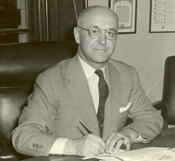
Here you will find contact information for Representative Roy Walter Riehlman, including email address, phone number, and mailing address.
| Name | Roy Walter Riehlman |
| Position | Representative |
| State | New York |
| District | 34 |
| Party | Republican |
| Status | Former Representative |
| Term Start | January 3, 1947 |
| Term End | January 3, 1965 |
| Terms Served | 9 |
| Born | August 26, 1899 |
| Gender | Male |
| Bioguide ID | R000250 |
About Representative Roy Walter Riehlman
Roy Walter Riehlman (August 26, 1899 – July 16, 1978) was an American businessman and Republican member of the United States House of Representatives from New York who served nine consecutive terms in Congress from 1947 to 1965. Over nearly two decades in the House of Representatives, he contributed to the legislative process during a significant period in American history, representing the interests of his New York constituents while participating in major national debates of the mid-twentieth century.
Riehlman was born in Otisco, Onondaga County, New York, on August 26, 1899, and was raised in the nearby community of Tully. He received his early education locally and went on to attend the Manlius Military Academy, from which he graduated in 1919. He then pursued business training at the Central City Business School in Syracuse, New York, completing his studies there in 1921. This combination of military-style discipline and business education helped prepare him for a career that blended entrepreneurship, local public service, and later national legislative work.
After finishing business school, Riehlman entered private enterprise and public service at the local level. From 1921 to 1923 he operated a general store and served as postmaster of Nedrow, New York, a position that gave him early experience in federal service and community affairs. In 1923 he returned to Tully and became the owner of a commercial baking company, the Tully Bakery, which he operated for many years. His business activities expanded over time, and he became involved in several local enterprises and civic organizations, including service on the advisory board of the Marine Midland Trust Company and on the area board of directors of Lynchburg College in Virginia, reflecting his broader engagement in educational and financial affairs.
Riehlman’s formal political career began in local government and party leadership. From 1933 to 1938 he served as a member of the Tully Board of Education, participating in the oversight of local schools during the challenging years of the Great Depression. In 1934 he was elected chairman of Tully’s Republican Committee, marking his emergence as a leader within the county party organization. He won election to the Onondaga County Board of Supervisors in 1937 and served there from 1938 to 1943, gaining experience in county administration and public finance. He then served as Onondaga County Clerk from 1943 to 1946, a position that further enhanced his profile as a capable Republican officeholder and administrator.
In 1946, capitalizing on his record in local and county government, Riehlman was elected to the United States House of Representatives as a Republican from New York. He took his seat in the 80th Congress on January 3, 1947, and was subsequently reelected eight times, serving continuously through the 88th Congress until January 3, 1965. During his nine terms in office, he participated actively in the democratic process and represented the interests of his constituents in a period that encompassed the early Cold War, the Korean War, the Eisenhower and Kennedy administrations, and the beginning of the Great Society era. As a senior member of the House Committee on Science and Technology, he became an advocate of the U.S. space program, supporting federal investment in scientific research and technological advancement at a time when space exploration was a central element of national policy and international competition.
Riehlman’s congressional record also reflected engagement with major civil rights and constitutional issues of his time. He voted in favor of the Civil Rights Act of 1957, the first federal civil rights legislation since Reconstruction, as well as the Civil Rights Act of 1960, which strengthened federal enforcement of voting rights. He also supported the landmark Civil Rights Act of 1964, which outlawed segregation in public accommodations and employment discrimination, and he voted for the 24th Amendment to the United States Constitution, which prohibited the use of poll taxes in federal elections. In 1952, Riehlman was among the group of Republicans who traveled to meet General Dwight D. Eisenhower, then serving as Supreme Allied Commander in Europe and commander of the North Atlantic Treaty Organization, to urge him to seek the Republican nomination for President, underscoring Riehlman’s involvement in national party affairs as well as legislative work.
Riehlman’s long tenure in Congress came to an end in the election of 1964. Running for reelection to the 89th Congress, he was defeated in the national Democratic landslide that accompanied President Lyndon B. Johnson’s victory, often referred to as the “Johnson Landslide.” After leaving office on January 3, 1965, he withdrew from elective politics and returned to private business. He relocated to Ormond Beach, Florida, where he became vice president of Lu-Mar Enterprises, a company engaged in owning restaurants and in the ownership and development of commercial real estate. In this capacity he continued his longstanding involvement in business and economic development, shifting his focus from New York to Florida.
Roy Walter Riehlman died in Ormond Beach, Florida, on July 16, 1978. He was interred in Tully Cemetery in Tully, New York, returning in death to the community where he had grown up, built his early business career, and launched his path into public service that ultimately led to nine terms in the United States House of Representatives.