Representative Rudolph Kleberg
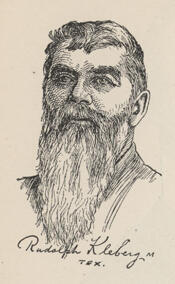
Here you will find contact information for Representative Rudolph Kleberg, including email address, phone number, and mailing address.
| Name | Rudolph Kleberg |
| Position | Representative |
| State | Texas |
| District | 11 |
| Party | Democratic |
| Status | Former Representative |
| Term Start | December 2, 1895 |
| Term End | March 3, 1903 |
| Terms Served | 4 |
| Born | June 26, 1847 |
| Gender | Male |
| Bioguide ID | K000258 |
About Representative Rudolph Kleberg
Rudolph Kleberg (June 26, 1847 – December 28, 1924) was a U.S. Representative from Texas, a member of the Democratic Party, and a prominent lawyer and public official in the late nineteenth and early twentieth centuries. He was born in Cat Spring, Austin County, Texas, where he was instructed by private tutors before pursuing formal higher education. He later attended Concrete College in De Witt County, Texas, from which he graduated in 1868. Kleberg was part of a family that would remain influential in Texas and national politics; he was the great uncle of future U.S. Representative Robert C. Eckhardt and the uncle of Richard M. Kleberg Sr., who also served in Congress.
During the American Civil War, Kleberg enlisted in the Confederate States Army in the spring of 1864. He served in Tom Green’s brigade of cavalry and remained in service until the close of the war in 1865. Following the end of the conflict, he turned to the study of law, moving to San Antonio, Texas, to read law in the traditional manner rather than through formal law school training. He was admitted to the bar in 1872, marking the beginning of a long legal career that would underpin his later public service.
After his admission to the bar, Kleberg commenced the practice of law in Cuero, De Witt County, Texas. Demonstrating an interest in public affairs and communication, he founded the Cuero Star in 1873, a local newspaper that contributed to the civic and political life of the community. His legal abilities and growing local prominence led to his appointment as prosecuting attorney of De Witt County, a position he held from 1876 to 1890. In this capacity, he was responsible for representing the state in criminal matters, gaining extensive courtroom experience and building a reputation as a capable attorney.
Kleberg’s public career expanded into state-level politics when he was elected to the Texas State Senate, where he served from 1882 to 1886. While serving in the legislature, he participated in shaping state law during a period of economic and social transition in Texas. In 1885, he was appointed United States attorney for the western district of Texas, a federal post in which he represented the United States government in legal matters within the district. This appointment reflected both his legal expertise and his standing within the Democratic Party in Texas.
Rudolph Kleberg’s congressional service began during a significant period in American history, marked by industrial expansion, regional realignments, and the aftermath of Reconstruction. He was elected as a Democrat to the Fifty-fourth Congress to fill the vacancy caused by the death of Representative William H. Crain. He took his seat on April 7, 1896, and was subsequently reelected to the Fifty-fifth, Fifty-sixth, and Fifty-seventh Congresses, serving continuously until March 3, 1903. As a member of the U.S. House of Representatives from Texas, he participated in the legislative process over four terms, representing the interests of his constituents and contributing to national debates of the era. Although specific committee assignments and legislative initiatives are less extensively documented, his tenure coincided with issues such as monetary policy, railroad regulation, and the Spanish–American War, in which Texas and the broader South had strong interests.
Kleberg chose not to be a candidate for renomination in 1902, thereby concluding his service in Congress at the end of his fourth term. After leaving the House of Representatives in 1903, he resumed the practice of law. In 1905 he moved with his family to Austin, Texas, the state capital, where he continued his legal work and remained engaged in public affairs. On February 24, 1905, he was appointed official reporter for the Texas Court of Criminal Appeals, a position that involved the preparation and oversight of the court’s opinions and records. He held this post for nearly two decades, contributing to the orderly development and publication of Texas criminal jurisprudence.
Rudolph Kleberg served as official reporter for the Court of Criminal Appeals until his death in Austin on December 28, 1924. He was interred in Oakwood Cemetery in Austin. Through his service as a Confederate soldier, local prosecutor, state senator, United States attorney, member of Congress from 1895 to 1903, and long-serving court reporter, Kleberg played a sustained role in Texas legal and political life over more than half a century, and his family connections extended his influence into subsequent generations of public service.