Senator Rufus Cecil Holman
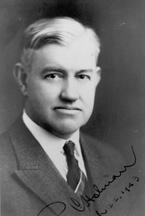
Here you will find contact information for Senator Rufus Cecil Holman, including email address, phone number, and mailing address.
| Name | Rufus Cecil Holman |
| Position | Senator |
| State | Oregon |
| Party | Republican |
| Status | Former Representative |
| Term Start | January 3, 1939 |
| Term End | January 3, 1945 |
| Terms Served | 1 |
| Born | October 14, 1877 |
| Gender | Male |
| Bioguide ID | H000731 |
About Senator Rufus Cecil Holman
Rufus Cecil Holman (October 14, 1877 – November 27, 1959) was an American politician and businessman who served as a United States senator from Oregon for a single term from 1939 to 1945, during World War II. A member of the Republican Party, he was active in Oregon business and public life for decades, holding local and statewide office before his election to the Senate. His career combined significant influence in state fiscal affairs and national legislation with controversial positions on isolationism, financial policy, and civil liberties.
Holman was born on October 14, 1877, in Portland, Oregon, into a family with deep roots in the state. He was raised in the Willamette Valley and educated in Oregon schools, coming of age in a region that was rapidly developing economically and politically at the turn of the twentieth century. Before entering public office, he became involved in business, most notably in the paper products industry, experience that later informed his views on economic and fiscal policy.
Holman’s early professional life was centered in Portland, where he established himself as a businessman and eventually became associated with the Portland Paper Box Company, a firm he would later manage. At the same time, he began to participate in civic and political affairs. In the 1920s, he was an officer in the Ku Klux Klan, reflecting the influence that organization briefly exerted in Oregon politics during that decade. He subsequently entered elective office, serving as a member of the Multnomah County Board of Commissioners, where he gained experience in local governance and public finance.
Building on his local service, Holman rose to statewide office as Oregon State Treasurer. In that capacity he was responsible for managing the state’s finances, investments, and public funds, and he developed a reputation as a fiscal conservative. His tenure as treasurer increased his visibility within the Republican Party and provided a platform for his eventual candidacy for the United States Senate. His background in both business and state financial administration shaped his later positions on national economic and monetary issues.
Holman was elected to the United States Senate as a Republican and served one term from 1939 to 1945, representing Oregon during a critical period that encompassed the final years of the Great Depression and the bulk of World War II. As a member of the Senate, he participated in the legislative process and represented the interests of his constituents in Oregon. His service in Congress occurred during a significant period in American history, and he took part in debates over foreign policy, wartime mobilization, and domestic economic measures. He was known for his strong views on international finance and what he regarded as the undue influence of “international bankers,” once declaring that while he deplored Adolf Hitler’s ambitions as a conqueror, he believed Hitler had “broke the control of these internationalists over the common people of Germany,” and that it “would be a good idea if the control of the international bankers over the common people of England was broken, and good if it was broken over the wages and savings of the common people of the United States.”
Initially identified with the isolationist wing of the Republican Party, Holman opposed American involvement in foreign conflicts prior to the attack on Pearl Harbor. After December 7, 1941, he attenuated his isolationism, came to support the war effort, and backed measures necessary for the prosecution of World War II. Nevertheless, his name remained closely associated with the now politically unpopular isolationist position, which damaged his standing as the war progressed. He was also an outspoken supporter of the internment of Japanese Americans during the war and actively lobbied against their return to the West Coast, positions that placed him firmly on the side of some of the most restrictive wartime civil-liberties policies.
Holman sought re-election in 1944 but faced a serious challenge within his own party. Running for re-election in May 1944, he was opposed in the Republican primary by Wayne Morse, a progressive law professor and member of the University of Oregon faculty who had gained a public reputation through service on the War Labor Board. During this campaign, Holman publicly charged that Morse was a stalking horse for the Democrats, arguing that, because the Democratic Party faced a severe deficit in party registrations in Oregon, it needed a split in the Republican ranks to capture the Senate seat in November. When this conspiratorial theory failed to gain traction with voters, Holman advanced another claim, alleging that the Portland shipyards of industrialist Henry J. Kaiser were being systematically used to stack the Republican primary against him. Newspaper editors around Oregon criticized these assertions, with one remarking that “like the ants, he has misplaced the center of the universe.” In the May 1944 Republican primary, the incumbent Holman carried a majority of Oregon’s counties, winning 20 to Morse’s 16, but Morse dominated in the more populous Multnomah and Lane counties. In a three-cornered race, Morse prevailed by a plurality of about 10,000 votes out of more than 143,000 cast, and Holman was defeated in his bid for renomination.
After his 1944 defeat, Holman’s congressional service came to an end in January 1945, and he returned to private life in Oregon. He did not seek public office again. Holman resumed management of the Portland Paper Box Company in Portland, returning to the business career that had preceded his time in high office. In his later years he retired to his farm near Molalla, Oregon, maintaining his ties to the region where he had spent much of his life. Rufus Cecil Holman died on November 27, 1959, closing a career that had spanned local, state, and national politics during some of the most turbulent decades of the twentieth century.