Senator Vance Hartke
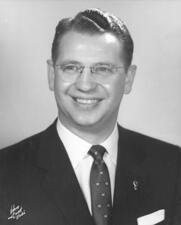
Here you will find contact information for Senator Vance Hartke, including email address, phone number, and mailing address.
| Name | Vance Hartke |
| Position | Senator |
| State | Indiana |
| Party | Democratic |
| Status | Former Representative |
| Term Start | January 7, 1959 |
| Term End | January 3, 1977 |
| Terms Served | 9 |
| Born | May 31, 1919 |
| Gender | Male |
| Bioguide ID | H000297 |
About Senator Vance Hartke
Rupert Vance Hartke (May 31, 1919 – July 27, 2003) was an American politician and attorney who served as a Democratic United States Senator from Indiana from 1959 until 1977. He was born in Stendal, Indiana, the son of Ida Mary (Egbert), an organist, and Hugo Leonard Hartke, a teacher. His paternal grandparents were German, as were all of his maternal great-grandparents. Hartke attended public schools in Stendal before moving on to higher education. He married Martha Hartke, with whom he had seven children.
Hartke graduated from Evansville College (now the University of Evansville) in 1940. During World War II he served in the United States Navy and the United States Coast Guard from 1942 to 1946, rising from seaman to lieutenant. After the war he pursued legal studies, earning his law degree from the Indiana University Maurer School of Law in 1948. That same year he was admitted to the Indiana State Bar and began practicing law in Evansville, Indiana.
Early in his legal career, Hartke served as deputy prosecuting attorney of Vanderburgh County from 1950 to 1951. He entered elective office as mayor of Evansville, serving from 1956 to 1958. As mayor he undertook local civil rights initiatives, including the integration of the city’s swimming pools. His performance in municipal government and his growing prominence in Democratic politics in Indiana positioned him for a statewide campaign for the United States Senate.
Hartke was elected to the Senate in 1958 at age 39, defeating Republican Governor Harold Handley, and took office in January 1959. A member of the Democratic Party, he served three consecutive terms, representing Indiana in the United States Congress from 1959 to 1977. During his first term he developed a reputation as a hard‑working, liberal Democrat and cultivated a strong relationship with Senate Majority Leader Lyndon B. Johnson. He served on the Senate Finance and Commerce Committees, where he supported key elements of the emerging Great Society agenda, including the creation of Medicare and Medicaid, and backed major civil rights legislation such as the Civil Rights Act of 1964.
Hartke was reelected to the Senate in 1964, defeating state Senator Russell Bontrager, becoming only the third Indiana Democrat—after Benjamin Franklin Shively in 1914 and Frederick Van Nuys in 1938—to be popularly elected to a second Senate term. His second term was marked by significant legislative activity on behalf of students, veterans, and transportation policy. He played an important role in the creation and expansion of federal student loan programs and new veterans’ benefits, and as chair of the Subcommittee on Surface Transportation he helped establish Amtrak. After his sister, Ruth E. Hartke, was killed in a head‑on automobile crash in Ohio in 1964 while working on his campaign, he used his position on the Commerce Committee’s transportation subcommittee to press for federal requirements that automakers equip cars with seat belts and other safety features.
In the Senate, Hartke became best known nationally for his early and outspoken opposition to the Vietnam War and for his chairmanship of the Senate Veterans Affairs Committee. Initially close to President Lyndon Johnson, he broke with the administration as one of the first senators to challenge the war, a stance that proved controversial in Indiana. He was credited with important roles in passing measures that created or supported student loan programs, veterans’ benefits, and the Head Start Program. He was also instrumental in creating the International Executive Service Corps, an organization modeled on the Peace Corps that sent retired U.S. business leaders to developing countries to help expand small enterprises. Hartke introduced legislation to establish a George Washington Peace Academy and a Department of Peace, a proposal later regarded as an early cornerstone of the campaign that led to the creation of the United States Institute of Peace. He was further praised for winning passage of a measure that made kidney dialysis more widely available; a statement entered into the Congressional Record on his 80th birthday credited this initiative with saving approximately 500,000 lives.
Despite the political risks, Hartke maintained his antiwar position and sought higher office. In 1970 he faced a bitter and extremely close reelection contest against Republican Congressman Richard L. Roudebush. After a recount, Hartke prevailed by 4,283 votes, securing a third Senate term. In 1972 he entered the Democratic presidential primaries, running against Senators Edmund Muskie and George McGovern, but he withdrew from the race after the first set of primaries. His opposition to the Vietnam War remained unpopular with many Indiana voters, and in 1976, after narrowly surviving a primary challenge from freshman Eighth District Congressman Philip Hayes, he lost his bid for a fourth Senate term in a landslide to Indianapolis Mayor Richard Lugar. He left the Senate in January 1977 after eighteen years of service. Until the election of Joe Donnelly in 2012, Hartke was the most recent Indiana Democrat, aside from members of the Bayh family, to be elected to and serve in the United States Senate.
In his later years Hartke remained involved in public affairs and legal work. He wrote three books—The American Crisis in Vietnam, You and Your Senator, and Inside the New Frontier, the last co‑authored with John M. Redding—reflecting on foreign policy, the legislative process, and the early 1960s in national politics. In 1994 he pleaded guilty to a misdemeanor election‑fraud charge in Dearborn County, Indiana, arising from his work as a consultant for a Kentucky‑based casino firm during a casino‑legalization referendum in the previous November’s general election. His family’s political involvement continued into the next generation; his daughter Anita Hartke was the 2008 Democratic nominee for the United States House of Representatives from Virginia’s 7th congressional district, though she was defeated by Republican incumbent Eric Cantor.
Rupert Vance Hartke died at a hospital in Fairfax, Virginia, on July 27, 2003, at the age of 84. In 2009 he was posthumously honored in his home region when the JFK Club of Vanderburgh County presented him with its John F. Kennedy Profiles in Courage Posthumous Award, recognizing his efforts “to carry forward the legacy and principles of President John F. Kennedy by supporting legislation and government officials or candidates that promote social justice and equality, in order to build a better community and society for all.”