Representative Russell Errett
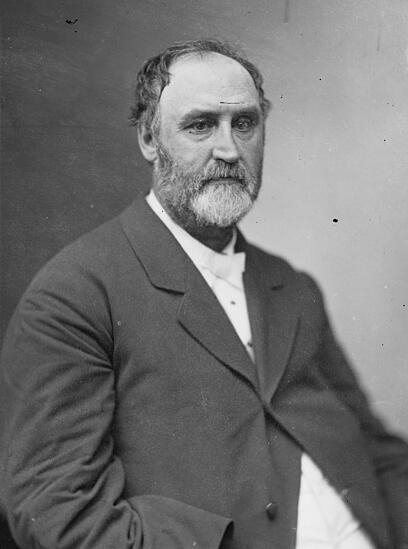
Here you will find contact information for Representative Russell Errett, including email address, phone number, and mailing address.
| Name | Russell Errett |
| Position | Representative |
| State | Pennsylvania |
| District | 22 |
| Party | Republican |
| Status | Former Representative |
| Term Start | October 15, 1877 |
| Term End | March 3, 1883 |
| Terms Served | 3 |
| Born | November 10, 1817 |
| Gender | Male |
| Bioguide ID | E000207 |
About Representative Russell Errett
Russell Errett (November 10, 1817 – April 7, 1891) was a Republican member of the U.S. House of Representatives from Pennsylvania who served three consecutive terms in Congress from 1877 to 1883. A member of the Republican Party, he contributed to the legislative process during a significant period in American history, participating in the democratic process and representing the interests of his Pennsylvania constituents in the House of Representatives.
Errett was born in New York City on November 10, 1817. In 1829 he moved with his family to Pittsburgh, Pennsylvania, which became the center of his professional and political life. As a young man he entered the newspaper trade, a field that would shape his public profile and influence. He became engaged in newspaper work in Pittsburgh and the surrounding region, gaining experience as both editor and publisher and establishing himself as a prominent voice in local and state affairs.
Errett’s career in journalism developed alongside his growing interest in politics and public reform. He edited the Pittsburgh Daily Sun, a small penny journal that contributed to the city’s expanding print culture. He later edited the Washington Patriot, an anti-slavery weekly published in Washington, Pennsylvania, reflecting his alignment with the anti-slavery and reform currents that helped give rise to the Republican Party. He also served as an editor of the Pittsburgh Gazette, one of western Pennsylvania’s leading newspapers, further enhancing his influence in regional political discourse.
By the late 1850s and early 1860s, Errett had moved directly into public office. He was elected comptroller of Pittsburgh in 1860, overseeing aspects of the city’s financial administration. That same year he began service as clerk of the Pennsylvania State Senate, a position he held in 1860 and 1861, and again from 1872 to 1876. His legislative clerical work placed him at the center of state government operations and familiarized him with parliamentary procedure and the mechanics of lawmaking.
During the American Civil War, Errett entered federal service. In 1861 he was appointed an additional paymaster in the United States Army, responsible for disbursing pay to Union soldiers, and he served in that capacity until he was mustered out in 1866. After the war, he continued his involvement in state politics, serving as a member of the Pennsylvania State Senate in 1867. In 1869 he was appointed assessor of internal revenue, a federal tax position, and he served in that office until 1873. Returning to journalism, he conducted the Pittsburgh Commercial newspaper from 1873 to 1876, maintaining his dual identity as newspaperman and public official.
Errett was elected as a Republican to the Forty-fifth, Forty-sixth, and Forty-seventh Congresses, serving in the U.S. House of Representatives from March 4, 1877, to March 3, 1883. His service in Congress occurred during a significant period in American history, in the years following Reconstruction and amid debates over economic policy, civil service reform, and federal expenditures. As a member of the House of Representatives, he participated in the legislative process and represented the interests of his Pennsylvania constituents. During the Forty-seventh Congress he served as chairman of the United States House Committee on Expenditures on Public Buildings, overseeing and reviewing federal spending related to public construction projects. He was an unsuccessful candidate for reelection in 1882, bringing his three-term congressional career to a close.
After leaving Congress, Errett remained in federal service. In 1883 President Chester A. Arthur appointed him United States pension agent at Pittsburgh, a position in which he administered pension payments to veterans and their dependents. He served in this capacity until May 1887, continuing his long record of public administration at both the state and federal levels. Errett’s family was also notable in religious and publishing circles; his younger brother, Isaac Errett, was the founding editor of the Christian Standard and a prominent figure in the American Restoration Movement, further underscoring the family’s influence in 19th-century American public life.
Russell Errett died in Carnegie, Pennsylvania, on April 7, 1891. He was interred in Chartiers Cemetery, leaving behind a legacy as a journalist, state official, Civil War paymaster, and three-term Republican representative from Pennsylvania who played an active role in the political and administrative life of his state and nation during the mid- and late 19th century.