Representative Ruth Sears Baker Pratt
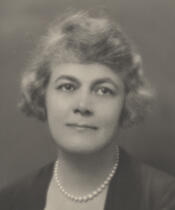
Here you will find contact information for Representative Ruth Sears Baker Pratt, including email address, phone number, and mailing address.
| Name | Ruth Sears Baker Pratt |
| Position | Representative |
| State | New York |
| District | 17 |
| Party | Republican |
| Status | Former Representative |
| Term Start | April 15, 1929 |
| Term End | March 3, 1933 |
| Terms Served | 2 |
| Born | August 24, 1877 |
| Gender | Female |
| Bioguide ID | P000505 |
About Representative Ruth Sears Baker Pratt
Ruth Sears Baker Pratt (née Baker; August 24, 1877 – August 23, 1965) was an American politician, civic leader, and the first female U.S. Representative to be elected from New York. A member of the Republican Party, she served two terms in the United States House of Representatives from 1929 to 1933, representing a New York City district during a period of profound economic and political change in the United States.
Pratt was born Ruth Sears Baker on August 24, 1877, in Ware, Massachusetts, to Carrie V. Baker and Edwin H. Baker, a cotton manufacturer. Raised in New England, she received a rigorous education that reflected both academic and cultural aspirations. She attended Dana Hall School in Wellesley, Massachusetts, and went on to study mathematics at Wellesley College, an experience that grounded her in analytical and quantitative disciplines unusual for women of her time. She also pursued musical training, spending a year and a half studying violin at the Conservatory of Liège in Belgium, which contributed to her lifelong interest in the arts.
In 1904, Ruth Sears Baker married John Teele Pratt, a corporate attorney, financier, philanthropist, and music impresario. He was one of six children of industrialist and Standard Oil co-founder Charles Pratt and Mary Helen (née Richardson) Pratt, and his siblings included Frederic, George, Herbert, and Harold Pratt; from his father’s first marriage he had two half-siblings, including Charles Millard Pratt. The couple became prominent members of New York society and maintained a family estate, Manor House, in Glen Cove, Long Island. Together they had five children: John Teele Pratt Jr. (1903–1969); Virginia Pratt (1905–1979); Sally Sears Pratt (1908–1973); Phyllis Pratt (1912–1987); and Edwin Howard Baker Pratt (1913–1975). Her husband died in 1927, leaving her a substantial fortune that afforded her financial independence and the means to pursue an active public and political life.
Pratt’s formal political career developed in the early decades of the twentieth century as women were beginning to exercise newly won voting rights. She became involved in Republican Party affairs in New York and quickly emerged as an organizer and leader, particularly in mobilizing women voters. In the 1920 presidential election she served as a presidential elector for Warren G. Harding and Calvin Coolidge. By 1922 she was a delegate to the Republican State Convention, a role she would repeat in 1924, 1926, 1928, 1930, 1936, and 1938. In 1924 she helped rally women’s support for Frank J. Coleman Jr.’s bid for leadership of the Fifteenth Assembly District in New York, and her effectiveness in that campaign led to her appointment as associate leader of the district and later as its secretary. Her growing influence within the party was reflected in her selection as a delegate to the Republican National Conventions of 1924, 1932, 1936, and 1940, and in her service on the Republican National Committee from 1929 to 1943.
Pratt also played a pioneering role in New York City government. In 1925 she was elected to the New York City Board of Aldermen, becoming the first woman to serve on that body. She was re-elected in 1927 and served until March 1, 1929. Her tenure on the Board of Aldermen gave her practical experience in municipal governance and public finance and helped establish her reputation as a capable legislator and advocate for her constituents. This local service provided a springboard to national office and positioned her as a visible symbol of women’s expanding role in public life.
In 1928 Pratt was elected as a Republican to the Seventy-first Congress and was re-elected to the Seventy-second Congress, serving in the U.S. House of Representatives from March 4, 1929, to March 3, 1933. She was the first woman elected to Congress from New York, winning her seat after defeating her primary opponent Phelps Phelps. Her service in Congress coincided with the onset of the Great Depression, and she participated in the legislative process during a time of intense economic crisis and policy experimentation. Among her most enduring legislative achievements was her co-sponsorship, with Senator Reed Smoot of Utah, of the Pratt–Smoot Act. Signed into law by President Herbert Hoover on March 3, 1931, the act appropriated $100,000 to be administered by the Library of Congress to provide books for blind adults. This initiative, known as the “Books for the Blind” program, was heavily amended and expanded in subsequent decades and remains a cornerstone of federal services for visually impaired readers. In the 1932 election, amid a national shift toward the Democratic Party, Pratt lost her bid for re-election to Democrat Theodore Peyser, concluding her two terms in the House.
After leaving Congress, Pratt remained active in Republican politics and civic affairs. She continued to serve on the Republican National Committee until 1943 and maintained a prominent role in women’s political organizations. From 1943 to 1946 she was president of the Women’s National Republican Club, where she worked to strengthen women’s participation in party activities and public life. Her leadership in these organizations extended her influence beyond elected office and helped institutionalize women’s roles within the Republican Party at both the state and national levels.
Pratt’s later years were spent largely at her Glen Cove estate and within her extended family, which included numerous descendants who would themselves achieve prominence in public, cultural, and professional life. Through her eldest son, John Teele Pratt Jr., she was the grandmother of Mary Christy Pratt (1923–1960), who married Bayard Cutting Auchincloss, nephew of U.S. Representative James C. Auchincloss, in 1950, and of Ruth Pratt, who in 1962 married U.S. State Department aide R. Campbell James, a Groton and Yale graduate and stepson of architect Harrie T. Lindeberg. Through her daughter Virginia, who married U.S. diplomat Robert Helyer Thayer in 1926, and through her daughter Phyllis, who married Paul Henry Nitze—later Secretary of the Navy and Deputy Secretary of Defense under President Lyndon B. Johnson—Pratt’s family became intertwined with American diplomatic and defense leadership. Through Phyllis she was the grandmother of William A. Nitze of Washington, D.C., chairman of Oceana Technologies and Clearpath Technologies, who married independent art dealer Ann Kendall Richards, and the great-grandmother of Nicholas Thompson, who became CEO of The Atlantic. Through her youngest son, Edwin Howard Baker Pratt, headmaster of the Browne & Nichols School, and his wife Aileen Kelly, she was the grandmother of singer-songwriter Andy Pratt.
Ruth Sears Baker Pratt died on August 23, 1965, one day before her eighty-eighth birthday, at the family house and estate, Manor House, in Glen Cove, Long Island, New York. She was interred in the Pratt Family Mausoleum on Old Tappan Road in Glen Cove. Her career as the first woman elected to Congress from New York, her pioneering service in New York City government, and her leadership within the Republican Party marked her as a significant figure in the history of women in the United States House of Representatives and in the broader evolution of women’s political participation in the twentieth century.