Representative Ruth Thompson
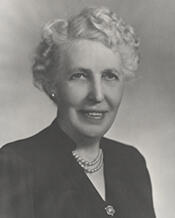
Here you will find contact information for Representative Ruth Thompson, including email address, phone number, and mailing address.
| Name | Ruth Thompson |
| Position | Representative |
| State | Michigan |
| District | 9 |
| Party | Republican |
| Status | Former Representative |
| Term Start | January 3, 1951 |
| Term End | January 3, 1957 |
| Terms Served | 3 |
| Born | September 15, 1887 |
| Gender | Female |
| Bioguide ID | T000216 |
About Representative Ruth Thompson
Ruth Thompson (September 15, 1887 – April 5, 1970) was a Republican politician and lawyer from the U.S. state of Michigan who served three terms as a Representative from Michigan in the United States Congress from 1951 to 1957. She was the first woman to represent Michigan in Congress and the first woman to serve on the House Judiciary Committee, contributing to the legislative process during a significant period in American history and representing the interests of her constituents as a member of the House of Representatives.
Thompson was born in Whitehall, Muskegon County, Michigan, where she attended the local public schools. After completing her early education, she enrolled at Muskegon Business College in nearby Muskegon, from which she graduated in 1905. She subsequently studied law, entered the legal profession, and established herself as a lawyer in private practice. Her legal training and early professional experience laid the groundwork for a public career that would span local, state, federal, and international service.
Before entering national politics, Thompson built a substantial record in county and state government. She served as registrar of the probate court of Muskegon County and then as judge of probate from 1925 to 1937. In that capacity she gained national recognition as an advocate for children’s rights, focusing on the welfare and legal protection of minors in probate and family matters. In 1938 she was elected Muskegon County’s first female state representative and served in the Michigan House of Representatives from 1939 to 1941, representing the Muskegon County 1st district. Her legislative experience in Lansing further established her as a prominent Republican figure in Michigan politics.
During the early 1940s, Thompson moved into federal and wartime service. She served on the Social Security Board from 1941 to 1942, followed by work on the staff of the United States Department of Labor in 1942. Later that year she joined the United States Adjutant General’s Office, where she served from 1942 to 1946. During and after World War II she worked as a civilian employee of the U.S. Army in Washington, D.C., and in Europe, contributing to the administrative and personnel functions that supported the war effort and postwar operations. Upon returning to Michigan, she continued her public service as a member and chair of the Michigan State Prison Commission for Women, overseeing issues related to the administration and conditions of women’s correctional facilities in the state.
In 1950, Thompson was elected as a Republican from Michigan’s 9th congressional district to the 82nd Congress and was subsequently re-elected to the 83rd and 84th Congresses, serving from January 3, 1951, to January 3, 1957, in the U.S. House of Representatives. Her tenure in Congress coincided with the early Cold War, the Korean War era, and the beginning of the modern civil rights movement, a period of substantial domestic and international change. As a member of the House Judiciary Committee—the first woman ever to serve on that panel—she participated in the consideration of legislation relating to the federal courts, civil liberties, criminal law, and constitutional issues. On February 26, 1954, she introduced legislation aimed at banning the mailing of “obscene, lewd, lascivious or filthy” phonograph records, a measure widely understood at the time as directed at certain rock and roll recordings, reflecting contemporary concerns about morality and popular culture.
Thompson’s congressional service ended after she sought re-nomination to the 85th Congress in 1956 and was defeated in the Republican primary by Robert P. Griffin. Following her departure from Congress in January 1957, she returned to her home in Whitehall, Michigan. Although no longer in elective office, her earlier achievements—as Michigan’s first woman in Congress, a pioneering female member of the House Judiciary Committee, and a long-serving advocate for children, social welfare, and correctional reform—remained an important part of the state’s political history.
Ruth Thompson died on April 5, 1970, at Plainwell Sanitorium in Allegan County, Michigan. She was interred in Oakhurst Cemetery in her hometown of Whitehall, bringing to a close a public career that had extended from local probate courts and the Michigan legislature to the halls of the United States Congress and wartime service in Washington and Europe.