Representative Rutherford Birchard Hayes
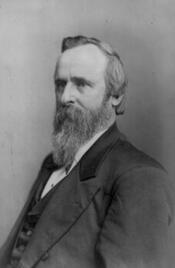
Here you will find contact information for Representative Rutherford Birchard Hayes, including email address, phone number, and mailing address.
| Name | Rutherford Birchard Hayes |
| Position | Representative |
| State | Ohio |
| District | 2 |
| Party | Republican |
| Status | Former Representative |
| Term Start | December 4, 1865 |
| Term End | March 3, 1869 |
| Terms Served | 2 |
| Born | October 4, 1822 |
| Gender | Male |
| Bioguide ID | H000393 |
About Representative Rutherford Birchard Hayes
Rutherford Birchard Hayes served as a Representative from Ohio in the United States Congress from 1865 to 1869. A member of the Republican Party, Rutherford Birchard Hayes contributed to the legislative process during 2 terms in office.
Rutherford Birchard Hayes’s service in Congress occurred during a significant period in American history. As a member of the House of Representatives, Rutherford Birchard Hayes participated in the democratic process and represented the interests of constituents.
Rutherford Birchard Hayes ( ; October 4, 1822 – January 17, 1893) was the 19th president of the United States, serving from 1877 to 1881. He served as Cincinnati’s city solicitor from 1858 to 1861 and was known as a staunch abolitionist who defended refugee slaves in court proceedings. At the start of the Civil War, Hayes left a fledgling political career to join the Union army. He was wounded five times, most seriously at the Battle of South Mountain in 1862. Hayes earned a reputation for bravery in combat, rising in the ranks to serve as brevet major general. After the war, he was a prominent member of the “Half-Breed” faction of the Republican Party. Hayes served in Congress from 1865 to 1867 and was elected governor of Ohio, serving two consecutive terms from 1868 to 1872 and half of a third two-year term from 1876 to 1877 before his swearing-in as president. Hayes won the Republican nomination in the 1876 United States presidential election. In the disputed general election, he defeated Democratic nominee Samuel J. Tilden while losing the popular vote. Neither candidate initially secured enough electoral votes to win, but Hayes prevailed after a Congressional Commission awarded him 20 contested electoral votes in the Compromise of 1877. The electoral dispute was resolved in an agreement between Southern Democrats and Whiggish Republican businessmen whereby Hayes would be president but end both federal support for Reconstruction and the military occupation of the former Confederacy. Hayes’s administration was influenced by his belief in meritocratic government and equal treatment without regard to wealth, social standing, or race. One of the defining events of his presidency was the Great Railroad Strike of 1877, which Hayes resolved by calling in the U.S. Army against the railroad workers. It remains the deadliest conflict between workers and strikebreakers in American history. He appointed John Marshall Harlan to the U.S. Supreme Court. As president, Hayes implemented modest civil service reforms that laid the groundwork for further reform in the 1880s and 1890s. He vetoed the Bland–Allison Act of 1878, which put silver money into circulation and raised nominal prices, but Congress overrode his veto. Hayes also arbitrated a territorial dispute between Argentina and Paraguay after the Paraguayan War. His policy toward western Native Americans anticipated the assimilationist program of the Dawes Act of 1887. At the end of his term, Hayes kept his pledge not to run for reelection and retired to his home in Ohio. Historians and scholars generally rank Hayes as an average to below-average president.