Representative Sam Gibbons
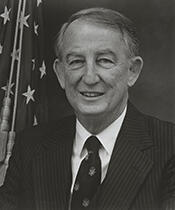
Here you will find contact information for Representative Sam Gibbons, including email address, phone number, and mailing address.
| Name | Sam Gibbons |
| Position | Representative |
| State | Florida |
| District | 11 |
| Party | Democratic |
| Status | Former Representative |
| Term Start | January 9, 1963 |
| Term End | January 3, 1997 |
| Terms Served | 17 |
| Born | January 20, 1920 |
| Gender | Male |
| Bioguide ID | G000153 |
About Representative Sam Gibbons
Samuel Melville Gibbons (January 20, 1920 – October 10, 2012) was an American politician and attorney from Tampa, Florida, who served in the Florida House of Representatives, the Florida State Senate, and as a Democratic member of the United States House of Representatives from 1963 to 1997. Over 17 consecutive terms in Congress, he represented the Tampa area for more than three decades and became a prominent figure in national trade policy and Florida higher education.
Gibbons was born in Tampa, Hillsborough County, Florida, on January 20, 1920. He attended Roosevelt Elementary School, where the auditorium was later named in his honor, and graduated from H. B. Plant High School, participating in the Junior Reserve Officers’ Training Corps (JROTC). He went on to the University of Florida, beginning a long association with that institution. After his initial college studies were interrupted by World War II, he returned to the University of Florida School of Law following his military service and earned his law degree in 1947. He then joined a longstanding family law practice in Tampa, becoming part of four generations of Gibbons attorneys serving the local community.
With the outbreak of World War II, Gibbons entered active military service, joining the United States Army as a second lieutenant in late 1941. He served in the 101st Airborne Division, rising to the rank of captain in the 501st Parachute Infantry Regiment. At approximately 1:00 a.m. on D-Day, June 6, 1944, he parachuted into Normandy near Carentan, France, on the Cotentin Peninsula. He took part in the intense fighting around Carentan, including the June 13, 1944, German counterattack south of the town, a day-long battle between German armor and American paratroopers in which the American line bent but did not break; by nightfall, fewer than 400 of the 600 paratroopers who began the day remained, and Gibbons later recalled counting a dozen burning tanks from his vantage point. The battle was later dramatized in the second episode of the television miniseries “Band of Brothers.” For his actions in Normandy, Gibbons was awarded the Bronze Star.
Gibbons continued to serve with the 101st Airborne Division throughout the European campaign. After the division was withdrawn to England on June 30, 1944, as the first battle-tested troops to return from France, he participated in Operation Market Garden, during which his unit helped seize the first bridge described in Cornelius Ryan’s book “A Bridge Too Far.” In December 1944, while the 101st was in reserve, the division was rushed by truck to Bastogne, Belgium, where it famously held the town during the Battle of the Bulge against overwhelming German forces, an episode remembered in part for the division’s one-word reply—“Nuts”—to a German surrender demand. The 101st later advanced into Germany and participated in the capture of Hitler’s Eagle’s Nest before meeting Soviet forces. Gibbons served in Europe until the end of the war and was promoted to major shortly before Germany’s surrender, though a communications delay meant he did not learn of the promotion until after his honorable discharge. Upon returning to Florida, he authored a memoir of his wartime experiences titled “I Was There.” In 2004, during the 60th anniversary commemoration of D-Day at the Normandy American Cemetery and Memorial, he was awarded the French Medal of Valor in recognition of his service.
After the war and completion of his legal education, Gibbons established himself as a practicing attorney in Tampa and entered public life. A member of the Democratic Party, he was elected to the Florida House of Representatives in 1952 and served from 1953 to 1958. During his tenure in the state legislature, he played a leading role in the creation of the University of South Florida in Tampa, an institution that would become a major public research university. He subsequently won election to the Florida Senate, serving from 1959 to 1962 after defeating incumbent Paul Kickliter. His work in the state legislature helped solidify his reputation as a strong advocate for education and regional development in the Tampa Bay area.
Gibbons was elected to the United States House of Representatives in 1962 from a newly created congressional district based in Tampa, defeating segregationist Sumter de Leon Lowry Jr. in the Democratic primary and runoff. He entered Congress on January 3, 1963, and served continuously until January 3, 1997, completing 17 terms in office. Over the course of his tenure, his district was renumbered several times—from Florida’s 10th District (1963–1967) to the 6th (1967–1973), the 7th (1973–1993), and finally the 11th (1993–1997)—but it consistently centered on Tampa. He was generally considered to represent the only reliable Democratic stronghold on Florida’s Gulf Coast and usually won reelection by comfortable margins. An exception came late in his career, when he was held to 52 percent of the vote in 1992 by Republican challenger Mark Sharpe and then defeated Sharpe again in 1994 by only about 4,700 votes.
During his years in the House of Representatives, Sam Melville Gibbons participated actively in the legislative process and represented the interests of his constituents through a period of significant social and political change in the United States. He voted against the Civil Rights Act of 1964 but supported the Voting Rights Act of 1965 and the Civil Rights Act of 1968, reflecting a complex legislative record on civil rights issues. Over time he became particularly influential on economic and trade matters. He chaired the House Ways and Means Subcommittee on Trade and was known as one of the chamber’s most consistent Democratic advocates of trade liberalization at a time when many in his party favored more protectionist policies. From 1994 until the Democratic Party lost control of the House in 1995, he served as acting chairman of the powerful House Ways and Means Committee, which has jurisdiction over taxation, tariffs, and many social welfare programs.
Gibbons’s final term in Congress coincided with the arrival of a large Republican majority after the 1994 elections, and he became known for several sharp verbal confrontations with the new leadership. In one widely noted incident during a taped Ways and Means Committee hearing, after repeatedly being denied the opportunity to speak, he walked out of the session, protesting that Democrats were being “railroaded” and denied time for debate. He compared the new Republican majority to dictators and declared that he had “to fight you guys 50 years ago,” an allusion to his combat against Nazi Germany in World War II. With Mark Sharpe preparing for a third challenge in 1996, Gibbons chose not to seek an 18th term and retired from Congress in January 1997, concluding 44 consecutive years in elected office without ever having been defeated. He was succeeded by State Representative Jim Davis, whom he had endorsed as his preferred successor. In recognition of his long service, the United States Courthouse at 801 North Florida Avenue in downtown Tampa was named in his honor.
In his personal life, Gibbons married Martha Hanley, with whom he had three sons: Clifford Sam, Mark Hanley, and Timothy Melville. The couple were married for 55 years until her death from cancer in 2002. He later married a longtime friend, Betty King Culbreath, who had been recently widowed. Beyond his legislative and military legacy, his papers and congressional records are preserved at the University of South Florida Tampa Library Special & Digital Collections, and he appeared frequently on C-SPAN during his years in Congress, documenting his role in national debates. Samuel Melville Gibbons died in Tampa on October 10, 2012, at the age of 92.