Representative Sam Johnson
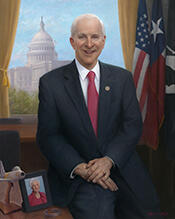
Here you will find contact information for Representative Sam Johnson, including email address, phone number, and mailing address.
| Name | Sam Johnson |
| Position | Representative |
| State | Texas |
| District | 3 |
| Party | Republican |
| Status | Former Representative |
| Term Start | January 3, 1991 |
| Term End | January 3, 2019 |
| Terms Served | 14 |
| Born | October 11, 1930 |
| Gender | Male |
| Bioguide ID | J000174 |
About Representative Sam Johnson
Samuel Robert Johnson (October 11, 1930 – May 27, 2020) was an American politician, decorated military officer, and long-serving member of the United States House of Representatives from Texas. A Republican, he represented Texas’s 3rd congressional district from May 8, 1991, to January 3, 2019, serving 14 consecutive terms in Congress. Over the course of his legislative career, he became known for his conservative views, his advocacy on national defense and veterans’ issues, and his leadership roles on the House Committee on Ways and Means, where he served as acting chairman in October and November 2015 and chaired the Social Security Subcommittee. At the time of his retirement, he was the last Korean War veteran to serve in Congress and, after the death of Representative Louise Slaughter in March 2018, he was the oldest sitting member of the U.S. House of Representatives.
Johnson was born on October 11, 1930, in San Antonio, Texas, the son of Mima (Nabors) and Samuel Robert Johnson Jr. He grew up in Dallas, where he attended public schools and graduated from Woodrow Wilson High School in 1947. He then enrolled at Southern Methodist University (SMU) in Dallas, his hometown institution, and earned a bachelor’s degree in business administration in 1951. While at SMU, he was active in campus life and joined the Delta Chi social fraternity as well as the Alpha Kappa Psi business fraternity, experiences that helped shape his early leadership skills and professional interests. He later pursued graduate study in international affairs, earning a master’s degree from the Elliott School of International Affairs at George Washington University in 1976, further preparing him for later roles in public service and national policy.
Following his graduation from SMU, Johnson embarked on a 29-year career in the United States Air Force, rising to the rank of colonel. A fighter pilot by training, he became a combat veteran of both the Korean War and the Vietnam War. During the Korean War, he flew 62 combat missions in the F-86 Sabre and shot down one Mikoyan-Gurevich MiG-15, earning recognition for his skill and bravery in aerial combat. Over the course of his Air Force career, he served as director of the Air Force Fighter Weapons School and flew the F-100 Super Sabre with the Air Force Thunderbirds precision flying demonstration team. He commanded the 31st Tactical Fighter Wing at Homestead Air Force Base in Florida and later commanded an air division at Holloman Air Force Base in New Mexico. Among his classmates in flight school was future astronaut Buzz Aldrin, with whom he maintained a lifelong friendship.
Johnson’s military service was marked most dramatically by his experience in the Vietnam War. Flying the F-4 Phantom II, he was on his 25th combat mission over North Vietnam when, on April 16, 1966, his aircraft was shot down. He suffered a broken right arm and a broken back in the crash and was captured by North Vietnamese forces. Johnson spent nearly seven years as a prisoner of war, including 42 months in solitary confinement. He was repeatedly tortured and endured harsh conditions that left lasting physical injuries. He was part of a group of eleven U.S. military prisoners known as the “Alcatraz Gang,” who were segregated from other prisoners because of their resistance to their captors and were held in a special facility dubbed “Alcatraz,” about a mile from the Hỏa Lò Prison, the “Hanoi Hilton.” Confined in a windowless 3-by-9-foot concrete cell, locked nightly in legcuffs with the light kept on around the clock, he emerged from captivity on February 12, 1973, when he was released during Operation Homecoming. At the time of his release, he weighed only 120 pounds, his right hand was permanently disabled, and he walked with a noticeable limp for the rest of his life. He later recounted his experiences in his autobiography, “Captive Warriors.” In 2018, he donated objects related to his imprisonment to the Smithsonian Institution’s National Museum of American History, preserving his story for future generations.
After retiring from the Air Force as a colonel, Johnson settled in Plano, Texas, and entered private business. Drawing on his business education and leadership experience, he established a homebuilding company in Plano, participating in the rapid growth and development of the region north of Dallas. His involvement in local affairs and his stature as a decorated veteran led him into elective politics. In 1984, he was elected to the Texas House of Representatives, where he served a total of seven years and was re-elected three times. In the state legislature, he built a reputation as a conservative Republican and an advocate for limited government, fiscal restraint, and strong national defense, laying the groundwork for his subsequent congressional career.
Johnson entered the U.S. House of Representatives in a special election held on May 8, 1991, following the resignation of eight-year incumbent Steve Bartlett, who left Congress to become mayor of Dallas. Running as a conservative Republican in the rapidly growing and increasingly Republican 3rd District, based in the northern suburbs of Dallas, Johnson defeated fellow Republican Thomas Pauken of Dallas, receiving 24,004 votes (52.6 percent) to Pauken’s 21,647 votes (47.4 percent). Once in Congress, he consistently won re-election in what became one of the most reliably Republican districts in Texas. In the 2004 election, he ran unopposed in the Republican primary and faced independent Paul Jenkins and Libertarian James Vessels in the general election, winning overwhelmingly with 178,099 votes (86 percent), while Jenkins received 16,850 votes (8 percent) and Vessels 13,204 votes (6 percent). In 2006, he defeated Robert Edward Johnson in the Republican primary by a margin of 85 to 15 percent, and in the general election faced Democrat Dan Dodd and Libertarian Christopher J. Claytor—both West Point graduates and military veterans—winning re-election with 62.5 percent of the vote to Dodd’s 34.9 percent and Claytor’s 2.6 percent. Although this was a smaller margin than in previous years, when he had often secured 80 percent or more of the vote, he remained firmly entrenched in his seat.
Johnson continued to secure re-election in subsequent cycles. In 2008, he again faced Democratic and Libertarian opposition, including a rematch with Libertarian nominee Christopher J. Claytor, and retained his seat with 60 percent of the vote, an unusually low total for such a heavily Republican district but still a decisive victory. In a later election, he won re-election with 66.3 percent of the vote against Democrat John Lingenfelder, who received 31.3 percent, and Libertarian Christopher Claytor, who received 2.4 percent. During his 14 terms in the House, Johnson participated actively in the legislative process and represented the interests of his North Texas constituents on issues ranging from tax policy and Social Security to national security and veterans’ affairs. His service in Congress spanned a significant period in American history, encompassing the end of the Cold War, the post–September 11 era, and major debates over fiscal policy and entitlement reform. In October and November 2015, he served as acting chairman of the powerful House Committee on Ways and Means, and he also chaired its Social Security Subcommittee, where he played a prominent role in discussions on the long-term solvency of the Social Security system.
On January 6, 2017, Johnson announced that he would not seek re-election in 2018, signaling the end of a congressional career that had lasted nearly three decades. He completed his final term on January 3, 2019, concluding 28 years of service in the U.S. House of Representatives. His retirement marked the departure of the last sitting member of Congress who had served in the Korean War, underscoring the passing of a generation of lawmakers with direct experience in mid-20th-century conflicts. Samuel Robert Johnson died on May 27, 2020, at the age of 89. His life encompassed distinguished military service, including years as a prisoner of war, entrepreneurial activity in Texas, and a long tenure in both the Texas House of Representatives and the U.S. Congress, during which he consistently aligned himself with the Republican Party and the interests of his North Texas constituents.