Representative Sam Steiger
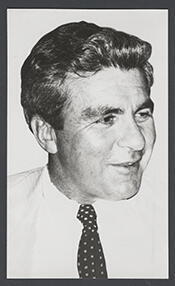
Here you will find contact information for Representative Sam Steiger, including email address, phone number, and mailing address.
| Name | Sam Steiger |
| Position | Representative |
| State | Arizona |
| District | 3 |
| Party | Republican |
| Status | Former Representative |
| Term Start | January 10, 1967 |
| Term End | January 3, 1977 |
| Terms Served | 5 |
| Born | March 10, 1929 |
| Gender | Male |
| Bioguide ID | S000846 |
About Representative Sam Steiger
Samuel Steiger (March 10, 1929 – September 26, 2012) was an American politician, journalist, and political pundit who served five terms as a Republican member of the U.S. House of Representatives from Arizona, two terms in the Arizona State Senate, and one term as mayor of Prescott, Arizona. A member of the Republican Party for most of his career, he represented Arizona in the United States Congress from 1967 to 1977, contributing to the legislative process during five terms in office. Over the course of a long and often controversial public life, he also made an unsuccessful run for the U.S. Senate, served as a special assistant to Arizona Governor Evan Mecham, ran for governor twice, and later became a radio and television talk show host. Despite these accomplishments, Steiger became widely known for two highly publicized incidents: the 1975 killing of two burros while he was a sitting congressman and, a decade later, his decision to paint an unauthorized crosswalk between Prescott’s courthouse and nearby Whiskey Row.
Steiger was born in New York City on March 10, 1929, to Lewis and Rebecca (Klein) Steiger. He was educated in local New York schools and first encountered Arizona at age fourteen, when he visited a dude ranch, an experience that helped foster his later attachment to the state. He attended Cornell University before transferring to Colorado A&M (now Colorado State University), from which he graduated in 1950 with a Bachelor of Science degree. Following college, Steiger was commissioned into the United States Army. He served during the Korean War as a tank platoon leader and was awarded the Purple Heart for wounds received in action. After leaving the Army, he settled in Prescott, Arizona, which became his long‑term home and the base of his political career.
In his personal life, Steiger married his first wife, Cynthia Jean Gardner, in 1954. The couple had three children: twins Lewis and Gail, born in April 1956, and Delia Rebecca, born in May 1959. That marriage ended in divorce, as did his later marriage to his second wife, Lynda, which concluded in January 1979. During the 1950s he worked in various occupations in Arizona, including as a ranch hand in Springerville. It was in this setting that he entered politics on a wager. In 1959, while discussing local politics with friends, Steiger observed that Yavapai County had never elected a Republican representative and argued that this was because the right Republican had not yet run. Challenged to prove his point, he became a candidate himself.
Steiger was elected to the Arizona State Senate in 1960 and served two terms. As a freshman senator he quickly developed a reputation as an outspoken maverick. He wrote a newspaper column alleging that some legislators had sold their votes for money and challenged Senate leaders over what he saw as backroom deals. Cultivating a combative public image, he likened himself to a tiger and used a black‑and‑orange motif on his campaign signs. In 1964 he sought higher office, running against Democratic incumbent George F. Senner Jr. for Arizona’s 3rd congressional district. Although he was endorsed by all the newspapers in the district—one Arizona Republic editorial described him as “independent, friendly, quick‑witted, very out‑spoken, crazy over horses, and [wearing] an infectious smile”—he narrowly lost the race. He then worked as a correspondent covering the Vietnam War before making a second bid for the same House seat in 1966. Benefiting from mid‑decade reapportionment that shifted the district into a heavily Republican area of Maricopa County near Phoenix, and from Democratic defections to third‑party candidates, Steiger defeated Senner and entered Congress.
As a member of the U.S. House of Representatives from 1967 to 1977, Steiger represented Arizona’s 3rd district during a significant period in American history marked by the Vietnam War, the civil rights movement, and the Watergate scandal. He participated in the democratic process and represented the interests of his constituents while maintaining an independent and often confrontational style. Early in his congressional career he delivered a floor speech declaring that it was “an irrefutable fact of life that the elected official is regarded by those who elect him as capable of the most flagrant dishonor,” and he called for a strict code of ethics that would require full disclosure of assets, liabilities, and honoraria by members of Congress, their spouses, and staff. He later claimed that some of his colleagues were frequently drunk and remarked that “there are members of Congress you wouldn’t hire to wheel a wheelbarrow.” These comments led Interior Secretary Stewart Udall, himself a former Arizona congressman, to label Steiger “a bomb thrower.” His voting record was staunchly conservative: in 1974 he received a zero rating from Americans for Democratic Action and a 100 percent rating from Americans for Constitutional Action, which also presented him with a Distinguished Service Award for his “devotion to those fundamental principles of good government which serve to promote individual rights and responsibilities, a sound dollar, a growing economy, and a desire for victory over communist aggression.” His opposition to environmental legislation, including controls on strip mining and his support for coal companies, earned him a place on the League of Conservation Voters’ “Dirty Dozen” list. At home, he was generally popular and easily reelected, facing a serious challenge only in 1974, when in the aftermath of Watergate he held his seat by just 3,073 votes, surviving largely because of a 3,291‑vote margin in the Maricopa County portion of his district.
A defining episode of Steiger’s congressional career occurred in 1975 near Paulden, Arizona. A herd of about 150 burros had been running loose in the area, and Steiger’s office received numerous complaints that the animals were frightening children at bus stops and creating hazards. On August 9, 1975, he went to investigate and found fourteen burros confined in an enclosure along a highway, awaiting retrieval by their owner. Entering the enclosure with a .30‑caliber carbine to check the animals’ brands, Steiger later reported to the local sheriff that the burros charged him and that he shot the two lead animals in self‑defense. The incident was referred to the county attorney and prompted two civil suits from the owner. Public reaction was intense: children picketed outside the federal building in Phoenix with signs reading “Steiger joins the murderers of innocent animals,” and the once‑celebrated political “tiger” was derided as “the jackass killer.” Steiger later remarked, “I could find a cure for cancer and they’d remember me as the guy who shot the burros.”
In 1976, rather than seek reelection to the House, Steiger ran for the U.S. Senate seat being vacated by Republican Senator Paul Fannin. His principal opponent in the Republican primary was fellow congressman John Bertrand Conlan. The campaign was bitter and personal. Conlan asserted, “We are both conservatives, but our style is different. He uses a meat ax and I use a scalpel,” and at one point asked voters whether they wanted “a Jew from New York telling Arizona what to do,” a remark widely interpreted as an appeal to prejudice. Steiger responded that “John thinks of himself as a scalpel. I prefer to think of him as a Roto‑Rooter,” and quipped that “Godzilla would make a better Senator than John Conlan.” Steiger narrowly defeated Conlan in the primary, but the divisive contest left him weakened. Many Conlan supporters refused to back him in the general election and instead supported Democratic nominee Dennis DeConcini, the Pima County Attorney. In the November 2, 1976, election, Steiger lost to DeConcini by a margin of 54 to 43 percent, ending his decade in Congress.
After his unsuccessful Senate bid, Steiger sought to reestablish himself in state politics. In 1978 he attempted to return to the Arizona State Senate but was unsuccessful. In 1982 he ran for governor of Arizona as the nominee of the Libertarian Party. His stated goal was not victory but to secure at least five percent of the vote to obtain ballot access for the Libertarian Party in future elections. He achieved 5.1 percent, one of the strongest showings for a Libertarian gubernatorial candidate at the time. During these years his standing in Prescott declined. As Prescott councilman Ken Bennett later observed, Steiger had been popular as a “brash young congressman out in Washington telling people what to do,” but was less well liked when he returned and began “telling our people what to do.” Bennett recalled that Steiger’s popularity reached “an all‑time low” before rebounding after a later, highly publicized local protest.
That turning point came in 1986, when the Prescott city council eliminated a long‑used crosswalk as part of a road resurfacing project. The crosswalk connected the Yavapai County Courthouse with Whiskey Row, a historic line of saloons across the street, and its removal generated strong public resentment. On May 2, 1986, Steiger took it upon himself to restore the crossing. Contrary to local legend that he painted the lines at night with a brush after visiting nearby bars, he actually used a parking‑lot striping machine in broad daylight. He was arrested and charged with criminal damage and disorderly conduct; the disorderly conduct charge was dropped, but the criminal damage case went to trial. Representing himself, Steiger argued that his actions did not constitute vandalism but “historic preservation.” The jury acquitted him after only twenty‑five minutes of deliberation, and the episode helped rehabilitate his image in Prescott, where he came to be seen by many as a defender of local tradition.
In 1987, Arizona Governor Evan Mecham appointed Steiger as a special assistant with oversight responsibilities for thirteen state agencies, including the Arizona Board of Pardons and Paroles. In this capacity, Steiger became embroiled in a legal controversy when he directed board member Ron Johnson to vote against requiring the resignation of fellow board member Patricia Castillo and warned Johnson that his pending appointment as a justice of the peace would be revoked if he did not comply. Johnson refused to follow the instruction, and Steiger arranged for his judicial appointment to be withdrawn. Johnson then contacted Arizona Attorney General Bob Corbin, who advised him to record a follow‑up conversation confirming the threat. Based on this evidence, Steiger was charged with extortion. He contended that he was being singled out because of past conflicts with Corbin, but on April 7, 1988, he was convicted and sentenced to four years’ probation, a US$5,500 fine, and 700 hours of community service. More than 170 letters were submitted to the court in his support. On September 21, 1989, the Arizona Court of Appeals unanimously overturned the conviction, holding that the statute under which he had been prosecuted was “unconstitutionally vague both because it provided insufficient guidance to those who make demands on others and because it permits arbitrary and discriminatory enforcement.”
Steiger returned to the Republican Party in 1990 and made a second run for governor that year, seeking the GOP nomination. He was defeated in the Republican primary by Fife Symington III. Also in 1990 he published a book, Kill the Lawyers!, in which he recounted his legal battles and political experiences in a humorous, anecdotal style. In the 1990s he shifted his focus to media and local politics. He hosted political talk shows on both radio and television and published a political newsletter titled The Burro Chronicles, a wry reference to the 1975 burro‑shooting incident that had shadowed his career. In 1999 he successfully ran for mayor of Prescott on a slow‑growth platform, reflecting local concerns about development and the preservation of community character. He served a single term as mayor before returning to private life.
In his later years, Steiger’s health declined. On September 20, 2002, he suffered a stroke that led to his placement in an assisted living facility. He remained in Prescott, the community that had shaped and witnessed much of his public life. Samuel Steiger died there on September 26, 2012.