Representative Samuel Fenton Cary
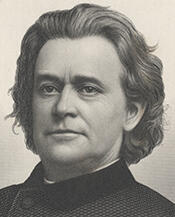
Here you will find contact information for Representative Samuel Fenton Cary, including email address, phone number, and mailing address.
| Name | Samuel Fenton Cary |
| Position | Representative |
| State | Ohio |
| District | 2 |
| Party | Independent |
| Status | Former Representative |
| Term Start | March 4, 1867 |
| Term End | March 3, 1869 |
| Terms Served | 1 |
| Born | February 18, 1814 |
| Gender | Male |
| Bioguide ID | C000216 |
About Representative Samuel Fenton Cary
Samuel Fenton Cary (February 18, 1814 – September 29, 1900) was an American politician, temperance advocate, and author who served as a Representative from Ohio in the United States Congress from 1867 to 1869. A member of the Independent Party and more specifically elected as an Independent Republican, he became well known nationally as a prohibitionist author and lecturer and was a significant leader in the 19th-century temperance movement. Over the course of his public life he also became associated with the Greenback Party and was a national candidate for high office.
Cary was born on February 18, 1814, in Cincinnati, Ohio, where he attended the public schools. He pursued higher education at Miami University in Oxford, Ohio, from which he graduated in 1835. He then studied law at the Cincinnati Law School, completing his legal education in 1837. That same year he was admitted to the bar and began practicing law in Cincinnati, maintaining an office in the city. His legal ability and public standing were such that he was elected a judge of the Ohio Supreme Court, but he declined to accept the position and instead continued in private practice.
In 1845 Cary abandoned the practice of law to become a farmer and to devote himself more fully to reform causes, particularly the temperance and anti-slavery movements. He emerged as a prominent lecturer and writer on prohibition and slavery, gaining a national reputation for his speeches and publications. His reform work drew him into broader political activity. He served as paymaster general for the State of Ohio under Governors Thomas W. Bartley and William Bebb, and in 1864 he was a delegate to the Republican National Convention, where he supported President Abraham Lincoln’s nomination for a second term. In 1865 he was appointed Collector of Internal Revenue for Ohio’s first district, further solidifying his role in public affairs.
Cary’s congressional service occurred during a significant period in American history, in the aftermath of the Civil War and during Reconstruction. In 1867 he was elected as an Independent Republican to the Fortieth Congress to represent Ohio’s second district, filling the vacancy caused by the resignation of Rutherford B. Hayes, who had been elected Governor of Ohio. Cary took his seat in the U.S. House of Representatives on November 21, 1867, and served until March 3, 1869, completing one full term in office. During his tenure he participated in the legislative process and represented the interests of his constituents in Ohio. He served as chairman of the House Committee on Education and Labor, a position that aligned with his longstanding interest in social reform. In one of the most consequential votes of the era, he voted against the impeachment of President Andrew Johnson. Cary was an unsuccessful candidate for reelection to the Forty-first Congress in 1868, losing to Job E. Stevenson.
After leaving Congress, Cary remained active in politics and reform. In 1875 he was an unsuccessful candidate for Lieutenant Governor of Ohio. He subsequently joined the Greenback Party, which advocated monetary reform and relief for farmers and laborers. In the presidential election of 1876 he was nominated by the Greenback Party for Vice President of the United States after Newton Booth declined to run. Cary appeared on the national ticket with presidential candidate Peter Cooper, opposing Republican nominee Rutherford B. Hayes and Democratic nominee Samuel J. Tilden. Hayes ultimately won the presidency with his running mate William A. Wheeler, while Cooper and Cary finished behind both the Republican and Democratic tickets. Cary’s vice-presidential candidacy nonetheless underscored his continued prominence in third-party and reform politics.
Cary’s influence as a temperance advocate extended beyond Ohio. His oratory and writings left a lasting impression on communities across the country. Frank Page, the founder and first mayor of Cary, North Carolina, named that town in his honor after hearing and admiring one of Cary’s temperance speeches delivered in the community. This act of commemoration reflected the national reach of Cary’s reform work and the respect he commanded among supporters of prohibition.
In his personal life, Cary was married twice. He married Maria Louisa Allen on October 18, 1836. She died of consumption on September 25, 1847. The couple had three children: Martha Louisa Cary, Ella Woodnutt Cary, and Lou Allen Cary. In 1849 he married Lida Stillwell, with whom he had three more children: Olive Cary, Samuel Fenton Cary Jr., and Jessie Cary. His family life ran parallel to his public career, and several of his later years were spent at the family homestead in what became the College Hill neighborhood of Cincinnati.
Cary lived out the final twenty years of his life primarily as a writer and lecturer, continuing to promote temperance and other reform causes while also reflecting on his long public career. He died at the Cary Homestead in College Hill, Cincinnati, Ohio, on September 29, 1900. He was interred with his family in Spring Grove Cemetery in Cincinnati. His life encompassed service as a lawyer, state official, member of Congress, national political candidate, and leading figure in the American temperance movement.