Representative Samuel Dickstein
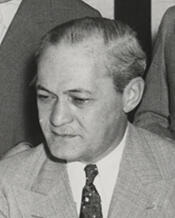
Here you will find contact information for Representative Samuel Dickstein, including email address, phone number, and mailing address.
| Name | Samuel Dickstein |
| Position | Representative |
| State | New York |
| District | 19 |
| Party | Democratic |
| Status | Former Representative |
| Term Start | December 3, 1923 |
| Term End | January 3, 1947 |
| Terms Served | 12 |
| Born | February 5, 1885 |
| Gender | Male |
| Bioguide ID | D000335 |
About Representative Samuel Dickstein
Samuel Dickstein (February 5, 1885 – April 22, 1954) was a Democratic Representative from New York who served twelve consecutive terms in the United States House of Representatives from 1923 to 1947, a justice of the New York State Supreme Court, and, according to later-released Soviet archives, a paid agent of the Soviet NKVD. Over a 22-year tenure in Congress, he played a central role in immigration policy and in the creation of the investigative body that evolved into the House Committee on Un-American Activities, which he used to pursue fascist and Nazi sympathizers as well as suspected communists. His career later became the subject of extensive historical scrutiny because of evidence that he engaged in bribery, illicit immigration schemes, and espionage on behalf of the Soviet Union.
Dickstein was born on February 5, 1885, into a Jewish family of five children near Vilna in the Russian Empire, in an area now known as Vilnius, Lithuania. His parents were Rabbi Israel Dickstein, who died in 1918, and Slata B. Gordon, who died in 1931. In 1887, when he was still a small child, the family immigrated to the United States and settled on the Lower East Side of New York City, a neighborhood that was then a center of Eastern European Jewish immigrant life. He attended both public and private schools in New York, then studied at the City College of New York. In 1906 he graduated from New York Law School, preparing for a legal career that would serve as his pathway into politics.
In 1908, Dickstein passed the New York bar and began practicing law in New York City with the firm of Hyman and Gross. He quickly became active in Democratic politics and, in 1911, entered the Tammany Hall organization in Manhattan under the mentorship of influential party leader John F. Ahearn. From 1911 to 1914 he served as a Deputy State Attorney General of New York, gaining experience in public law enforcement and administration. He was elected a New York City Alderman in 1917 and, two years later, in 1919, won election as a member of the New York State Assembly. These early posts established his reputation as a capable, ambitious Democratic politician closely tied to the powerful Tammany Hall machine.
In 1922, Dickstein was elected as a Democrat to the Sixty-eighth Congress, defeating Socialist incumbent Meyer London in a Lower East Side district with a large immigrant and working-class population. He entered the House of Representatives on March 4, 1923, and was reelected eleven times, serving continuously until his resignation on December 30, 1945. During his twelve terms, he represented New York through the Roaring Twenties, the Great Depression, the New Deal era, and World War II, participating in the legislative process and advocating for his constituents. A member of the Democratic Party, he became particularly prominent in matters relating to immigration and internal security. In 1930, he co-sponsored a bill condemning religious persecution in the Soviet Union, reflecting both his concern for religious freedom and his awareness of developments abroad.
By 1931, Dickstein had risen to become chairman of the House Committee on Immigration and Naturalization, a position he held from the Seventy-second through the Seventy-ninth Congresses. In that capacity he confronted the complex issues of legal and illegal immigration, as well as the growing wave of antisemitism and the spread of antisemitic literature in the United States. His concern about foreign extremist movements led him to investigate Nazi and other fascist organizations operating within the country. In 1932, he joined forces with Representative Martin Dies Jr. in an effort to outlaw membership in the Communist Party of the United States, signaling his willingness to target both fascist and communist movements. Following the failed assassination attempt on President Franklin D. Roosevelt by Giuseppe Zangara in 1933, Dickstein called for a congressional investigation into anarchism. In 1939, he held hearings on a “Child Refugee Bill,” also known as the Wagner–Rogers Bill, which proposed to admit up to 10,000 children under age 14 into the United States in 1939–1940, in addition to the existing German immigration quotas. The hearings made explicit that the bill’s purpose was to save German Jewish children from “annihilation… a complete pogrom.” The measure faced strong opposition from Secretary of State Cordell Hull and organizations such as the American Legion, the United Daughters of the Confederacy, the Society of Mayflower Descendants, and the Daughters of the American Revolution, and it ultimately did not pass.
Dickstein’s most enduring institutional legacy arose from his efforts to investigate foreign subversive propaganda. On January 3, 1934, he introduced the “Dickstein Resolution” (H.R. 198), which was adopted in March 1934 and created a “Special Committee on Un-American Activities Authorized to Investigate Nazi Propaganda and Certain Other Propaganda Activities,” commonly known as the McCormack–Dickstein Committee. Its mandate was to obtain information on how foreign subversive propaganda entered the United States and to identify the organizations disseminating it. From 1934 to 1937, the Special Committee, chaired by John William McCormack of Massachusetts with Dickstein as vice chairman, conducted public and private hearings and compiled some 4,300 pages of testimony. One of its first major inquiries concerned the so‑called “Business Plot,” an alleged 1933 conspiracy in which retired Marine Corps Major General Smedley Butler claimed that wealthy businessmen sought to organize a fascist veterans’ movement and overthrow President Roosevelt. Butler testified before the committee in 1934, but no prosecutions followed, and extensive portions of the record relating to prominent financiers were reportedly deleted. Contemporary media initially treated the plot seriously before many outlets, including The New York Times in an editorial, dismissed it as a “gigantic hoax,” and later historians have found no corroborating evidence beyond Butler’s assertions.
Throughout 1934, the McCormack–Dickstein Committee summoned many leading figures in the American fascist movement. Dickstein, who declared that his aim was the eradication of all traces of Nazism in the United States, personally questioned each witness. His flair for dramatics and sensationalism, and his tendency to make exaggerated claims, drew national headlines and increased his public profile. By 1935, the committee had helped expose that organizations such as the Friends of New Germany (later associated with the German American Bund of Fritz Julius Kuhn) and the “Silver Shirts” of William Dudley Pelley were actively supporting Nazi Germany while operating within the bounds of existing U.S. law. In 1937, Dickstein sought to continue the House’s investigative work, but control of the effort shifted to Martin Dies Jr., and he lost his leadership role. The successor body, later renamed the House Committee on Un-American Activities and made a standing committee in 1945, shifted its primary focus to communist organizations. Democratic leaders in the House, though unaware of his secret contacts with the Soviets or his alleged bribery, had grown distrustful of Dickstein because of his harsh treatment of witnesses and his propensity to exaggerate evidence, and they removed him from membership on the committee. After the 1938 German annexation of Austria, he attempted to introduce legislation that would reallocate unused immigration quotas to refugees fleeing Hitler, continuing his advocacy on behalf of those persecuted by the Nazi regime. In September 1945, shortly before leaving Congress, he publicly criticized the Dies Committee’s investigations into Hollywood as “a lot of ballyhoo” directed at an industry he described as almost “100 per cent American,” and he asserted that “the alien problem is dying away.”
Decades after his congressional service, archival evidence emerged indicating that Dickstein had also been engaged in espionage and corrupt practices during the late 1930s. According to research by Allen Weinstein and Alexander Vassiliev, published in 1999 and further elaborated in Weinstein’s 2000 book “The Haunted Wood,” Soviet NKVD files show that Dickstein was paid approximately $1,250 per month from 1937 to early 1940—equivalent to about $27,300 in 2024—in return for information on anti-communist and pro-fascist forces in the United States, as well as on supporters of Leon Trotsky. Soviet operatives reportedly concluded that he was “heading a criminal gang that was involved in shady businesses, selling passports, illegal smuggling of people, [and] getting citizenship,” and that he ran a lucrative trade in illegal visas for Soviet agents before offering to spy for the NKVD in exchange for cash. An Austrian working for the Soviets approached him seeking help in securing American citizenship; Dickstein allegedly replied that the Austrian quota was filled but that, for $3,000, he would “see what he could do,” adding that he had “settled dozens” of such cases illegally, according to an NKVD memorandum. His Soviet handlers, who nicknamed him “Crook,” described him as a “devoted and reliable” agent, and journalist Sam Roberts later noted that “Not even Julius Rosenberg knew that Samuel Dickstein had been on the KGB’s payroll.” Historian Joe Persico similarly wrote that Soviet files documented his spying and his greed. NKVD reports cited by Peter Duffy state that Dickstein denounced the Dies Committee as a “Red-baiting excursion” at Moscow’s request, delivered speeches in Congress on themes dictated by Soviet intelligence, and turned over “materials on the war budget for 1940, records of conferences of the budget subcommission, reports of the war minister, chief of staff, etc.” He also attempted, unsuccessfully, to expedite the deportation of Soviet defector Walter Krivitsky, while the Dies Committee worked to keep Krivitsky in the United States. Whether the information Dickstein supplied was of lasting intelligence value remains uncertain; when he left the investigative committee, the Soviets removed him from their payroll.
Following his resignation from Congress on December 30, 1945, Dickstein continued his public career in the judiciary. He served as a justice of the New York State Supreme Court, one of the state’s principal trial courts, and remained on the bench until his death. His judicial service capped a long and controversial public life that had begun in local New York politics and extended through some of the most turbulent decades of the twentieth century. On April 22, 1954, he died in New York City at the age of 69. He was buried at Union Field Cemetery in Queens, New York. On the Lower East Side of Manhattan, a one-block section of Pitt Street between Grand Street and East Broadway was named Samuel Dickstein Plaza in his honor, reflecting his long association with the neighborhood he once represented. In later years, as more information about his espionage and corruption became widely known, there were efforts to rename the street, but as of 2025 these attempts had not succeeded. Dickstein is also frequently noted in discussions and compilations of Jewish members of the United States Congress, reflecting both his heritage and his prominence in mid-twentieth-century American political life.