Representative Samuel Clarence Hyde
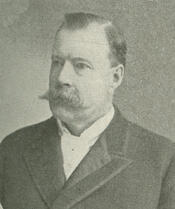
Here you will find contact information for Representative Samuel Clarence Hyde, including email address, phone number, and mailing address.
| Name | Samuel Clarence Hyde |
| Position | Representative |
| State | Washington |
| District | -1 |
| Party | Republican |
| Status | Former Representative |
| Term Start | December 2, 1895 |
| Term End | March 3, 1897 |
| Terms Served | 1 |
| Born | April 22, 1842 |
| Gender | Male |
| Bioguide ID | H001024 |
About Representative Samuel Clarence Hyde
Samuel Clarence Hyde (April 22, 1842 – March 7, 1922) was an American attorney and Republican politician from Washington who served as a Representative from Washington in the United States Congress from 1895 to 1897. He was most notable for his service as prosecuting attorney of Spokane County from 1880 to 1886 and as a member of the United States House of Representatives during the 54th Congress, when he contributed to the legislative process during one term in office and represented the interests of his constituents in Washington’s at-large congressional district.
Hyde was born in Ticonderoga, New York, on April 22, 1842, the son of Eli N. Hyde and Susan S. Hyde. He was a twin; his sister, Salina Clarissa, died in infancy at eight months of age. When he was three years old, his parents moved west to a farm near Oshkosh in Winnebago County, Wisconsin, where he was raised and received his early education. Growing up in the developing Midwest, Hyde experienced frontier agricultural life, which would later inform his familiarity with land, resource, and settlement issues that were central to the politics of the late nineteenth-century American West.
In December 1861, shortly after the outbreak of the American Civil War, Hyde enlisted in the Union Army. He joined Company K of the 17th Wisconsin Volunteer Infantry as a private, with his enlistment credited to the town of Utica in Winnebago County. During his service he attained the rank of sergeant. His military career was cut short when he was discharged for disability in July 1862, after approximately seven months of service. Following his discharge, Hyde did not immediately return to farming but instead worked as an explorer and surveyor of timber and mining lands in Michigan’s Upper Peninsula, gaining practical experience in land evaluation and resource development that would later complement his legal and political work.
By 1871 Hyde had moved into agriculture, beginning to farm in Lyon County, Iowa. In the early 1870s he pursued formal legal studies at what is now Iowa State University, where he studied law while continuing to build his professional prospects. He was admitted to the bar in 1872 and commenced the practice of law in Rock Rapids, Iowa. In addition to his legal practice, Hyde became publisher of the Lyon County Press, a local newspaper, and quickly emerged as an active Republican. He served as chairman of the Republican Party’s central committee in Lyon County, a role that marked his early engagement in party organization and electoral politics.
In 1877 Hyde moved to Washington Territory, where he continued his legal career in the rapidly growing communities of the Pacific Northwest. He practiced law in both Seattle and Tacoma before relocating in 1879 to Spokane, then a small but developing settlement. In Spokane he continued his legal work and became one of the city’s early developers, participating in the construction and management of several commercial buildings that contributed to the town’s emerging business district. In 1881 he was appointed prosecuting attorney of both Spokane County and Stevens County, and he served in this capacity for six years, from 1880 to 1886, gaining prominence as a public official and solidifying his reputation as a leading Republican attorney in eastern Washington.
In 1894 Hyde was nominated by the Republican Party as its candidate for the United States House of Representatives from Washington’s at-large congressional district. He was elected and served in the 54th Congress from March 4, 1895, to March 3, 1897. His service in Congress occurred during a significant period in American history marked by debates over economic policy, western development, and military preparedness. As a member of the House of Representatives, Samuel Clarence Hyde participated in the democratic process, contributed to the legislative work of the chamber, and represented the interests of his Washington constituents. Among his notable achievements in Congress was his successful advocacy for the construction of Fort George Wright, an army post near Spokane, which enhanced the region’s military presence and economic development. A member of the Republican Party, he sought reelection in 1896 but was unsuccessful, and his congressional service concluded after one term.
After leaving Congress, Hyde returned to Spokane and resumed the practice of law. He remained an active figure in local public life, serving for many years as a justice of the peace in Spokane. In that capacity he presided over cases in Spokane’s justice court, continuing his involvement in the administration of justice at the community level. He held this position until shortly before his death, when he retired due to ill health. His long tenure in local judicial service complemented his earlier roles as prosecuting attorney and congressman, reflecting a career devoted to law and public service in Washington.
Hyde’s personal life was rooted in the Midwest and later in Washington. In 1869 he married Mattie A. Rogers (1850–1891) of Rosendale, Wisconsin. The couple remained married until her death and were the parents of two children, a daughter, Katherine, and a son, Earl. Hyde’s family connections extended into Washington public life; his brother E. B. Hyde became a banker and real estate developer in Spokane and also served in the Washington State Senate, further entrenching the Hyde family in the civic and economic development of the region.
Samuel Clarence Hyde died in Spokane, Washington, on March 7, 1922. His funeral was held at Central Methodist Church in Spokane, where he received funeral honors from members of the local Grand Army of the Republic post, recognizing his Civil War service. He was interred at Fairmount Cemetery in Spokane. His life spanned the era from antebellum New York and frontier Wisconsin through the Civil War, western territorial development, and statehood politics in Washington, and his career encompassed roles as soldier, surveyor, farmer, attorney, newspaper publisher, local prosecutor, congressman, and justice of the peace.