Representative Samuel Austin Kendall
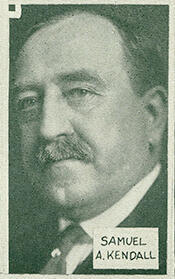
Here you will find contact information for Representative Samuel Austin Kendall, including email address, phone number, and mailing address.
| Name | Samuel Austin Kendall |
| Position | Representative |
| State | Pennsylvania |
| District | 24 |
| Party | Republican |
| Status | Former Representative |
| Term Start | May 19, 1919 |
| Term End | March 3, 1933 |
| Terms Served | 7 |
| Born | November 1, 1859 |
| Gender | Male |
| Bioguide ID | K000097 |
About Representative Samuel Austin Kendall
Samuel Austin Kendall (November 1, 1859 – January 8, 1933) was a Republican member of the U.S. House of Representatives from Pennsylvania who served seven consecutive terms in Congress from 1919 to 1933. Over the course of his legislative career, he represented his Pennsylvania constituents during a transformative period in American history that encompassed the end of World War I, the Roaring Twenties, and the onset of the Great Depression.
Kendall was born in Greenville Township, Somerset County, Pennsylvania, on November 1, 1859. He was educated in the public schools and later pursued further studies at Valparaiso, Indiana, and at Mount Union College in Alliance, Ohio. Although he did not emerge from a traditional elite background, his early commitment to education and self-improvement shaped his subsequent professional and political life.
From 1876 to 1890, Kendall worked in the field of education, teaching school for fourteen years. He advanced to an administrative role and served for five years as superintendent of the public schools of Jefferson, Iowa. His experience as a teacher and school administrator provided him with practical insight into public education and local governance. In 1890 he returned to Somerset County, Pennsylvania, where he shifted his focus from education to business and industry.
Upon his return to Pennsylvania, Kendall engaged in the lumber business and the mining of coal, sectors that were central to the regional economy. He became vice president of the Kendall Lumber Company of Pittsburgh, reflecting his emergence as a significant figure in the lumber trade. He also served as president of the Preston Railroad Company, a position that placed him at the intersection of resource extraction and transportation, and underscored his role in the broader industrial development of the region. His business activities helped establish his prominence in local affairs and laid the groundwork for his entry into state politics.
Kendall’s political career began at the state level when he was elected to the Pennsylvania House of Representatives, in which he served from 1899 to 1903. As a member of the state legislature, he gained experience in lawmaking and public policy that would later inform his work in the national legislature. His service in Harrisburg strengthened his standing within the Republican Party and among voters in his home region.
Building on his state legislative experience, Kendall was elected as a Republican to the Sixty-sixth Congress and to the six succeeding Congresses, serving in the U.S. House of Representatives from Pennsylvania from March 4, 1919, until his death on January 8, 1933. During these seven terms in office, he participated actively in the legislative process and the democratic governance of the nation, representing the interests of his constituents in a period marked by major economic and social change. As a member of the House of Representatives, he contributed to debates and decisions on national policy as the country navigated postwar adjustments, economic expansion, and the challenges of the early Depression years.
Kendall’s long congressional tenure came to an end under difficult circumstances. He was unsuccessful in his bid for reelection in 1932, losing his seat to Democrat J. Buell Snyder. Before his successor was sworn in, Kendall died of a self-inflicted gunshot wound in the House Office Building in Washington, D.C., on January 8, 1933. His death placed him among those members of the United States Congress who died in office in the first half of the twentieth century. He was interred in Hochstetler Cemetery in Greenville Township, Somerset County, Pennsylvania, returning in death to the community where his life had begun.