Representative Samuel Scott Marshall
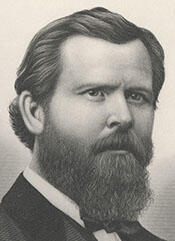
Here you will find contact information for Representative Samuel Scott Marshall, including email address, phone number, and mailing address.
| Name | Samuel Scott Marshall |
| Position | Representative |
| State | Illinois |
| District | 19 |
| Party | Democratic |
| Status | Former Representative |
| Term Start | December 3, 1855 |
| Term End | March 3, 1875 |
| Terms Served | 7 |
| Born | March 12, 1821 |
| Gender | Male |
| Bioguide ID | M000160 |
About Representative Samuel Scott Marshall
Samuel Scott Marshall (March 12, 1821 – July 26, 1890) was an American politician, attorney, and jurist who served a total of seven terms as a U.S. Representative from Illinois between 1855 and 1875. A member of the Democratic Party, he played a sustained role in the legislative process during a transformative period in American history, representing his Illinois constituents in the House of Representatives before, during, and after the Civil War.
Marshall was born near Shawneetown, Gallatin County, Illinois, on March 12, 1821. He was raised on the Illinois frontier and attended both public and private schools in McLeansboro, Illinois. Seeking further education, he studied at Cumberland College in Kentucky, an institution that prepared many young men in the region for professional careers. After his collegiate studies, he returned to Illinois to read law, reflecting the common 19th‑century practice of legal apprenticeship rather than formal law school training.
In 1845, Marshall was admitted to the bar and commenced the practice of law in McLeansboro, Illinois. His legal ability and growing local reputation soon led him into public service. He was elected to the Illinois House of Representatives, serving in the state legislature in 1846 and 1847. Shortly thereafter, he became State’s Attorney for the third judicial circuit of Illinois, holding that prosecutorial office in 1847 and 1848. Marshall’s judicial career advanced further when he was appointed and then served as an Illinois circuit court judge from 1851 until 1854, gaining experience that would later inform his work in Congress.
Marshall entered national politics in the mid‑1850s. He was elected as a Democrat to the Thirty‑fourth and Thirty‑fifth Congresses, serving in the U.S. House of Representatives from March 4, 1855, to March 3, 1859. During this initial period in Congress, he represented Illinois as sectional tensions over slavery and states’ rights intensified. In the Thirty‑fifth Congress he served as chairman of the House Committee on Claims, overseeing legislation related to financial claims against the federal government. His four years in Washington during this first tenure established him as a prominent Democratic figure from Illinois.
After leaving Congress in 1859, Marshall remained active in party and public affairs. He served as a delegate to the Democratic National Convention in 1860, participating in the fractious national deliberations that preceded the Civil War. In January 1861 he was the Democratic candidate of the Illinois legislature for the United States Senate, opposing incumbent Republican Lyman Trumbull. On January 9, 1861, the Illinois House of Representatives reelected Trumbull, who received 54 votes to Marshall’s 46. Following this defeat, Marshall returned to the bench, again serving as an Illinois circuit court judge from 1861 until 1864. He continued his involvement in national politics as a delegate to the Democratic National Convention in 1864, even as the Civil War continued to reshape the political landscape.
Marshall returned to Congress during the Reconstruction era. He was elected as a Democrat to the Thirty‑ninth Congress and to the four succeeding Congresses, serving continuously from March 4, 1865, to March 3, 1875. Over these five consecutive terms he represented Illinois’s 11th congressional district for four terms and, after redistricting, represented the 19th district for his final term. His long service during Reconstruction placed him at the center of debates over the reintegration of the former Confederate states, civil rights, and the balance of power between the executive and legislative branches. In 1867, during the Fortieth Congress, he was the Democratic candidate for Speaker of the House, reflecting his prominence within his party, though the Republican majority elected one of their own.
Marshall’s most consequential congressional work during this period involved the impeachment proceedings against President Andrew Johnson. During the Fortieth Congress he served on the House Committee on the Judiciary when it conducted the first impeachment inquiry. On November 25, 1867, the committee voted 5–4 to recommend impeachment; Marshall was on the minority side opposing impeachment, joining the other Democrat on the committee and two Republicans. On December 7, 1867, when the full House considered a resolution to impeach Johnson, Marshall was among the 108 members, including 66 Republicans, who voted against the measure, which was defeated 57–108. On January 28, 1868, he again voted against a resolution launching a second impeachment inquiry, although that resolution passed 99–31. He subsequently opposed the impeachment itself: on March 2 and 3, 1868, Marshall voted against all eleven articles of impeachment brought against Johnson. When the House moved on March 2, 1868, to select impeachment managers to prosecute the case before the Senate, Speaker Schuyler Colfax initially appointed Marshall to act as a teller to tally the vote. Marshall requested to be excused from this role, and he, along with the rest of the House Democrats, ultimately abstained from voting on the selection of impeachment managers.
Throughout his later congressional career, Marshall remained active in broader national political efforts at reconciliation and party realignment. He served as a delegate to the National Union Convention in 1866, a gathering that sought to build a coalition in support of President Johnson’s more lenient Reconstruction policies and to bridge divisions between moderate Republicans and Democrats. Despite his long tenure, Marshall was unsuccessful in his bid for reelection in 1874 to the Forty‑fourth Congress, bringing his service in the House to a close on March 3, 1875, after a total of seven terms between 1855 and 1875.
After leaving Congress, Marshall continued to contribute to education and party affairs in Illinois. From 1875 through 1880 he served as president of the board of managers of Hamilton College, an institution in Illinois, reflecting his interest in higher education and civic leadership. He again took part in national Democratic politics as a delegate to the Democratic National Convention in 1880, maintaining his influence within the party even after his congressional career had ended.
Samuel Scott Marshall spent his final years in McLeansboro, Illinois, where he had long practiced law and maintained his home. He died there on July 26, 1890. He was interred in Odd Fellows Cemetery in McLeansboro, closing a public career that had spanned state legislative service, judicial office, and two distinct periods in the U.S. House of Representatives during some of the most turbulent decades in American political history.