Representative Samuel Barrett Pettengill
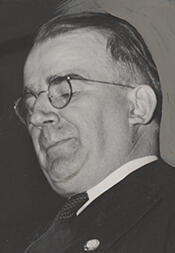
Here you will find contact information for Representative Samuel Barrett Pettengill, including email address, phone number, and mailing address.
| Name | Samuel Barrett Pettengill |
| Position | Representative |
| State | Indiana |
| District | 3 |
| Party | Democratic |
| Status | Former Representative |
| Term Start | December 7, 1931 |
| Term End | January 3, 1939 |
| Terms Served | 4 |
| Born | January 19, 1886 |
| Gender | Male |
| Bioguide ID | P000268 |
About Representative Samuel Barrett Pettengill
Samuel Barrett Pettengill (January 19, 1886 – March 20, 1974) was a Democratic U.S. Representative from Indiana who served four terms in the United States House of Representatives from 1931 to 1939, representing first Indiana’s 13th congressional district and, after redistricting, Indiana’s 3rd congressional district. A nephew of former territorial delegate William Horace Clagett, he became widely known for his legislative work on interstate commerce and petroleum regulation and for his later opposition to aspects of the New Deal and to proposals to expand and reorganize the Supreme Court.
Pettengill was born on January 19, 1886, in Portland, Oregon, the second son of Samuel Barrett and Susan Clagett Pettengill. After his mother’s death in 1890, the family moved in 1892 to Vermont, where they settled on the ancestral farm in Grafton, Windham County, first established by his great-grandfather in 1787. He attended local common schools and then Vermont Academy in Saxtons River, from which he graduated in 1904. He went on to Middlebury College in Middlebury, Vermont, earning his degree in 1908, and then studied law at Yale University, graduating from its law department in 1911. He was admitted to the bar in 1912 and commenced the practice of law that same year in South Bend, Indiana, beginning a long professional association with that city.
In his early legal career, Pettengill became a member of the bar of the Supreme Court of Indiana and later of the Supreme Court of the United States. He was active in local civic affairs and served on the South Bend board of education from 1926 to 1928. Over the course of his life he received honorary degrees from Harding, Franklin, Marietta, and Middlebury Colleges, as well as from Norwich University, reflecting his prominence as a lawyer, legislator, and author. On June 1, 1912, he married Josephine Campbell of Napoleon, Ohio; the couple had one daughter, Susan (Mrs. Thomas B. Douglas), who made her home in Washington, D.C. After Josephine’s death on June 26, 1948, Pettengill married Helen M. Charles of New York City on July 16, 1949. A lifelong Congregationalist, he maintained his membership in the Grafton Church in Grafton, Vermont, throughout his life.
Pettengill entered national politics as a Democrat and was elected to the Seventy-second Congress, taking office on March 4, 1931. He was initially chosen to represent Indiana’s 13th congressional district, which was eliminated following the 1930 Census; he was then redistricted and elected to represent Indiana’s 3rd congressional district, which he continued to serve in the three succeeding Congresses until January 3, 1939. His eight years in Congress coincided with the Great Depression and the early New Deal era, a significant period in American history. As a member of the House of Representatives, he participated actively in the legislative process and represented the interests of his Indiana constituents while engaging in national debates over economic regulation and federal power.
During his congressional service, Pettengill served on key committees, including the Committee on Military Affairs and, most notably, the Committee on Interstate and Foreign Commerce. In these roles he helped formulate much influential legislation. He was instrumental in the enactment of the Connolly Hot Oil Act and in the development of the Interstate Oil Compact, reflecting his deep involvement in the regulation and conservation of petroleum resources. As a member of the Interstate and Foreign Commerce Committee, he contributed to the drafting of the Securities Act, the Motor Carriers Act, the Securities Exchange (Stock Exchange) Act, the Natural Gas Act, and other measures affecting railroads, commodity exchanges, public utilities, aviation, and the Panama Canal. Although elected as a Democrat, he became widely known for his opposition to certain New Deal initiatives, particularly his prominent role in the defeat of President Franklin D. Roosevelt’s Supreme Court “packing” proposal and the related Reorganization Bill. Choosing not to seek renomination in 1938 to the Seventy-sixth Congress, he left office on January 3, 1939, and resumed the practice of law.
Alongside his legal work, Pettengill developed a substantial career as an author and commentator on public affairs. His first book, “Hot Oil,” published in 1936, examined the arguments for and against federal control or nationalization of the petroleum industry; he favored state rather than federal regulation and advocated the highest degree of industrial freedom consistent with conservation of national petroleum resources. In 1939 he published “Jefferson, The Forgotten Man,” arguing that the principles of Thomas Jefferson had been largely abandoned in contemporary American governance. A strong critic of numerous New Deal policies, he wrote the best-selling non-fiction book “Smoke Screen” in 1940, drawing parallels between expanding federal controls over American business and developments in Germany and Italy. He continued this theme in “For Americans Only,” published in 1944, which updated his critique of centralized federal authority. From 1939 to 1948 he worked as a newspaper columnist, writing a twice-a-week column titled “The Gentleman From Indiana,” syndicated to more than 100 newspapers nationwide, and from 1947 to 1948 he spoke on public affairs every Sunday afternoon over the American Broadcasting System.
Pettengill also played an active role in national political and business organizations after leaving Congress. In 1940 he served as chairman of the “No Third Term” campaign meeting at Carnegie Hall, opposing a third presidential term for Franklin D. Roosevelt. In 1942 he was elected chairman of the Republican National Finance Committee, marking a notable shift from his earlier Democratic affiliation. He served as vice president and general counsel of the Transportation Association of America from 1943 to 1945, though he resigned early in 1944 to devote more time to his law practice, writing, and public speaking. From 1949 to 1956 he was a practicing attorney for the Pure Oil Company in Chicago, Illinois, and from 1956 to 1965 he served as a consultant to the Coe Foundation.
On July 1, 1956, Pettengill formally retired from public life and returned to Vermont, settling again at his boyhood farm in Grafton. In retirement he continued to write and speak in defense of constitutional government and the competitive free enterprise system. He taught American history at various colleges in the Vermont area and remained deeply engaged in the study of regional history. He served as a trustee of the Vermont Historical Society and in 1962 helped found the Grafton Historical Society, serving as its president for the next ten years. His interest in the early history of Vermont and its settlers led him to write his fifth book, “The Yankee Pioneers—A Saga of Courage,” published in 1971, which reflected his longstanding fascination with the state’s colonial and revolutionary-era past.
Pettengill was also active in Masonic affairs. He attained the 33rd Degree in Freemasonry, served as Master of Lodge No. 294, and was a past deputy Grand Master of the Indiana Grand Lodge. In 1973 he received a citation and a medal of honor from the Masons in recognition of his distinguished service to the craft. He continued to reside at his family farm in Grafton until his death in Springfield, Vermont, on March 20, 1974. He was interred in Grafton Village Cemetery in Grafton, Vermont. His autobiography, “My Story,” edited by his wife Helen, was published posthumously in 1979, providing a personal account of his life as lawyer, legislator, author, and public advocate.