Representative Samuel Leland Powers
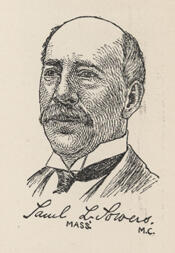
Here you will find contact information for Representative Samuel Leland Powers, including email address, phone number, and mailing address.
| Name | Samuel Leland Powers |
| Position | Representative |
| State | Massachusetts |
| District | 12 |
| Party | Republican |
| Status | Former Representative |
| Term Start | December 2, 1901 |
| Term End | March 3, 1905 |
| Terms Served | 2 |
| Born | October 26, 1848 |
| Gender | Male |
| Bioguide ID | P000492 |
About Representative Samuel Leland Powers
Samuel Leland Powers (October 26, 1848 – November 30, 1929) was a United States Representative from Massachusetts and a prominent Republican lawyer, civic leader, and public official whose career spanned municipal, state, and federal service during a significant period in American history. Over two terms in the U.S. House of Representatives from 1901 to 1905, he contributed to the legislative process and represented the interests of his Massachusetts constituents.
Powers was born in Cornish, New Hampshire, on October 26, 1848. He received his early education locally before attending Kimball Union Academy in Meriden, New Hampshire, an institution that prepared many students for collegiate study. He went on to Dartmouth College in Hanover, New Hampshire, where he graduated in 1874. After college, he pursued legal studies at the University of the City of New York Law School (now New York University School of Law) and continued his legal training in Worcester, Massachusetts, thereby laying the foundation for a long professional life in the law.
In November 1875, Powers was admitted to the bar in Worcester County, Massachusetts. At that time he commenced the practice of law in Boston, establishing himself in the city’s legal community, and he took up residence in nearby Newton. His growing reputation as an attorney and citizen led him into local public service. In Newton he served on the Newton City Council and rose to the position of president of the council, gaining experience in municipal governance and building a political base that would support his later congressional career.
A member of the Republican Party, Powers was elected to the Fifty-seventh and Fifty-eighth Congresses as a Representative from Massachusetts, serving from March 4, 1901, to March 3, 1905. His service in Congress occurred during a significant period in American history marked by industrial expansion, debates over imperial policy, and the early stirrings of the Progressive Era. As a member of the House of Representatives, Samuel Leland Powers participated in the democratic process and represented the interests of his constituents in Massachusetts. He was appointed one of the managers by the House of Representatives in 1905 to conduct the impeachment trial proceedings against Charles Swayne, judge of the United States District Court for the Northern District of Florida, a notable responsibility that reflected the confidence of his colleagues. Powers declined to be a candidate for renomination in 1904, thereby concluding his congressional service after two terms.
After leaving Congress, Powers resumed the practice of law in Boston, where he continued to be an influential figure in legal and civic affairs. He maintained close ties to his alma mater, serving as a trustee of Dartmouth College from 1905 to 1915. His interest in education extended to public service at the state level; he was a member of the Massachusetts Board of Education from 1915 to 1919, contributing to the oversight and development of educational policy in the Commonwealth. In addition to his civilian roles, Powers served in the state militia for ten years and was a member of the Ancient and Honorable Artillery Company of Massachusetts, one of the oldest chartered military organizations in the United States.
Powers also played a role in constitutional and governmental reform in Massachusetts. After the Massachusetts legislature and electorate approved the calling of a constitutional convention in 1916, he was elected in May 1917 to serve as a member of the Massachusetts Constitutional Convention of 1917, representing the Massachusetts Thirteenth Congressional District. In this capacity, he participated in deliberations on potential changes to the state’s fundamental law during the World War I era, bringing to the convention his experience as a lawyer, legislator, and educator.
In his later years, Powers remained active in civic, cultural, and business affairs. He was a member of several prominent clubs, including the University, Exchange, Newton, and Atlantic Conference Clubs, and he served as president of the Boston Art Club, reflecting his engagement with the cultural life of the region. From 1918 to 1928 he was a trustee of the board of public control for the operation of the Boston Elevated Railway, the major urban transit system in the Boston area at the time, and he served as chairman of that board from 1923 to 1928. In this role he helped oversee public transportation policy and operations during a decade of growth and modernization.
Samuel Leland Powers died in Newton, Massachusetts, on November 30, 1929. He was interred in Newton Cemetery in Newton Center. His career encompassed local government, national legislative service, educational leadership, military and civic participation, and oversight of key public infrastructure, marking him as a significant public figure in Massachusetts in the late nineteenth and early twentieth centuries.