Senator Samuel Lewis Southard
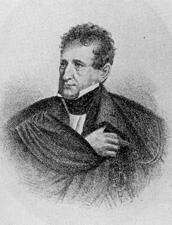
Here you will find contact information for Senator Samuel Lewis Southard, including email address, phone number, and mailing address.
| Name | Samuel Lewis Southard |
| Position | Senator |
| State | New Jersey |
| Party | Whig |
| Status | Former Representative |
| Term Start | January 26, 1821 |
| Term End | June 26, 1842 |
| Terms Served | 4 |
| Born | June 9, 1787 |
| Gender | Male |
| Bioguide ID | S000689 |
About Senator Samuel Lewis Southard
Samuel Lewis Southard (June 9, 1787 – June 26, 1842) was a prominent American statesman of the early nineteenth century, serving as a United States senator from New Jersey, secretary of the Navy, the tenth governor of New Jersey, and president pro tempore of the United States Senate. A leading figure in the emerging Whig Party, he played a significant role in national politics during a formative period in American history and, for a brief time, stood first in the presidential line of succession due to concurrent vacancies in the offices of vice president and speaker of the House.
Southard was born on June 9, 1787, in the Basking Ridge section of Bernards Township, New Jersey, the son of Henry Southard and Sarah (Lewis) Southard. His father served in Congress, and the family’s background included notable early American ancestry; among his forebears was Anthony Janszoon van Salee, one of the earliest settlers of New Amsterdam and of partial Moorish descent. His siblings included Isaac Southard, who would also enter public life. Southard received a classical education at the Brick Academy in Basking Ridge and went on to Princeton University, from which he graduated in 1804, laying the academic foundation for his subsequent legal and political career.
After completing his studies, Southard initially taught school in New Jersey before moving to Virginia, where he spent several years as a tutor in the household of John Taliaferro, a colleague of his father in Congress. While residing in Virginia, he read law under Francis T. Brooke and Judge Williams of Fredericksburg. Upon admission to the bar, he returned to New Jersey and established a law practice in Flemington in 1811. His legal abilities were quickly recognized: in 1814 the New Jersey Legislature appointed him law reporter, and in 1815 he was elected to the New Jersey General Assembly. Shortly thereafter he was appointed to the New Jersey Supreme Court to succeed Mahlon Dickerson, and in 1820 he served as a presidential elector, further integrating himself into both state and national political affairs.
Southard’s congressional career began when he was elected by the New Jersey Legislature to the United States Senate to fill the vacancy caused by the resignation of James J. Wilson. He was appointed to the remainder of Wilson’s term and served from January 26, 1821, to March 3, 1823, when he resigned. During this initial period in the Senate, he was a member of the committee that produced the Missouri Compromise, a landmark measure in the ongoing national debate over the expansion of slavery. His service in Congress occurred during a significant period in American history, and as a senator from New Jersey he participated in the legislative process and represented the interests of his constituents at a time of rapid territorial and political change.
In September 1823 President James Monroe selected Southard to serve as Secretary of the Navy, a post he continued to hold under President John Quincy Adams. He also briefly held additional cabinet responsibilities as ad interim Secretary of the Treasury in 1825 and Secretary of War in 1828. As Secretary of the Navy, Southard proved to be one of the most effective early leaders of the department. He worked to enlarge the Navy and improve its administration, purchased land for the first naval hospitals, and initiated construction of the first Navy dry docks. Under his direction, the Navy undertook surveys of the United States coastline and promoted exploration in the Pacific Ocean. Responding to the actions of influential officers such as David Porter, Southard reinforced the American tradition of civilian control over the military establishment. During his tenure, the Navy expanded by roughly 50 percent in personnel and expenditures and extended its operations into waters that had not previously seen an American man-of-war. In the 1820s he was also a member of the Columbian Institute for the Promotion of Arts and Sciences, a prestigious society whose membership included former presidents Andrew Jackson and John Quincy Adams and many leading figures in government, the military, and the professions.
Returning to state service after the change in national administrations, Southard became attorney general of New Jersey in 1829, succeeding Theodore Frelinghuysen. His prominence in state politics continued to grow, and in 1832 the New Jersey Legislature elected him governor over Peter D. Vroom by a vote of 40 to 24, making him the tenth governor of New Jersey. In 1833 he was again chosen by the legislature to represent New Jersey in the United States Senate. During this extended Senate service, which lasted until 1842, he emerged as a leader of the Whig Party and attained national prominence as chairman of the Committee on Naval Affairs. Over the course of four terms in office between 1821 and 1842, he contributed significantly to the legislative process and helped shape Whig policy on issues ranging from internal improvements to executive power.
During his later Senate years, Southard was elected president pro tempore of the Senate. In that capacity, following the death of President William Henry Harrison and the accession of Vice President John Tyler to the presidency in 1841, Southard stood first in the presidential line of succession at a moment when the offices of vice president and speaker of the House were both vacant. His standing in the national intellectual community was also recognized; in 1839 he was elected to membership in the American Philosophical Society. However, his health began to decline, and failing health ultimately forced him to resign from the Senate in 1842, bringing an end to more than two decades of high-level public service.
Samuel Lewis Southard died in Fredericksburg, Virginia, on June 26, 1842, while still in office as a United States senator. He was interred in the Congressional Cemetery in Washington, D.C. His legacy has been commemorated in several ways: the destroyer USS Southard (DD-207), later redesignated DMS-10 and in service from 1919 to 1946, was named in his honor; a public park in Basking Ridge, New Jersey, bears his name; and streets named Southard Street in Key West, Florida, and in Trenton, New Jersey, also memorialize his contributions to the state and the nation.