Senator Saxby Chambliss
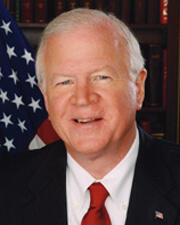
Here you will find contact information for Senator Saxby Chambliss, including email address, phone number, and mailing address.
| Name | Saxby Chambliss |
| Position | Senator |
| State | Georgia |
| Party | Republican |
| Status | Former Representative |
| Term Start | January 4, 1995 |
| Term End | January 3, 2015 |
| Terms Served | 10 |
| Born | November 10, 1943 |
| Gender | Male |
| Bioguide ID | C000286 |
About Senator Saxby Chambliss
Clarence Saxby Chambliss, born November 10, 1943, is an American lawyer and retired politician who represented the state of Georgia in the United States Congress from 1995 to 2015. A member of the Republican Party, he served four terms in the U.S. House of Representatives from 1995 to 2003 and two terms in the U.S. Senate from 2003 to 2015. His congressional career spanned a significant period in American history, during which he participated in the legislative process and represented the interests of his Georgia constituents.
Chambliss was born in Warrenton, North Carolina, and grew up in a family with deep roots in the American South. He attended public schools and later enrolled at Louisiana Tech University before transferring to the University of Georgia, where he received a Bachelor of Business Administration degree in 1966. He went on to study law at the University of Tennessee College of Law, earning his Juris Doctor in 1968. After completing his legal education, he moved to Moultrie, Georgia, where he established himself as a practicing attorney. His early legal career in south Georgia, focused largely on business and agricultural interests, helped build the local connections and reputation that would later underpin his entry into elective office.
Chambliss entered national politics in the Republican wave of the mid-1990s. He was elected to the U.S. House of Representatives in 1994 and took office on January 3, 1995, representing a Georgia district in the U.S. Congress. He was re-elected and ultimately served in the House until January 3, 2003. During his House tenure, Chambliss became particularly active on national security issues. He chaired the House Intelligence Subcommittee on Terrorism and Homeland Security, a position that placed him at the center of congressional oversight of the intelligence community. In the aftermath of the September 11, 2001, terrorist attacks, this subcommittee oversaw investigations of the intelligence community’s performance and contributed to the legislative response on terrorism and homeland security.
In 2002, Chambliss sought election to the U.S. Senate after encouragement from White House political adviser Karl Rove and the Bush administration, who viewed the Democratic Party of Georgia as politically vulnerable. He ran against freshman Democratic incumbent Senator Max Cleland, a decorated Vietnam War veteran who had lost three limbs during his military service. The campaign drew national attention, particularly an advertisement run by Chambliss’s campaign that portrayed Cleland as weak on defense and homeland security. The ad was widely criticized by both Democrats and Republicans; Republican Senators John McCain and Chuck Hagel complained to the Republican National Committee about the advertisement, which was subsequently taken down. Despite the controversy, Chambliss won the election, receiving 53 percent of the vote to Cleland’s 46 percent, and took office in the Senate on January 3, 2003.
As a U.S. senator from Georgia from 2003 to 2015, Chambliss played a prominent role on several key committees. He chaired the Senate Committee on Agriculture, Nutrition, and Forestry during the 109th Congress (2005–2007), a significant post for a senator from an agriculturally important state. In that capacity, he helped shape federal farm policy, nutrition programs, and forestry legislation. He also served on the Senate Select Committee on Intelligence, and during the 112th Congress (2011–2012) he was the ranking Republican member of that committee, continuing his long-standing engagement with national security and intelligence oversight. His Senate service also included work on fiscal and budgetary issues; in December 2011, the Washington Post named Chambliss as one of the “Best Leaders of 2011” for his efforts to craft a bipartisan deficit reduction package, reflecting his participation in cross-party negotiations on long-term federal debt and spending.
Chambliss was re-elected to the Senate in 2008 in a closely watched contest. In the general election held on November 4, 2008, he received 49.8 percent of the vote, while Democratic challenger Jim Martin received 47 percent and Libertarian candidate Allen Buckley received 3 percent. Because no candidate exceeded 50 percent of the vote, Georgia law required a runoff election between Chambliss and Martin, which was held on December 2, 2008. During the runoff period, Chambliss received a subpoena in connection with litigation against Imperial Sugar Company arising from the February 7, 2008, explosion at a Savannah-based sugar refinery. The lawsuit alleged that Imperial Sugar had wrongfully failed to remove hazards that caused the disaster, and Chambliss was accused of “harassing” a former sugar company executive. In response, he issued a statement expressing sympathy for the families affected by the explosion and indicated that he had referred the matter to Senate lawyers. When subpoenaed to testify, he asserted “legislative immunity.” Chambliss ultimately defeated Martin in the runoff election, winning 57 percent of the vote to Martin’s 43 percent.
Chambliss’s congressional service, encompassing six terms in office across both chambers, coincided with major developments in U.S. domestic and foreign policy, including the post–Cold War realignment, the wars in Afghanistan and Iraq, and the Great Recession. He contributed to the legislative process on agriculture, national security, intelligence, and fiscal policy, and was a visible figure in debates over homeland security and deficit reduction. In 2014, he chose not to seek reelection to the Senate, and his term concluded on January 3, 2015, marking the end of two decades of continuous service in the U.S. Congress. After leaving office, Chambliss returned to private life, drawing on his experience as a lawyer and former legislator while remaining a respected voice on agricultural policy, intelligence matters, and bipartisan fiscal reform.