Representative Scott McInnis
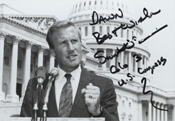
Here you will find contact information for Representative Scott McInnis, including email address, phone number, and mailing address.
| Name | Scott McInnis |
| Position | Representative |
| State | Colorado |
| District | 3 |
| Party | Republican |
| Status | Former Representative |
| Term Start | January 5, 1993 |
| Term End | January 3, 2005 |
| Terms Served | 6 |
| Born | May 9, 1953 |
| Gender | Male |
| Bioguide ID | M000477 |
About Representative Scott McInnis
Stephen Scott Emory McInnis (born May 9, 1953) is an American politician and lawyer who served as a Republican member of the United States House of Representatives from Colorado from 1993 to 2005. Born in Glenwood Springs, Colorado, he graduated from Glenwood Springs High School and went on to attend Mesa State College in Grand Junction. He later transferred to Fort Lewis College in Durango, where he earned a Bachelor of Arts degree in 1975. McInnis subsequently studied law at St. Mary’s University School of Law in San Antonio, Texas, receiving his Juris Doctor in 1980.
Before entering elective office, McInnis held a variety of positions in public service and the private sector. He served as a police officer in Glenwood Springs, gaining early experience in law enforcement and community issues. He later worked as a hospital director, further broadening his administrative and management background. After completing law school, he returned to Colorado and established a law practice, building a legal career that would underpin his subsequent work as a legislator. Over time, he also became active in policy and civic organizations, including membership in the American Legislative Exchange Council (ALEC) and service as an honorary adviser for the National Student Leadership Conference.
McInnis began his political career in the Colorado House of Representatives, where he served from 1983 to 1993. During his decade in the state legislature, he rose to key leadership roles, including election as House Majority Leader. He also served as Chairman of the Agriculture and Natural Resources Committee, reflecting his focus on issues central to Colorado’s rural communities, public lands, and resource management. His work in the state house helped establish his reputation as a legislator attentive to Western water, land, and agricultural concerns and positioned him for higher office.
In 1992, McInnis was elected to the U.S. House of Representatives from Colorado’s 3rd Congressional District and took office on January 3, 1993. He served six consecutive terms, remaining in Congress until January 3, 2005. As a member of the House of Representatives, McInnis participated in the legislative process during a significant period in American history and represented the interests of his largely rural and Western Slope constituency. He held a seat on the powerful Committee on Ways and Means, which oversees taxation, trade, and many aspects of federal economic policy. Following the Chandra Levy investigation, McInnis proposed that the House adopt strict rules prohibiting members from having romantic or sexual relationships with interns they supervised, reflecting his interest in congressional ethics and workplace standards.
Public lands and conservation policy were central themes of McInnis’s congressional tenure. Along with Senator Ben Nighthorse Campbell, he sponsored legislation to redesignate Black Canyon of the Gunnison National Monument as Black Canyon of the Gunnison National Park in 1999. In 2000, McInnis and Senators Ben Nighthorse Campbell and Wayne Allard authored the Great Sand Dunes National Park and Preserve Act, which led to Great Sand Dunes becoming the nation’s 58th national park in 2004. In recognition of his work on public lands and conservation, the McInnis Canyons National Conservation Area, located west of Grand Junction, was named in his honor. Over the course of his service, he received numerous awards, including being named “Person of the Decade” by The Glenwood Post in 1999 and “Best Local Government Official” by The Grand Junction Daily Sentinel from 1999 to 2003. He was also honored with the Colorado Association of Homebuilders’ Award for Government Service, the Legislator of the Year Award from the Colorado Wildlife Federation, the Golden Bulldog Award from Watchdogs of the Treasury, the National Security Leadership Award from the American Security Council, the Sound Dollar Award from the Free Congress Foundation, the Spirit of Free Enterprise Award from the U.S. Chamber of Commerce, the Hero of the Taxpayer Award from Americans for Tax Reform, the Tax Fighter Award from the National Tax Limitation Committee, and the Friend of Farm Bureau award from the American Farm Bureau Federation. During this period he also employed and mentored future Colorado state senator Josh Penry, who has been described as his political protégé.
After leaving Congress in 2005, McInnis accepted a two-year fellowship with the Hasan Family Foundation. Under the fellowship, he was paid $300,000 to conduct speaking engagements and to research and write a series of monthly articles on Colorado water issues for potential publication and distribution. Soon after beginning the fellowship, he also took a full-time position with the law firm Hogan & Hartson (later Hogan Lovells) in Denver. In 2005, his congressional campaign committee came under scrutiny when Democrats filed a complaint with the Federal Election Commission alleging improper payments to his wife, Lori McInnis, for work as campaign manager in 2004 when he was not actively seeking office. The campaign explained that she was employed to maintain campaign archives, direct contributions to other campaigns, and serve as liaison with the campaign’s accounting firm. McInnis’s chief of staff argued it was naive to assume that the campaign was inactive simply because he was not seeking re-election. The FEC ultimately dismissed the complaint and found no evidence of wrongdoing. During this period, McInnis was also regarded as an early Republican frontrunner for Colorado’s 2008 U.S. Senate election but chose not to enter the race, citing family reasons.
McInnis’s post-congressional career was significantly affected by controversy surrounding his work for the Hasan Family Foundation. In 2010, the foundation posted his water-policy writings—150 pages in 23 parts—on its website. Teresa Fishman, director of the Center for Academic Integrity at Clemson University, reviewed the material and concluded that several parts constituted clear plagiarism, with both ideas and language closely tracking a 20-year-old essay by then–Colorado Supreme Court Justice Gregory J. Hobbs. A McInnis spokesperson stated that he had relied on the research and expertise of Rolly (Rollie) Fischer, a Glenwood Springs engineer associated with the Colorado River Water Conservation District, and asserted that Fischer had handled the sections in question. McInnis’s Republican primary opponent for governor, Dan Maes, publicly criticized him for attempting to shift blame and urged him to accept responsibility. Fischer, for his part, rejected efforts to place responsibility on him, telling the Glenwood Springs Post Independent that “Scott’s responsible for it” and declining further comment. In a televised interview with KMGH-TV, McInnis repeatedly declined to give a definitive answer as to who had written the articles, but later issued a written apology stating that he should have been more vigilant in reviewing the research materials submitted by Fischer. Fischer subsequently said he had not known the articles were to be published, had not known of the foundation grant, had been paid a few hundred dollars per article, and had been asked by the McInnis campaign to sign a letter taking responsibility for the lack of attribution, which he refused to do. The Hasan Family Foundation announced an internal investigation and indicated that, if the allegations were proven, it would demand repayment of the fellowship funds. Dr. Malik Hasan, a board member who had hired McInnis, expressed disappointment in both the quantity and quality of the work and said he would recommend that McInnis return a substantial portion of the money. The controversy was further colored by the fact that the Hasans’ son, Ali Hasan, had failed to secure the Republican nomination for state treasurer in 2010 and had not received McInnis’s endorsement, though Dr. Hasan stated that this did not influence the foundation’s stance on repayment. Hogan Lovells confirmed on January 6, 2011, that McInnis would not return to its Denver office.
The plagiarism allegations emerged in the midst of McInnis’s 2010 campaign for governor of Colorado. Having previously been mentioned as a possible candidate for either the U.S. Senate or the governorship, he ultimately declined to pursue the Senate seat but expressed interest in challenging Democratic Governor Bill Ritter. After Ritter announced he would not seek re-election, McInnis formally declared his candidacy for governor on May 21, 2009. Although he did not secure the nomination at the Republican state convention, he was widely regarded as the frontrunner for the party’s nomination. The plagiarism story, however, gained substantial public attention and damaged his standing with voters and party activists. In the August 10, 2010, Republican primary, McInnis lost the nomination by slightly more than one percent of the vote to businessman Dan Maes. An aide indicated that McInnis had apologized to Justice Hobbs and hoped to meet with him, and McInnis publicly apologized to voters, calling the incident a “mistake” that was “unacceptable” and “inexcusable,” though he maintained it was unintentional. The Hasan Foundation and McInnis later reached a settlement under which he agreed to repay the organization, while continuing to assert that his primary error was trusting Fischer. In 2011, the Office of Attorney Regulation Counsel (OARC) in Colorado announced that it had found insufficient evidence to support claims that McInnis had violated professional disciplinary rules as an attorney. OARC’s review of archived materials showed that both Fischer and Seeme Hasan had forgotten certain communications with McInnis from 2005, and that in fact McInnis had instructed Fischer in writing not to plagiarize any work because the articles might be published by the foundation. OARC reported that Fischer alone chose to import large sections of Justice Hobbs’s article without attribution and without disclosing this to McInnis, and that McInnis had disclosed his use of a research assistant to Seeme Hasan in 2005. Ethics Watch stated that it considered the matter closed. Commenting on the OARC ruling, some observers, including political operative Jennifer Raiffie, argued that McInnis had been publicly exonerated and criticized the Denver Post’s coverage of the controversy as unfair and damaging.
Despite the setbacks of 2010, McInnis remained active in public life. In November 2014, he was elected to the Mesa County Board of County Commissioners, representing a key jurisdiction on Colorado’s Western Slope. He took office in January 2015, succeeding Commissioner Steven Acquafresca, and served two terms on the board. His tenure on the commission continued his long-standing engagement with local governance, land use, and economic development issues in western Colorado. McInnis left the board in January 2023, when he was succeeded by Bobbie Daniel. Throughout his career, from the Colorado House of Representatives to the U.S. Congress and later county government, McInnis has remained a prominent Republican figure associated with Western resource policy, fiscal conservatism, and the politics of Colorado’s 3rd Congressional District.