Representative Seaborn Anderson Roddenbery
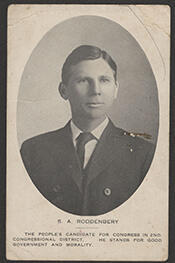
Here you will find contact information for Representative Seaborn Anderson Roddenbery, including email address, phone number, and mailing address.
| Name | Seaborn Anderson Roddenbery |
| Position | Representative |
| State | Georgia |
| District | 2 |
| Party | Democratic |
| Status | Former Representative |
| Term Start | March 15, 1909 |
| Term End | March 3, 1915 |
| Terms Served | 3 |
| Born | January 12, 1870 |
| Gender | Male |
| Bioguide ID | R000370 |
About Representative Seaborn Anderson Roddenbery
Seaborn Anderson Roddenbery (January 12, 1870 – September 25, 1913) was a Democratic member of the U.S. House of Representatives from the state of Georgia, serving from 1909 until his death in 1913. He was known nationally for his proposal of an anti-miscegenation amendment to the United States Constitution and for his conservative positions on fiscal and pension matters. Over the course of three terms in office, he represented Georgia’s 2nd congressional district and participated actively in the legislative process during a significant period in American political history.
Roddenbery was born on a farm in Decatur County, Georgia, on January 12, 1870, to Dr. Seaborn Anderson Roddenbery and Martha America Braswell Roddenbery. His family name, sometimes misspelled “Roddenberry,” had earlier been changed by his grandfather from “Roddenbury.” His father, originally a country doctor who practiced medicine on horseback, developed a sideline business producing open-kettle sugar cane syrup. As the syrup enterprise expanded, Dr. Roddenbery abandoned medicine to devote himself fully to the syrup trade, which eventually grew into the W. B. Roddenbery Company, based in Cairo, Georgia. Growing up in this environment, the younger Roddenbery was exposed to both professional and entrepreneurial pursuits that shaped his early outlook.
Roddenbery attended public schools in Georgia before enrolling at Mercer University. His studies at Mercer lasted three years, but he was forced to withdraw due to family financial constraints. Despite leaving college without a degree, he quickly entered public life. In 1891, at just twenty-one years of age, he was elected to represent his home district in the Georgia House of Representatives. After serving two terms in the state legislature, he was appointed professor of language and mathematics at South Georgia College in McRae, Georgia, reflecting both his intellectual abilities and his growing stature in state affairs.
In 1894, after reading law, Roddenbery was admitted to the bar in Georgia and resigned his academic post to begin a legal career. Over the next several years, he built a private law practice while deepening his involvement in local and regional politics. He served as president of the Thomas County Board of Education from 1895 to 1898, overseeing local educational matters, and was appointed a judge of the county court of Thomas County, serving from 1897 to 1901. His prominence in civic life continued to grow, and he was elected mayor of Thomasville, Georgia, holding that office from 1903 to 1904. These roles established him as a significant figure in south Georgia public life and prepared him for national office.
Roddenbery entered Congress during the 61st United States Congress. In 1910, he was elected as a Democrat to represent Georgia’s 2nd congressional district in the U.S. House of Representatives for the remainder of the term left vacant by the death of Representative James M. Griggs. He was subsequently re-elected to the 62nd and 63rd Congresses, serving continuously until his death in 1913. As a member of the House of Representatives, he represented the interests of his constituents in southwest Georgia and took an active part in debates and legislative initiatives. He developed a reputation in Washington as a skillful and inspiring orator, and by the time of his death he was regarded as one of the top three parliamentarians in the House, frequently resorting to filibusters and procedural tactics when confronting legislation he opposed.
In Congress, Roddenbery was a conservative on fiscal matters and became known for his vigorous opposition to what he termed “pension buccaneers.” He resisted efforts to expand federal retirement benefits for certain groups, particularly proposals to increase pensions for Union veterans of the Civil War, while many Confederate veterans in Georgia—where the war’s destruction had been especially severe—remained ineligible for federal pensions under the terms of the Fourteenth Amendment. His views on race and social policy were even more uncompromising. In 1912, he demanded that Congress dismiss Black employees of the Pension Office and replace them with white veterans of the Spanish–American War. He is most remembered for his passionate opposition to miscegenation (interracial marriage), positions that were on the more extreme end of the racial spectrum even in the early twentieth century. The 1912 marriage of African American heavyweight boxing champion Jack Johnson to a white woman, Lucille Cameron, prompted Roddenbery to introduce House Joint Resolution 368 in January 1913, proposing a constitutional amendment to outlaw interracial marriage nationwide and specifically to prohibit such unions in states where they remained legal. In advocating the measure, he declared that intermarriage between whites and Blacks was “repulsive and averse to every sentiment of pure American spirit,” “abhorrent and repugnant,” “subversive to social peace,” and “destructive of moral supremacy,” warning that “this slavery to black beasts will bring this nation to a fatal conflict.” Although H.J. Res. 368 failed, Roddenbery’s efforts influenced the introduction of anti-miscegenation bills in 1913 in half of the twenty states that did not already have such laws, with only Wyoming ultimately enacting such legislation.
Roddenbery’s congressional career was cut short by serious illness. A heavy cigar smoker, he developed throat cancer, which forced him to withdraw from active participation in House proceedings only a few weeks after the failure of his anti-miscegenation amendment. Apparently not fully aware of the severity of his condition, he returned home to Georgia, telling colleagues he hoped to resume his duties after a period of rest. Instead, his health rapidly declined, and he died in office on September 25, 1913. Memorial addresses in his honor were later delivered in both the U.S. House of Representatives and the Senate and were published as part of the congressional record.
Roddenbery married Johnnie Butler on November 5, 1891, and the couple had five children. After his death, his widow continued the family’s public service connection when, in 1914, she received a federal appointment as postmaster of Thomasville, Georgia. She held that position through successive four-year appointments under Presidents Woodrow Wilson, Warren G. Harding, and Calvin Coolidge, with her final reappointment announced on December 20, 1928. Roddenbery’s family remained associated with the broader legacy of the Roddenbery enterprises in Georgia, including the W. B. Roddenbery Company that had grown from his father’s syrup-making business.