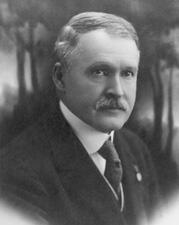
Senator Selden Palmer Spencer
Here you will find contact information for Senator Selden Palmer Spencer, including email address, phone number, and mailing address.
| Name | Selden Palmer Spencer |
| Position | Senator |
| State | Missouri |
| Party | Republican |
| Status | Former Representative |
| Term Start | November 6, 1918 |
| Term End | May 16, 1925 |
| Terms Served | 2 |
| Born | September 16, 1862 |
| Gender | Male |
| Bioguide ID | S000730 |
About Senator Selden Palmer Spencer
Selden Palmer Spencer (September 16, 1862 – May 16, 1925) was an American lawyer, jurist, and Republican politician who represented Missouri in the United States Senate from 1918 until his death in 1925. Over the course of two terms in office, he contributed to the legislative process during a significant period in American history, participating in the democratic process and representing the interests of his Missouri constituents.
Spencer was born in Erie, Pennsylvania, to Samuel Selden and Eliza Deborah (Palmer) Spenser. He received his early education in the public schools of Erie before attending Hopkins School, a college preparatory institution in New Haven, Connecticut. He then enrolled at Yale College, where he was an editor of the student newspaper and participated in lacrosse. Distinguished as a scholar, he graduated in 1884 with honors, ranking seventh in a class of 150. Shortly after completing his undergraduate studies, he moved to St. Louis, Missouri, to pursue legal training at Washington University School of Law, from which he graduated in 1886.
Admitted to the bar in 1886, Spencer opened a law practice in St. Louis, forming a partnership with Forrest Donnell, who would later become governor of Missouri. In addition to his private practice, Spencer served as a professor of medical jurisprudence at the Missouri Medical College. In recognition of his contributions, the college awarded him an honorary M.D. degree. His academic and professional reputation was further acknowledged when Westminster College in Fulton, Missouri, conferred upon him honorary Ph.D. and LL.D. degrees. Spencer also became active in the American Bar Association, serving on its executive board and rising to the position of vice president in 1914.
Spencer’s first elected office came in 1895, when he was chosen as a member of the Missouri House of Representatives. During his service in the state legislature, he chaired the Committee on Banks and Banking and also served on the Judiciary, Ways and Means, Militia, and Rules Committees, gaining broad experience in financial, legal, and military affairs. From 1897 to 1903 he served as a judge of the United States circuit court, after which he returned to his law practice in St. Louis. Beyond his legal and legislative work, Spencer was a member of the Missouri State Militia, attaining the rank of captain, and during World War I he served as chairman of a St. Louis–area draft board, helping to administer the nation’s mobilization efforts.
The unexpected death of Missouri U.S. Senator William J. Stone in April 1918 prompted Spencer’s return to political office at the national level. After Xenophon P. Wilfley was appointed as a temporary replacement, a special election was scheduled to fill the remainder of Stone’s term. In November 1918 Spencer, running as a Republican, defeated former Democratic governor Joseph W. Folk with 52 percent of the vote to complete the final two years of the term. In 1920 he secured reelection to a full term in the Senate, first overcoming tennis star–turned–politician Dwight F. Davis in the Republican primary and then defeating Democrat Breckinridge Long by more than 121,000 votes in the general election.
During his tenure in the United States Senate from 1918 to 1925, Spencer played an active role in committee work and in major foreign policy debates of the era. He served as chairman of the Committee on Claims during the Sixty-sixth and Sixty-seventh Congresses and was a member of the Committee on Indian Affairs in the Sixty-seventh Congress. He also served on the influential Committee on Privileges and Elections from the Sixty-seventh through the Sixty-ninth Congresses. A prominent Republican voice on international issues, Spencer was noted for his opposition to the Treaty of Versailles and to American participation in the League of Nations, working closely with Senator Henry Cabot Lodge and the group of senators often referred to as the “Irreconcilables.” He delivered numerous speeches against the treaty while campaigning for fellow Republicans in the 1920 and 1922 elections. Spencer also took an interest in East Asian affairs and was a supporter of the Korean independence movement, writing critically of Japan’s violent suppression of Korea’s peaceful March First Movement protests in 1919.
Selden Palmer Spencer’s congressional service continued until his death in office. He died at Walter Reed Hospital in Washington, D.C., on May 16, 1925, following complications from hernia surgery. His death placed him among the members of the United States Congress who died in office in the first half of the twentieth century. He was buried in Bellefontaine Cemetery in St. Louis, Missouri, closing a career that spanned law, state and federal public service, and significant involvement in national and international issues during a transformative era in American history.