Representative Selucius Garfielde
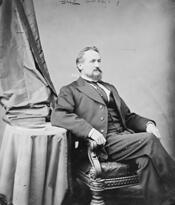
Here you will find contact information for Representative Selucius Garfielde, including email address, phone number, and mailing address.
| Name | Selucius Garfielde |
| Position | Representative |
| State | Washington |
| District | -1 |
| Party | Republican |
| Status | Former Representative |
| Term Start | March 4, 1869 |
| Term End | March 3, 1873 |
| Terms Served | 2 |
| Born | December 8, 1822 |
| Gender | Male |
| Bioguide ID | G000064 |
About Representative Selucius Garfielde
Selucius Garfielde (December 8, 1822 – April 13, 1883) was an American lawyer and politician who served as a Delegate to the United States House of Representatives from the Territory of Washington for two terms, from March 4, 1869, to March 3, 1873. A member of the Republican Party during his congressional service, he played a notable role in the political development of the Pacific Northwest and in the organization of the Idaho Territory, after earlier careers in Kentucky and California politics.
Garfielde was born in Shoreham, Addison County, Vermont, on December 8, 1822. In early life he moved first to Gallipolis, Ohio, and later to Paris, Kentucky, although sources are unclear whether these relocations occurred in his childhood or late teens. He was educated in the public schools and went on to graduate with a bachelor’s degree from Augusta College, a Methodist institution in Kentucky. To support himself, he taught in public schools both before and after his college studies, gaining early experience as a teacher and public speaker that would later serve him in politics.
By the late 1840s, Garfielde had become active in Kentucky public life. He worked as a reporter and, in 1849, was elected as a delegate from Fleming County to the Kentucky Constitutional Convention, which revised the state’s organic law. In 1850 he traveled extensively in South America, and in 1851 he settled in California. Arriving in poor health and nearly penniless, he quickly recovered his physical and financial footing. In 1852 he was elected as a Democrat to the California State Assembly from El Dorado County, serving a single term from January 3 to May 19, 1853. The legislature in 1853 appointed him to assist in codifying the laws of the new state. During his time in California he studied law, was admitted to the State Bar of California in 1854, and established a legal practice in San Francisco. In October 1853 he married Sarah Electa Perry, also a native of Shoreham, Vermont. The couple had several children, including William Chase Garfield, born in Kentucky in 1854; Henry Stevens Garfield, born in January 1860; a daughter, Mollie, who died in infancy in November 1859; and Charles Darwin Garfield, born in February 1867, who later became a widely known fur trader in Alaska and died in Seattle, Washington, in September 1961.
Garfielde likely returned to Kentucky in 1854 and remained active in Democratic politics. He was elected a delegate to the Democratic National Convention in 1856, where he supported Senator Stephen A. Douglas for the presidential nomination. Although Douglas lost the nomination to James Buchanan, Garfielde remained a loyal Democrat during the ensuing campaign. He traveled widely through the western and northwestern states, delivering thousands of speeches on Buchanan’s behalf and earning a reputation as a “captivating” public orator. His efforts won him favor with national Democrats, and President Buchanan rewarded him by appointing him Receiver of Public Monies for the federal land office in Washington Territory. Garfielde emigrated to Olympia, Washington Territory, in the spring following his appointment and soon became a supporter of Isaac I. Stevens, the territory’s first Delegate to Congress. His relationship with Stevens later deteriorated as Garfielde, a staunch Unionist, began to align himself with the emerging Republican Party. Political maneuvering over his land office position culminated in the end of his service as receiver of public moneys on August 16, 1860.
In 1861 Garfielde sought the Democratic nomination for Territorial Delegate to Congress. The party was deeply divided over secession, and at the territorial convention pro-Union forces secured a ruling against the use of proxy votes, undermining Stevens’s strength. The convention ultimately split, with Union Democrats nominating Garfielde and pro-secession Democrats backing Judge Edward Lander, while Republicans nominated William H. Wallace. Garfielde and Lander attacked one another during the campaign, enabling Wallace to win the election with about 43 percent of the vote to Garfielde’s 37.6 percent and Lander’s 19.4 percent. In the early 1860s Garfielde turned his attention to the rapidly changing political geography of the Northwest. He played a direct role in the movement to organize Idaho Territory, which emerged out of the eastern portion of Washington Territory and part of Dakota Territory as population surged in the mining districts. At the Oro Fino Conference in the summer of 1862, he joined William H. Wallace, Dr. Anson G. Henry, and others in formulating the plan for a separate Idaho Territory. With Henry’s access to President Abraham Lincoln, Congress created Idaho Territory on March 4, 1863. During much of the period from 1862 to 1864 Garfielde resided in British Columbia, but he remained engaged in regional politics and law.
Between November 1861 and January 1864 Garfielde formally shifted his allegiance from the Democratic to the Republican Party, reflecting his strong Unionist views. He continued to practice law while becoming an important Republican campaigner. In the 1864 Delegate election he stumped throughout Washington Territory for Republican candidate Arthur A. Denny, and by 1865 he was regarded as one of the party’s leading figures in the region. In 1866 President Andrew Johnson appointed him surveyor general of Washington Territory, a post he held until early 1869. Around 1868 he joined Daniel Bagley, P. H. Lewis, Josiah Settle, and George F. Whitworth in acquiring abandoned coal claims east of Seattle. They organized the Lake Washington Company and secured territorial legislation chartering the Coal Creek Road Company to build a road to the coal fields. When they sold their interests in 1870, they realized a profit of about 500 percent. Garfielde also sought the Republican nomination for Territorial Delegate in 1868. His shifting party loyalties and florid oratory had earned him critics who derided him as “Selucius the Babbler,” and a faction of prominent Republicans denounced the nominating process as fraudulent. Despite this intraparty revolt, he secured the nomination and narrowly won election over Marshall F. Moore by 149 votes out of more than 5,300 cast.
As a Republican Delegate from Washington Territory, Garfielde served in the United States House of Representatives for two terms, from 1869 to 1873, during a significant period of Reconstruction-era national politics and western territorial development. Because of a change in the territorial election date, his first term was unusually long, beginning on March 4, 1869, although the House did not seat him until December 1870. He won reelection in 1870 over Democrat J. D. Mix of Walla Walla by 735 votes out of more than 6,200 cast. In Congress he participated in the legislative process on behalf of Washington Territory’s constituents, advocating for infrastructure, land, and economic measures important to the Pacific Northwest. His tenure coincided with the expansion of railroads and settlement in the region, and he became closely associated with the Northern Pacific Railway. In 1871 Jay Cooke, the investment banker controlling the Northern Pacific, hired him to campaign throughout Washington Territory to build public support for the railroad’s interests. This arrangement, intended in part to please Frederick H. Billings of the railroad’s land office, drew criticism from Billings himself, who considered it improper for a sitting Delegate to promote a private enterprise so openly and faulted Garfielde’s ties to independent loggers accused of cutting timber from railroad lands. In the 1872 election, amid an influx of new Democratic voters into the territory and lingering controversy over his business and political alliances, Garfielde lost his bid for a third term to Democrat Obadiah Benton McFadden by 761 votes out of about 7,700 cast, leaving office on March 3, 1873.
After his congressional service, Garfielde remained a significant figure in Republican politics. President Ulysses S. Grant, newly reelected in 1872, appointed him customs collector for the Puget Sound District on March 26, 1873. He moved from Washington, D.C., to Seattle, where he resumed the practice of law while serving as customs collector until June 22, 1874. Following his removal from that post, he returned to Washington, D.C., and entered a markedly different phase of his career. He established several gambling parlors in the capital, which were frequently raided by authorities, though he managed to avoid imprisonment. Throughout his adult life he had exhibited habits—heavy drinking, gambling, and womanizing—that many contemporaries regarded as disreputable. By the late 1870s these strains proved intolerable to his family life, and he and Sarah Electa Garfielde divorced around 1879. He later married Nellie Homer, the proprietress of a bar frequented by criminals and the down-and-out, in late 1881. In addition to his political and business activities, he authored a pamphlet, “Climates of the Northwest” (1872), based on a lecture he had delivered, reflecting his interest in promoting the region’s development.
In early April 1883 Garfielde fell ill with pleurisy and pneumonia at his residence at 410 10th Street NW in Washington, D.C. His condition worsened rapidly beginning April 11, and he died there at 5:30 p.m. on April 13, 1883. He was interred at Glenwood Cemetery in Washington, D.C. A Freemason and past Grand Master of the Grand Lodge of Washington Territory, he nonetheless did not receive Masonic rites at his funeral because he had not affiliated with any lodge in the District of Columbia. His life traced a complex path from Vermont and Kentucky to California, British Columbia, and the Pacific Northwest, encompassing roles as teacher, lawyer, legislator, territorial official, congressional Delegate, businessman, and political orator during a formative era in the history of the American West.