Representative Sereno Elisha Payne
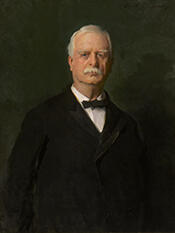
Here you will find contact information for Representative Sereno Elisha Payne, including email address, phone number, and mailing address.
| Name | Sereno Elisha Payne |
| Position | Representative |
| State | New York |
| District | 36 |
| Party | Republican |
| Status | Former Representative |
| Term Start | December 3, 1883 |
| Term End | March 3, 1915 |
| Terms Served | 15 |
| Born | June 26, 1843 |
| Gender | Male |
| Bioguide ID | P000153 |
About Representative Sereno Elisha Payne
Sereno Elisha Payne (June 26, 1843 – December 10, 1914) was a United States Representative from New York and the first House Majority Leader, holding that office from 1899 to 1911. A Republican, he served in Congress for 15 terms, sitting in the House of Representatives from 1883 to 1887 and then continuously from 1889 until his death in 1914. Over the course of his long tenure he became one of the most influential legislators of his era, notably as chairman of the House Committee on Ways and Means for 12 years beginning in 1899, and as the principal author of the Payne–Aldrich Tariff. He was widely known as a staunch protectionist and a leading spokesman for high-tariff policies within the Republican Party.
Payne was born on June 26, 1843, in Hamilton, Madison County, New York, the son of William Wallace Payne. During his childhood the family moved to Auburn, New York, which would remain his lifelong home and political base. He was educated in the local schools and attended Auburn Academy before enrolling at the University of Rochester. He graduated from the University of Rochester in 1864. After completing his undergraduate studies he read law, and in 1866 he was admitted to the bar, commencing practice in Auburn.
In addition to his legal work, Payne quickly became active in local public affairs in Auburn and Cayuga County. He served as city clerk of Auburn from 1867 to 1868 and as a member of the city’s board of supervisors from 1871 to 1872. From 1873 to 1879 he held the office of district attorney of Cayuga County, gaining prominence as a capable prosecutor. He also played a significant role in local educational administration, serving as president of the Auburn board of education from 1879 to 1882. His growing reputation as a lawyer and local official helped pave the way for his entry into national politics.
Payne was first elected as a Republican to the Forty-eighth and Forty-ninth Congresses, serving from March 4, 1883, to March 3, 1887, as a Representative from New York. After a brief interval out of office, he returned to the House when he was elected to the Fifty-first Congress to fill the vacancy caused by the death of Representative Newton W. Nutting. He took his seat on December 2, 1889, and was subsequently reelected to the twelve succeeding Congresses, serving continuously until his death on December 10, 1914. During this period he represented the interests of his New York constituents through a time of rapid industrialization and significant political change, participating actively in the legislative and democratic processes of the House.
Within Congress, Payne steadily rose through the Republican leadership. He served as chairman of the Committee on Merchant Marine and Fisheries during the Fifty-fourth and Fifty-fifth Congresses, where he dealt with issues affecting American shipping and maritime commerce. In 1899 he became chairman of the powerful Committee on Ways and Means, a position he held from the Fifty-fifth through the Sixty-first Congresses. That same year he was appointed a member of the American-British Joint High Commission, reflecting his prominence in matters of trade and international economic policy. From 1899 to 1911 he also served as the first formal House Majority Leader, acting as the chief floor leader for the Republican majority in the Fifty-seventh through Sixty-first Congresses and helping to shape the legislative agenda during the administrations of William McKinley, Theodore Roosevelt, and William Howard Taft.
Payne’s most notable legislative achievement was the Payne–Aldrich Tariff Act of 1909, which he introduced and guided through Congress as chairman of Ways and Means. The measure revised the tariff schedules and was intended to maintain and adjust protective duties on imported goods. As a staunch protectionist, Payne consistently advocated high tariffs to shield American industry from foreign competition, and he became closely identified with the Republican Party’s traditional tariff policy. In addition to his committee and leadership roles, he was active in national party affairs, serving as a delegate to the Republican National Conventions of 1892, 1896, 1900, and 1904. His long service and leadership made him one of the central figures in the House during the late nineteenth and early twentieth centuries. He was reelected to the Sixty-fourth Congress but died before that term began, making him one of the members of Congress who died in office in the early twentieth century.
Outside his public career, Payne maintained strong ties to his hometown of Auburn. In 1873 he married Gertrude Flourette Knapp, the daughter of Arietta Montgomery Terry and Oscar Fitzalen Knapp of Auburn. The couple had one son, William K. Payne. They resided at 4 James Street in Auburn, and Payne continued to make his home there throughout his life, even as his congressional duties required extended stays in Washington, D.C. His wife, Gertrude, died in 1911, three years before his own death.
Sereno Elisha Payne died of heart disease on December 10, 1914, at the Portland Hotel in Washington, D.C., while still serving in the House of Representatives. He was buried in Fort Hill Cemetery in Auburn, New York, returning to the community that had shaped his early life and career. In recognition of his contributions, Colgate University and the University of Rochester each awarded him honorary Doctor of Laws (LL.D.) degrees. His long record of service, his role as the first House Majority Leader, and his leadership on tariff and fiscal policy secured him a lasting place in congressional history, commemorated in memorial addresses delivered in the House and Senate and later published in 1916.