Representative Seth Wakeman
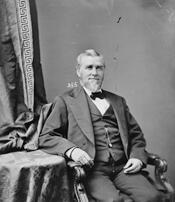
Here you will find contact information for Representative Seth Wakeman, including email address, phone number, and mailing address.
| Name | Seth Wakeman |
| Position | Representative |
| State | New York |
| District | 29 |
| Party | Republican |
| Status | Former Representative |
| Term Start | March 4, 1871 |
| Term End | March 3, 1873 |
| Terms Served | 1 |
| Born | January 15, 1811 |
| Gender | Male |
| Bioguide ID | W000028 |
About Representative Seth Wakeman
Seth Wakeman (January 15, 1811 – January 4, 1880) was an American attorney and politician from Batavia, New York. Initially a Whig and later a Republican, he was most notable for his service in the New York State Assembly from 1856 to 1857 and as a Representative from New York in the United States Congress from 1871 to 1873. A member of the Republican Party during his congressional tenure, Wakeman contributed to the legislative process during one term in office, participating in the democratic process and representing the interests of his constituents during a significant period in American history.
Wakeman was born in Franklin, Vermont, on January 15, 1811, the son of Nathan Wakeman and Phoebe Johnston. When he was still a child, the Wakeman family moved to Pembroke, New York. His father joined the New York Militia during the War of 1812 and died in Malone, New York, while on military duty, leaving the family without its patriarch. Seth Wakeman attended the local schools of Pembroke and worked as a farmer in his youth. He became involved in local affairs at an early age, serving in positions such as constable and justice of the peace, and he began the study of law while continuing to reside in western New York.
In 1844, Wakeman was admitted to the bar and commenced the practice of law in Batavia, New York, which remained his home for the rest of his life. Originally aligned with the Whig Party, he quickly became a prominent figure in Genesee County public life. He served as Genesee County Treasurer from 1845 to 1846 and as Genesee County District Attorney from 1850 to 1855. In addition to his legal and political work, Wakeman was active in local business ventures, particularly in transportation infrastructure. He served as secretary of the Batavia and Lancaster Plank Road Company and sat on the board of directors of the Batavia and Oakfield Plank Road Company. In 1852, he was appointed secretary of the Buffalo and Batavia Plank Road Company, reflecting his role in the region’s economic development.
As the Whig Party collapsed in the mid-1850s, Wakeman became one of the early adherents of the newly formed Republican Party. He was elected to the New York State Assembly, representing Genesee County’s 1st District, and served in 1856 and 1857. His legislative experience at the state level helped establish his reputation as a capable Republican leader in western New York. Later, he was chosen as a delegate to the New York State constitutional convention of 1867–1868, where he participated in efforts to revise and modernize the state’s fundamental law.
Wakeman’s growing prominence within the Republican Party led him to seek national office. In 1868, he was a candidate for the Republican nomination for a seat in the United States House of Representatives, though the nomination went instead to John Fisher, who subsequently won the general election. Undeterred, Wakeman remained active in party affairs, and in 1870 he was elected as a Republican to the 42nd United States Congress. He served one term in the House of Representatives, from March 4, 1871, to March 3, 1873, representing a New York district during the Reconstruction era. As a member of Congress, he participated in the legislative process at a time of national adjustment following the Civil War, aligning with Republican policies and advocating for the interests of his New York constituents.
After leaving Congress in 1873, Wakeman returned to Batavia and resumed the practice of law. He continued to be involved in his legal and business affairs for several years, maintaining his standing as a respected member of the local bar and community. Around 1875, however, his health began to decline significantly. As his condition worsened, he gradually withdrew from most of his professional and business responsibilities. In the last few years of his life, Wakeman was nearly an invalid and was largely confined to his home in Batavia.
Wakeman’s personal life reflected long-standing ties to western New York and the broader region. In 1832, he married Demis Powers of Pembroke, New York. They were the parents of two children: Eugene, born in 1834, and Demie, who lived from 1836 to 1904. After the death of his first wife, Wakeman married Laura Winans of Cleveland in 1856. With her he had four children: Mary Emma (1860–1919), Bryan Seth (born 1862), Henry Clay (1864–1870), and William Sprague (1868–1954). His family connections and multiple generations of descendants helped to sustain his legacy in the region after his public career had ended.
Seth Wakeman died in Batavia, New York, on January 4, 1880, just short of his sixty-ninth birthday. He was interred at Elmwood Cemetery in Batavia. His career, spanning local office, county administration, state legislative service, and a term in the United States House of Representatives, reflected the trajectory of a nineteenth-century lawyer-politician who rose from rural beginnings to participate in state and national governance during a transformative era in American history.