Representative Sherman Lloyd
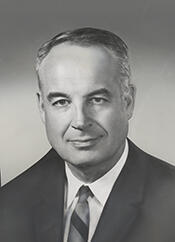
Here you will find contact information for Representative Sherman Lloyd, including email address, phone number, and mailing address.
| Name | Sherman Lloyd |
| Position | Representative |
| State | Utah |
| District | 2 |
| Party | Republican |
| Status | Former Representative |
| Term Start | January 9, 1963 |
| Term End | January 3, 1973 |
| Terms Served | 4 |
| Born | January 11, 1914 |
| Gender | Male |
| Bioguide ID | L000382 |
About Representative Sherman Lloyd
Sherman Parkinson Lloyd (January 11, 1914 – December 15, 1979) was an American lawyer and Republican politician who served four terms as a U.S. Representative from Utah between 1963 and 1973. Over the course of a decade in the House of Representatives, he participated in the legislative process during a significant period in American history, representing the interests of his Utah constituents and contributing to national debates during the 1960s and early 1970s.
Lloyd was born on January 11, 1914, in St. Anthony, Fremont County, Idaho. His father served as a counselor in the local Stake Presidency of the Church of Jesus Christ of Latter-day Saints, and three of his grandparents were English immigrants, reflecting a family background rooted in both immigration and Latter-day Saint religious life. He attended public schools in St. Anthony and Rexburg, Idaho, and was raised in the faith of the Church of Jesus Christ of Latter-day Saints, which remained an important influence throughout his life.
After completing his early education, Lloyd moved to Utah for college and received his Bachelor of Science degree from Utah State University in 1935. He then went to Washington, D.C., to study law at George Washington University, where he earned his LL.B. in 1939. While a law student, he worked as an employee of the United States Department of Agriculture, gaining early exposure to the workings of the federal government and public policy. He was admitted to the bar in 1939 and began the practice of law in Salt Lake City, Utah, marking the start of a long career that combined legal work, business, and public service.
Lloyd’s early professional years were closely tied to both the private sector and state-level public affairs. From 1940 to 1962 he served as general counsel for the Utah Retail Grocers Association, representing the interests of retail businesses in the state. He entered elective office as a member of the Utah State Senate, serving from 1954 to 1962. During his tenure in the state senate he rose quickly in leadership, serving as majority leader in 1957, president of the senate in 1959, and minority leader in 1961. He was a member of the Utah Legislative Council from 1957 to 1961 and chaired that body from 1959 to 1961. Beyond Utah, he represented the state on the board of managers of the Council of State Governments from 1959 to 1961 and chaired the Council’s Committee on State Taxation of Interstate Income from 1961 to 1962, reflecting his growing expertise in fiscal and intergovernmental issues. At the same time, he served as a director of Beehive State Bank from 1960 to 1966, and he became active in Republican Party politics as a delegate to the 1960, 1962, 1964, and 1966 Republican state conventions, as well as a delegate to the 1960 Republican National Convention. He first sought federal office as an unsuccessful candidate for Congress in 1960.
Lloyd was elected to the U.S. House of Representatives as a Republican to the Eighty-eighth Congress on November 6, 1962, defeating fellow state senator Bruce Sterling Jenkins. He served his first term from January 3, 1963, to January 3, 1965. During this period he participated in the democratic process at the national level, representing Utah in the House of Representatives at a time of major legislative activity on civil rights, social programs, and foreign policy. Choosing not to seek re-election to the House in 1964, he instead ran unsuccessfully for the United States Senate. After that defeat, he returned to Utah and became vice president of Prudential Federal Savings, where he managed public relations, and he also served as a lecturer at the University of Utah, maintaining his engagement with public affairs and higher education.
Lloyd returned to Congress when he was elected to the Ninetieth Congress and to the two succeeding Congresses, serving from January 3, 1967, to January 3, 1973. In these three additional terms, he again represented Utah as a member of the House of Representatives and contributed to the legislative process during a period marked by the Vietnam War, domestic unrest, and evolving federal policy in areas such as taxation, commerce, and international relations. A member of the Republican Party throughout his congressional career, he served a total of four terms in the House between 1963 and 1973. He was an unsuccessful candidate for re-election in 1972, ending his service in Congress at the close of the Ninety-second Congress.
Following his departure from the House, Lloyd continued in federal service and in academic life. In 1973 he was appointed assistant director of the United States Information Agency, a position that involved oversight of aspects of U.S. public diplomacy abroad. Later that year he again returned to Utah and joined the faculty of Utah State University, where he held the Milton R. Merrill Chair in Political Science from 1973 to 1974. In 1974 he was named a trade specialist in charge of the Utah office of the United States Department of Commerce, further extending his involvement in federal–state economic and trade matters. He sought higher office once more as a candidate in the 1976 United States Senate election in Utah, but he was unsuccessful in the Republican primary. After this defeat, he turned to work as an editor and publisher, remaining active in public discourse even after leaving electoral politics.
Sherman P. Lloyd resided in Salt Lake City, Utah, during his later years. He died there on December 15, 1979, and was interred in Salt Lake City Cemetery. His papers, documenting his legal, legislative, and political career, are preserved in the Sherman P. Lloyd Papers at the L. Tom Perry Special Collections, Harold B. Lee Library, Brigham Young University, providing a record of his contributions to Utah and to the United States Congress.