Representative Silvio O. Conte
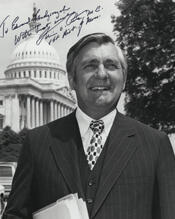
Here you will find contact information for Representative Silvio O. Conte, including email address, phone number, and mailing address.
| Name | Silvio O. Conte |
| Position | Representative |
| State | Massachusetts |
| District | 1 |
| Party | Republican |
| Status | Former Representative |
| Term Start | January 7, 1959 |
| Term End | January 3, 1993 |
| Terms Served | 17 |
| Born | November 9, 1921 |
| Gender | Male |
| Bioguide ID | C000709 |
About Representative Silvio O. Conte
Silvio Ottavio Conte (November 9, 1921 – February 8, 1991) was an American lawyer and politician who served as a Republican member of the United States House of Representatives from Massachusetts from January 3, 1959, until his death in 1991. Over the course of 16 consecutive terms, spanning 17 elections, he represented Massachusetts’s 1st congressional district and became one of the most influential members of the House Appropriations Committee. He was particularly noted for his strong support of environmental protection legislation and for his advocacy of federal funding for medical and scientific research.
Conte was born in Pittsfield, Massachusetts, to parents who were Italian immigrants, and he grew up in that city’s working-class West Side neighborhood. He attended local public schools, including Pittsfield Vocational High School, from which he graduated in 1940. Before entering military service, he worked as a machinist and pressman, experience that grounded his later political identity in the concerns of industrial and blue-collar workers. Raised in the Roman Catholic faith, he remained closely tied to his hometown and its institutions throughout his life.
During World War II, Conte served in the United States Navy Seabees from 1942 to 1944 as a construction mechanic. His wartime service in the Pacific theater exposed him to the logistical and engineering challenges of military operations and later informed his interest in defense policy and veterans’ issues. After the war, he took advantage of the G.I. Bill of Rights to pursue higher education. He enrolled at Boston College, where he played on the Boston College Eagles football and basketball teams, and then continued at Boston College Law School. He earned his law degree (LL.B.) in 1949, passed the Massachusetts bar, and began practicing law. In 1948 he married Corinne Duval (often spelled Duvall), with whom he had four children.
Conte quickly turned to public service upon returning to Pittsfield. He entered state politics as a Republican and was elected to the Massachusetts Senate in 1950. He served in the Massachusetts legislature during the 1951–1952, 1953–1954, and 1955–1956 sessions, remaining in the state Senate until 1958. In that role he built a reputation as an energetic and effective advocate for his region, which helped lay the groundwork for his subsequent congressional career. His early legislative work and visibility in western Massachusetts positioned him as a leading Republican figure in a predominantly Democratic state.
In 1958 Conte ran for the U.S. House of Representatives from Massachusetts’s 1st congressional district and defeated James M. Burns, a professor at Williams College. He took office on January 3, 1959, beginning a congressional tenure that would last until his death in 1991. A member of the Republican Party, Conte was part of what was then its liberal Northern tradition. He was appointed to the powerful House Appropriations Committee at the outset of his federal service and retained that assignment throughout his long career, eventually becoming the ranking minority member of the committee. He never lost an election and, in 1964, was the only Republican member of Congress who did not have an opponent on the ballot, underscoring his popularity and the breadth of his support in his district.
Conte’s congressional service coincided with a significant period in American history, and he played an active role in major legislative debates. He consistently supported civil rights measures, voting in favor of the Civil Rights Act of 1960, the Civil Rights Act of 1964, the Civil Rights Act of 1968, the Voting Rights Act of 1965, and the 24th Amendment to the U.S. Constitution, which abolished the poll tax in federal elections. He also joined fellow Massachusetts Republicans F. Bradford Morse, William H. Bates, Joseph W. Martin Jr., and Hastings Keith in voting for the creation of the Medicare health program. In 1966, he was one of three Republican senators and four Republican representatives who signed a telegram to Georgia Governor Carl E. Sanders protesting the Georgia legislature’s refusal to seat Julian Bond in the state House of Representatives. The telegram described the refusal as “a dangerous attack on representative government,” affirming that although the signers strongly repudiated Bond’s views on the Vietnam War, he was entitled to express them unless a court of law determined otherwise. On social issues, Conte’s record was more conservative, reflecting his Roman Catholic faith; he opposed abortion and often took traditionalist positions in that area.
Within his district, Conte was widely regarded as highly effective in securing federal resources for western Massachusetts. He helped obtain defense contracts for the General Electric plant in Pittsfield, supporting local employment and the regional economy. An avid fisherman and committed environmentalist, he introduced legislation to restore Atlantic salmon to the Connecticut River and worked to protect other natural resources in New England. His environmental advocacy would later be commemorated through the naming of the Silvio O. Conte National Fish and Wildlife Refuge, which spans parts of Massachusetts, Vermont, New Hampshire, and Connecticut, and the Silvio O. Conte Anadramous Fish Research Center in Turners Falls, Massachusetts, which he founded and which was renamed in his honor after his death.
Conte was also a vigorous proponent of federal investment in scientific and medical research. He championed funding for the National Institutes of Health and was a passionate advocate for federally funded health research. In recognition of his efforts, NIH’s Building 49 in Bethesda, Maryland, was named for him, and the agency continues to honor his legacy with neurological research grants awarded in his name. He secured federal support for a polymer research center at the University of Massachusetts Amherst, later named the Silvio O. Conte National Center for Polymer Research. Several universities subsequently established Silvio O. Conte Centers for neuroscience research, further reflecting his impact on national science policy. His influence extended to the mentoring of younger public servants; among those who worked on his staff was Betty Boothroyd, who served as his legislative assistant from 1960 to 1962 and later became Speaker of the House of Commons of the United Kingdom.
Known for his independence and occasionally theatrical style, Conte sometimes broke with his party leadership. He was one of only three Republicans in the House—along with Frank Riggs of California and Connie Morella of Maryland—to vote against U.S. involvement in the 1991 Gulf War. He also became “somewhat famous” for donning a pig mask at a 1983 press conference to protest what he regarded as excessive pork-barrel spending, a gesture that underscored both his fiscal concerns and his flair for drawing public attention to budgetary issues. His long service on the Appropriations Committee made him a central figure in federal spending debates, and he was widely recognized for his diligence in representing the interests of his constituents while participating in the broader national legislative process.
Conte’s contributions were recognized both in the United States and abroad. In 1963 he was awarded the Commander of the Order of Merit of the Italian Republic for his work in support of the North Atlantic Treaty Organization (NATO), an honor that reflected both his heritage and his commitment to transatlantic security. Over time, numerous public buildings and institutions were named in his honor, including the Conte Forum, a multi-purpose sports arena at Boston College, dedicated in 1988; the Silvio O. Conte Federal Building in Pittsfield; the National Archives regional center in Pittsfield; West Side Elementary School in Pittsfield, renamed the Silvio O. Conte Community School; and the former Silvio O. Conte Middle School in North Adams, Massachusetts, later Colegrove Park Elementary School. These dedications, along with the fish and wildlife refuge and research centers bearing his name, attest to the breadth of his influence in education, science, conservation, and public service.
Silvio O. Conte died at age 69 of prostate cancer in Bethesda, Maryland, on February 8, 1991, while still serving in Congress. He was thus among the members of the United States Congress who died in office between 1950 and 1999. He was buried in St. Joseph’s Cemetery in his hometown of Pittsfield. The depth of local affection was evident when more than 5,000 constituents waited in 5 °F (−15 °C) weather to attend his wake at All Souls Church, his childhood parish in Pittsfield. His funeral drew four U.S. Cabinet secretaries, approximately 100 members of Congress, and Vice President Dan Quayle, and he was eulogized by former Speaker of the House Thomas P. “Tip” O’Neill Jr. and Senator Edward M. Kennedy, both long-time political friends. Conte was survived by his wife, Corinne, and their four children. He was succeeded in Congress by Democrat John Olver, who won the special election to fill the vacancy in Massachusetts’s 1st congressional district.