Senator Sinclair Weeks
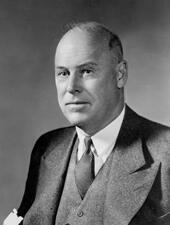
Here you will find contact information for Senator Sinclair Weeks, including email address, phone number, and mailing address.
| Name | Sinclair Weeks |
| Position | Senator |
| State | Massachusetts |
| Party | Republican |
| Status | Former Representative |
| Term Start | February 8, 1944 |
| Term End | January 3, 1945 |
| Terms Served | 1 |
| Born | June 15, 1893 |
| Gender | Male |
| Bioguide ID | W000248 |
About Senator Sinclair Weeks
Charles Sinclair Weeks (June 15, 1893 – February 7, 1972), better known as Sinclair Weeks, was an American businessman and Republican politician who served as a United States Senator from Massachusetts in 1944–1945 and as United States Secretary of Commerce from 1953 until 1958 during President Dwight D. Eisenhower’s administration. His brief tenure in the Senate came during World War II, and his later Cabinet service coincided with major postwar economic expansion and the creation of the Interstate Highway System.
Weeks was born on June 15, 1893, in West Newton, Massachusetts, the second child of John Wingate Weeks and Martha Aroline (Sinclair) Weeks. His father was a prominent public figure who served as a United States Representative from Massachusetts and later as Secretary of War, and his older sister, Katherine Weeks, married John Washington Davidge. Raised in a politically engaged family with strong New England roots, Weeks was exposed early to public affairs and civic responsibility, influences that would shape his own career in public service.
Weeks attended Harvard College, from which he graduated before the First World War. He served on the U.S.–Mexico border with the U.S. National Guard in 1916, during the period of heightened tensions along the border, and subsequently served in World War I. These early military experiences reinforced his sense of national service and provided him with organizational and leadership skills that he later applied in business and politics.
Following his education and wartime service, Weeks pursued a career in business, working in a variety of industries and financial institutions. He was associated with the First National Bank of Boston and the United Carr Fastener Corporation, and he later became president of Reed & Barton, the noted silversmith firm based in Taunton, Massachusetts. Through these roles he developed a reputation as a capable executive and industrialist, experience that would later inform his approach to economic policy and commerce at the national level.
Weeks entered elective office as mayor of Newton, Massachusetts, serving from 1930 to 1935. His mayoralty coincided with the early years of the Great Depression, a period that required careful municipal management and attention to local economic conditions. A committed Republican, he became increasingly active in party affairs at the state and national levels. He served as treasurer of the Republican National Committee from 1940 to 1944 and as a member of the Republican National Committee from 1941 to 1953, playing a significant role in party organization and finance during and after World War II. From 1946 to 1950 he was president of the American Enterprise Association, a policy-oriented organization that promoted free enterprise and economic research.
Weeks’s congressional service came during a critical phase of World War II. A member of the Republican Party, he was appointed a United States Senator from Massachusetts on February 8, 1944, by Governor Leverett Saltonstall, following the resignation of Senator Henry Cabot Lodge Jr., who left the Senate to serve in the war. Weeks thus entered the Senate during a significant period in American history, when wartime legislation, mobilization, and planning for postwar reconstruction dominated the legislative agenda. He served from February 8, 1944, until December 19, 1944, when a newly elected senator took office, and he did not run in the special election to complete the term. During his one term in office, he participated in the democratic process and represented the interests of his Massachusetts constituents in the United States Congress.
After the war, Weeks continued to combine business leadership with national political involvement. His longstanding party work and reputation as a businessman brought him to the attention of General Dwight D. Eisenhower and Republican leaders as they prepared for the 1952 presidential campaign. Following Eisenhower’s election, Weeks was appointed United States Secretary of Commerce, taking office on January 21, 1953. He served in this Cabinet position until November 10, 1958. As Secretary of Commerce, he was centrally involved in the Eisenhower administration’s economic and infrastructure initiatives, most notably the development of the Interstate Highway System authorized in 1956. Weeks was charged with helping to secure funding and support for this transformative national project, which reshaped American transportation, commerce, and regional development.
Weeks’s public service extended beyond formal officeholding. In 1941, he and his sister Katherine Weeks Davidge donated their father’s summer estate on Mount Prospect in Lancaster, New Hampshire, to the State of New Hampshire to be used as a state park. They intended the Arts and Crafts–style 1913 lodge and the 1912 observation tower on the summit to serve as a public resource for education about sustainable forestry management. The property became Weeks State Park, which, with its historic 1910 New Hampshire Scenic Byway road to the summit, lodge, and tower, has since attracted thousands of visitors annually to enjoy panoramic 360-degree views of the White Mountains of New Hampshire and the Green Mountains of Vermont. In the 1960s, Weeks also worked with his friend and fellow Republican, New Hampshire Governor Sherman Adams, and others to ensure that Interstate 93 did not irreparably damage the fragile environment of Franconia Notch State Park. Their efforts led to the creation of the unique eight-mile Franconia Notch Parkway, where the interstate narrows into a scenic parkway before resuming as a standard interstate highway.
Weeks’s personal life reflected both deep New England ties and connections across the country. On December 4, 1915, he married Beatrice Lee Dowse of Newton, Massachusetts, daughter of William Bradford Homer Dowse, president of Reed & Barton Silversmiths, and granddaughter of Henry Gooding Reed, co-founder of Reed & Barton. They had six children: three daughters, Frances Lee Weeks Hallowell Lawrence, Martha Sinclair Weeks Sherrill, and Beatrice Weeks Bast; and three sons, John Wingate Weeks III, Sinclair Weeks Jr., and William D. Weeks. His first wife, Beatrice, died on July 10, 1945, in Lancaster, New Hampshire. Weeks married his second wife, Jane Tompkins Rankin of Nashville, Tennessee, on January 3, 1948, and, after her illness and declining health, he retired in 1958 to his farm in Lancaster, New Hampshire. In 1968 he married his third wife, Alice Requa Palmer Low of San Francisco, California, the widow of Admiral Francis S. Low. He had no children by his second or third marriages.
In his later years, Weeks divided his time between his New Hampshire farm and ongoing civic and environmental interests, remaining a respected elder statesman within Republican circles and among New England business and conservation communities. He died on February 7, 1972, at the age of 78, in Concord, Massachusetts. Sinclair Weeks was buried in Summer Street Cemetery in Lancaster, New Hampshire, not far from the landscapes and institutions that had shaped his family’s legacy and his own long career in business, politics, and public service.